
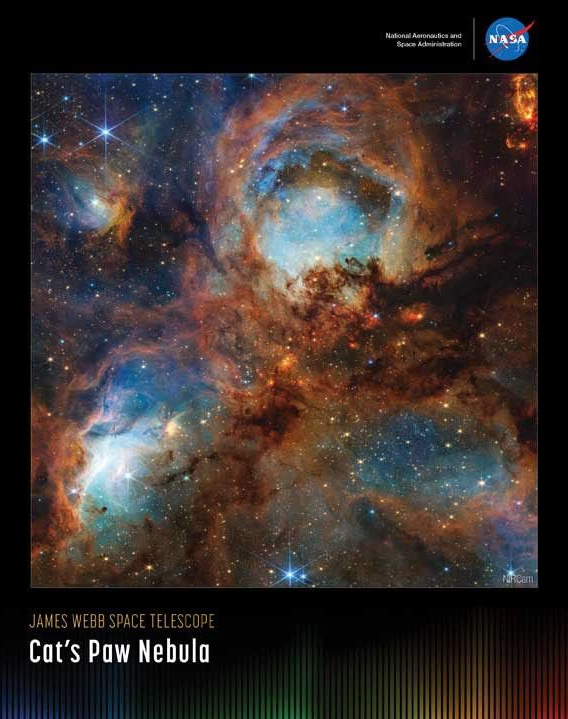
This week’s image highlights a NASA poster that you can download (in a variety of versions). It shows the Cat’s Paw Nebula (NGC 6334) as captured by the James Webb Space Telescope (JWST).
Here is a short summary of what you are seeing from NASA:
Located approximately 4,000 light-years away in the constellation Scorpius, the Cat’s Paw Nebula offers scientists the opportunity to study the turbulent cloud-to-star process in great detail. Webb’s observation of the nebula in near-infrared light builds upon previous studies by NASA’s Hubble and retired Spitzer Space Telescope in visible- and infrared-light, respectively.
With its sharp resolution, Webb shows never-before-seen structural details and features: Massive young stars are carving away at nearby gas and dust, while their bright starlight is producing a bright nebulous glow represented in blue. It’s a temporary scene where the disruptive young stars, with their relatively short lives and luminosity, have a brief but important role in the region’s larger story. As a consequence of these massive stars’ lively behavior, the local star formation process will eventually come to a stop.
For more details and videos, visits the NASA page on the Cat’s Paw Nebula, which helps to commemorate the third anniversary of the JWST.
 Our Awesome Universe