Space Stories: Earth’s Second Moon, Organic Molecules on Enceladus, and Mysterious Gullies on Mars

Image (Credit): Earth as observed by the Apollo 11 spacecraft. (NASA/JSC)

Here are some recent space-related stories of interest.

The Economic Times: NASA Confirms Earth Has a Second Moon, And It Will Stay With Us Until 2083

Earth has received a new cosmic partner, a small asteroid designated as 2025 PN7. NASA confirmed this week that the object, initially found by the University of Hawaii, qualifies as a “quasi-moon” , an uncommon type of celestial body that moves almost similarly in sync with Earth. While not a real moon, it has a similar orbit surrounding the Sun, seeming to shadow our planet as it travels through space. Researchers estimate the asteroid measures 18 to 36 meters wide, approximately the height of a small building, making it small by cosmic standards but noteworthy for Earth’s extended neighborhood.

Sky&Telescope: New Study Identifies Organic Molecules Spewing from Saturn’s Icy Moon Enceladus

Twenty years after the Cassini spacecraft discovered an ocean under the icy surface of Saturn’s moon Enceladus, a new study of previously collected data hints at a much better chance for habitability. The change comes from recording how a plume of ice grains hit Cassini just minutes after it erupted from the moon. The close encounter exposed organic compounds not previously seen on Enceladus.

Utrecht University: “Mysterious Gullies on Mars Appear to Have Been Dug, But by Whom or What?

Did life really exist on Mars after all? Unfortunately, there is no conclusive evidence for this yet. Nevertheless, it would seem that some form of life was the driving force behind the mysterious Martian dune gullies. Earth scientist Dr Lonneke Roelofs from Utrecht University has investigated how these gullies were formed. In a test setup, she observed that blocks of CO2 ice ‘dug’ these gullies in a unique way. “It felt like I was watching the sandworms in the film Dune.”


Space Quote: SpaceX May Lose the Moon

Credit: Image by Gordon Johnson from Pixabay.

“If SpaceX is behind, but Blue Origin can do it before them, good on Blue Origin…But … we’re not going to wait for one company. We’re going to push this forward and win the second space race against the Chinese.”

Statement by acting NASA Administrator Sean Duffy regarding ongoing delays with SpaceX’s Starship, which was given a $2.9 billion contract in 2021 for a lunar landing vehicle as part of Artemis III. As a result, NASA may reopen to lunar lander contract. Blue Origin is working on its own lunar lander called Blue Moon. As noted in yesterday’s post, Mr. Musk has been distracted this year, so it may make sense to have a solid back up.

Update: Mr. Musk was not pleased with the news. In reference to acting NASA Administrator Duffy, Mr. Musk commented, “The person responsible for America’s space program can’t have a 2 digit IQ.” The man certainly knows how to make friends.

We Need Mr. Musk to Concentrate on Starship

Credit: Image by mariocus from Pixabay.

Now that Mr. Musk is done with his misadventures in Washington, DC, everyone was hoping he would start to focus more on SpaceX and the Starship tests that are critical to NASA’s Artemis mission. That may be too reasonable.

First, we see that Mr. Musk is getting involved in British politics again. That has never been a good thing for the Brits or his ignored companies. I agree with the UK’s Energy Secretary Ed Miliband when he states,

We have a message for Elon Musk. Get the hell out of our politics and our country.

And now we read that the Russians are interested in a rail tunnel between Alaska and Russia, with Musk’s Boring Company taking the lead. President Trump said he is considering it.

It sounds like a ruse to me. President Putin is ten times smarter than Mr. Musk when it comes to foreign affairs, so it is likely this is something he can dangle in front of Musk to distract him and maybe even bring him over to his side on the Ukranian issue where Starlink is still a critical resource. President Putin’s Chinese friends will also be very happy for the distraction if it delays U.S. ambitions related to the Moon.

None of this makes a lot of sense. Russia’s main export is energy, which is more economical by ship (and Alaska is not looking for any competition with its oil industry). Plus, the Russian side of the tunnel is underdeveloped and not ready for the inflows the tunnel would bring. Besides, I thought we were trying to restrict Russian trade.

It all sounds like a pipe dream (or tunnel dream) with no real purpose other than to play the trade card for Trump while making Musk feel like an important piece of the puzzle.

Both President Trump and Mr. Musk have trouble focusing unless they see themselves personally benefiting, and the Russians know this.

NASA needs to drum up a Moon tunnel real quick for Mr. Musk’s company if it wants to regain his attention.

A Comet You Will Not See for Another Millennium

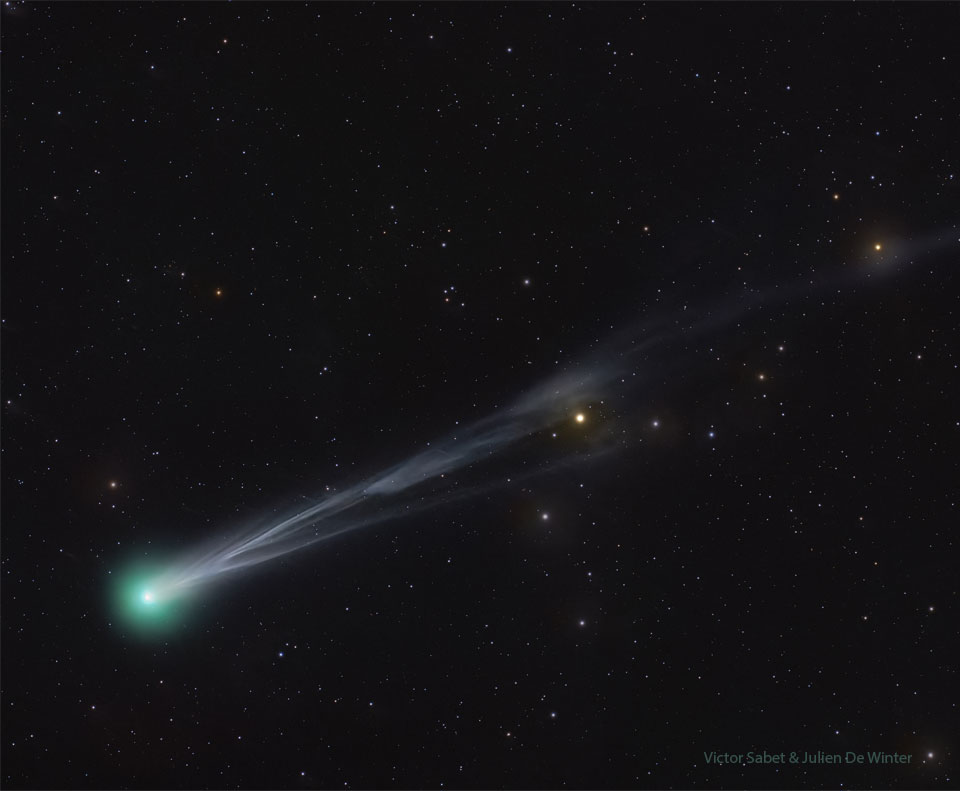
Image (Credit): Comet Lemmon shared via NASA’s Astronomy Picture of the Day. (Victor Sabet & Julien De Winter)

Now is your chance to view Comet Lemmon before it cycles its way though the solar system over the course of 1,350 years. You might even be able to view it over the next few weeks with the naked eye if you are lucky.

Wired magazine has a story about this comet that tells you all you need to know. It also provides some helpful guidance for spotting it in the night sky:

As of early October, Comet Lemmon can be found slightly below the handle in the Big Dipper (or the Plough, as it’s known in the UK), which forms part of the Ursa Major constellation. If you look up at the northern sky, you will be able to trace its path. In the northern hemisphere, it is predicted to appear in the northwestern-to-western sky after sunset from mid-October onward. It will be at a low altitude above the horizon and is expected to emit a faint glow in the twilight just after the sun has set.

Look up and observe this time capsule from 4.6 billion years ago.

Potential Exomoon Being Studied by JWST

Image (Credit): Artist’s rendering of WASP-39b. (NASA, ESA, CSA, Joseph Olmsted (STScI))

We hear plenty about all the exoplanets being studies at the moment, but we hear very little about exomoons, though several astronomers are eager to find them and learn more about them.

This time last year I highlighted a paper that discussed a possible exomoon circling an exoplanet called WASP-49Ab located about 635 light-years away . It was spotted by the European Southern Observatory’s Very Large Telescope in Chile.

Well, now the James Webb Space Telescope (JWST) has provided data related to another possible exomoon orbiting a hot Jupiter-like exoplanet called WASP-39b. It is located about 700 million light-years away.

In a Scientific American article titled “Have Astronomers Finally Found an Exomoon?” we learn that a paper is being released shortly outlining the argument for this potential “hypervolcanic exomoon.” This presumed IO-like exomoon is being cooked by the parent sun.

The paper accepted for publication, Volcanic Satellites Tidally Venting Na, K, SO2 in Optical & Infrared Light, states the following:

Recent infrared spectroscopy from the James Webb Space Telescope (JWST) has spurred analyses of common volcanic gases such as carbon dioxide (CO2), sulfur dioxide (SO2), alongside alkali metals sodium (Na I) and potassium (K I) surrounding the hot Saturn WASP-39 b. We report more than an order-of-magnitude of variability in the density of neutral Na, K, and SO2 between ground-based measurements and JWST, at distinct epochs, hinting at exogenic physical processes similar to those sourcing Io’s extended atmosphere and torus. Tidally-heated volcanic satellite simulations sputtering gas into a cloud or toroid orbiting the planet, are able to reproduce the probed line-of-sight column density variations. The estimated SO2 flux is consistent with tidal gravitation predictions, with a Na/SO2 ratio far smaller than Io’s. Although stable satellite orbits at this system are known to be < 15.3 hours, several high-resolution alkali Doppler shift observations are required to constrain a putative orbit. Due to the Roche limit interior to the planetary photosphere at ~ 8 hours, atmosphere-exosphere interactions are expected to be especially important at this system.

It is a dense summary, but also a hopeful finding that may lead to more focused searches for exomoons.

The addition of exomoons to the list of new discoveries will only increase the chances that some form of life can be found among he many solar systems we can study. Interestingly enough, we are still probing our own solar system’s moons with the same hope.