Pic of the Week: The Sculptor Galaxy

Image (Credit): The Sculptor Galaxy. (ESO/VLT)

This week’s image is from the European Southern Observatory’s (ESO) Very Large Telescope (VLT) in northern Chile. It shows the Sculptor Galaxy, which is about 11 million light-years away.

Here is a description of what you are seeing:

This image shows a detailed, thousand-colour image of the Sculptor Galaxy captured with the MUSE instrument at ESO’s Very Large Telescope (VLT). Regions of pink light are spread throughout this whole galactic snapshot, which come from ionised hydrogen in star-forming regions. These areas have been overlaid on a map of already formed stars in Sculptor to create the mix of pinks and blues seen here...

To create this map of the Sculptor Galaxy, which is 11 million light-years away and is also known as NGC 253, the researchers observed it for over 50 hours with the Multi Unit Spectroscopic Explorer (MUSE) instrument on ESO’s VLT. The team had to stitch together over 100 exposures to cover an area of the galaxy about 65 000 light-years wide.

According to co-author Kathryn Kreckel from Heidelberg University, Germany, this makes the map a potent tool: “We can zoom in to study individual regions where stars form at nearly the scale of individual stars, but we can also zoom out to study the galaxy as a whole.”
NASA Cuts Endanger Mars Rover Missions

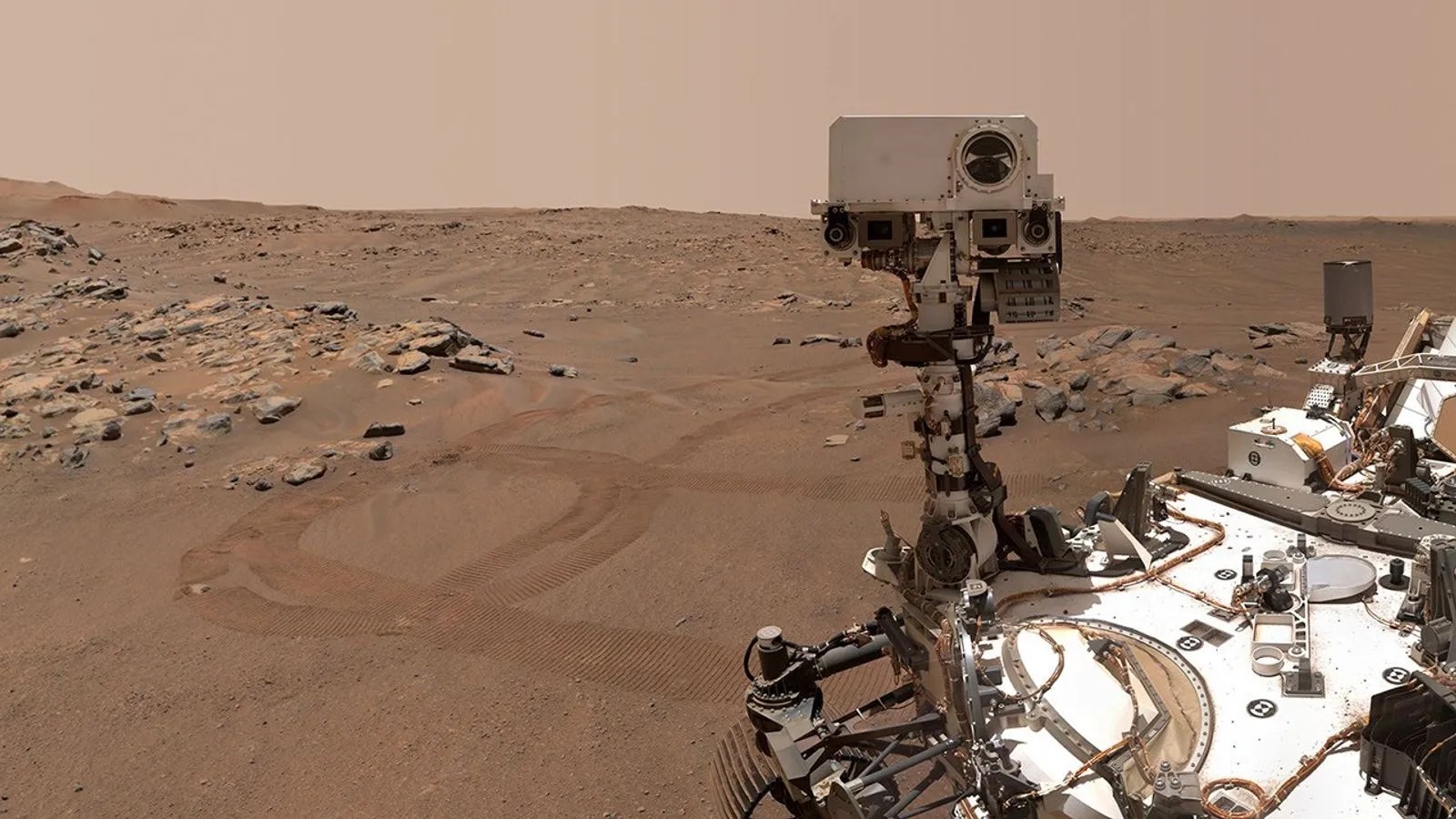
Image (Credit): Selfie by NASA’s Perseverance Mars rover taken on September 10, 2021. (NASA/JPL-Caltech)

First the White House dropped the idea of retrieving soil samples from Mars. Now it is going after the rover collecting those samples.

This week NASA’s Jet Propulsion Laboratory (JPL), which manages the rovers on Mars, announced the layoff of 550 workers, stating:

In order to best position JPL going forward, we are taking steps to restructure and establish an appropriate size to ensure future success. As part of this effort, JPL is undergoing a realignment of its workforce, including a reduction in staff. This reduction — part of a reorganization that began in July and not related to the current government shutdown — will affect approximately 550 of our colleagues across technical, business, and support areas.

One of the employees at JPL who formerly operated rovers noted that the White House cuts is reducing the funding for the Perseverance Mars rover, which collected the soil samples, by two-thirds. He was quoted as saying that they cuts are “…just enough to technically keep it going and not get the full PR backlash of canceling a working rover.”

We only have two rovers left on Mars, the Perseverance rover and the Curiosity rover. Are we going to see these rovers go dark in the near future as they continue to look for life on the planet? And what does it say that we are hoping to put humans on Mars when we cannot even find a way to properly fund the robots that are already there? Would you be your life on this government?

None of this give the US public any confidence, nor does it give bright students much hope for a NASA career when the roles they want to fill are being eliminated.

We are treading water nowadays rather than reaching for the stars. It will have repercussions that may be long-lasting.

Starship Has Successful 11th Launch

Image (Credit): The Starship rocket on the launchpad in Texas on Monday, October 13th, just prior to launch. (SpaceX)

The Starship launches have been going a little better, with yesterday’s 11th launch meeting its goals, including the release of a practice satellite.

Following the launch, SpaceX stated:

Every major objective of the flight test was achieved, providing valuable data as we prepare the next generation of Starship and Super Heavy...Focus now turns to the next generation of Starship and Super Heavy, with multiple vehicles currently in active build and preparing for tests. This next iteration will be used for the first Starship orbital flights, operational payload missions, propellant transfer, and more as we iterate to a fully and rapidly reusable vehicle with service to Earth orbit, the Moon, Mars, and beyond.

I like that ending, which sounds like something you would hear on the airport bus as you approach the rental lot, “…with service to Earth orbit, the Moon, Mars, and beyond.”

Let’s just hope this bus can get NASA to its next destination on time.

Space Stories: Layoffs at NASA’s JPL, Rocky Giants in our Solar System, and New Findings from Apollo 17

Here are some recent space-related stories of interest.

NBC News: NASA’s Jet Propulsion Laboratory Lays Off 550 Workers

NASA’s Jet Propulsion Laboratory announced Monday that it will cut around 550 jobs — around 10% of its staff. In a statement posted online, the lab’s director, Dave Gallagher, said the layoffs are part of a broad “realignment of its workforce” and not a result of the government shutdown. The cuts will affect positions across the NASA center’s technical, business and support areas, he said.

Space.com: Uranus and Neptune May Not Be ‘Ice Giants’ After All, New Research Suggests

Astronomers have long called Uranus and Neptune the “ice giants” because models suggested that these outer planets’ interiors are largely made of mixtures of water, ammonia and other ices — compounds that freeze easily in deep space. But new research reveals that we actually know very little about what’s going on inside these planets, causing researchers to propose that Uranus and Neptune be called “rocky giants” instead.

Brown University: “With New Analysis, Apollo Samples Brought to Earth in 1972 Reveal Exotic Sulfur Hidden in Moon’s Mantle

In a study published in JGR: Planets, researchers report a sulfuric surprise in rock samples taken from the Moon’s Taurus Littrow region during Apollo 17. The analysis shows that volcanic material in the sample contains sulfur compounds that are highly depleted of sulfur-33 (or 33S), one of four radioactively stable sulfur isotopes. The depleted 33S samples contrast sharply with sulfur isotope ratios found on Earth, the researchers say.

Upcoming Conference: Space Settlement Summit

If you are interested in seeing humanity spread into space, you might want to attend the upcoming Space Settlement Summit hosted by the National Space Society (NSS) and scheduled for November 3 and 4 in Orlando, Florida.

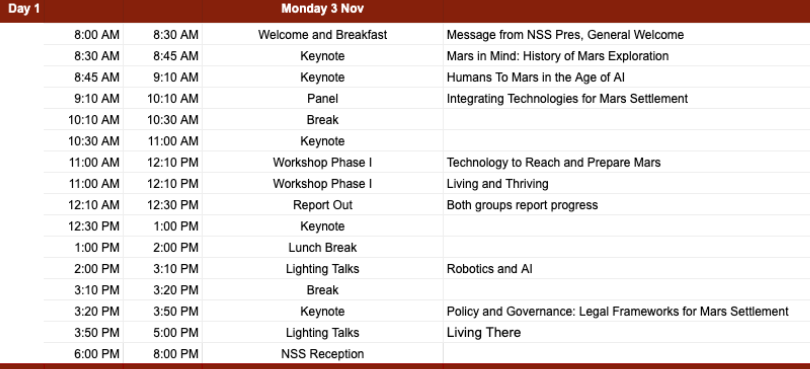
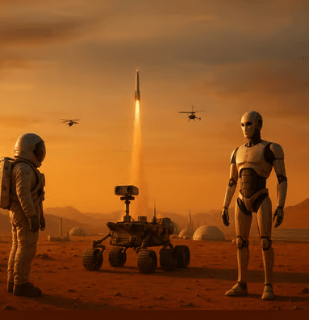
The federal government may be backing out of conferences, and science in general, but that need not stop you from learning more. Do you want to know more about the difficulties of settling on Mars, the role of robotics and AI in space travel, or some of the approaches being pursued by the big space industry players?

Some of the sessions already posted on the schedule for the first day are shown below:

You should also check out the range of presenters from industry, academia, and the non-profit center. It will take superior hardware, software, and brain power to eventually settle on Mars and elsewhere. You can be part of the discussion now.

The Early Bird prices end this coming Friday, so you need to make up your mind soon.

Credit: NSS