Television: Star Trek’s Starfleet Academy is Almost Here

Image (Credit): Some of the new characters in the upcoming Star Trek: Starfleet Academy. (Paramount+)

You only have to wait until January 15th for the latest Star Trek series on Paramount+, but you may want to see this most recent trailer because it sets up some of the background on the characters.

Paramount+ has already shared quite a few details about Star Trek: Starfleet Academy on its site, so here are some important items:

  • Plot: Star Trek: Starfleet Academy is about a young group of Starfleet cadets navigating friendships and rivalries, as well as first loves and a new enemy that poses a threat not to just the Academy, but to the Federation.

  • The Names of the Cadets:
    • Caleb Mir is an orphaned human who hasn’t yet declared his major, or focus, at Starfleet Academy.
    • Jay-Den Kraag is a Klingon cadet whose focus is the sciences.
    • SAM is a hologram – a Series Acclimation Mil, or SAM, for short. She’s the first of her kind at Starfleet Academy. SAM’s focus is operations.
    • Darem Reymi is a Khionian from a well-to-do background who aims to be in command – hence, the focus of his studies at Starfleet Academy.
    • Genesis Lythe is a Dar-Sha, a species new to the Star Trek universe. She’s the daughter of an admiral, and is also studying command.

  • Time Period: Star Trek: Starfleet Academy is set in the 32nd century, at the upper end of the Star Trek timeline. More specifically, it takes place 125 years after The Burn, a catastrophic event that ravaged the galaxy, and hobbled the Federation. The cadets we meet represent a fresh start for the Federation; they belong to the first Starfleet Academy class since The Burn. You will need to watch Star Trek: Discovery season three to understand The Burn.

  • Key Actors in Season 1:
    • Holly Hunter as Capt. Nahla Ake Hunter’s character is the Chancellor of Starfleet Academy – and the captain of the U.S.S. Athena.
    • Tig Notaro as Jett Reno Notaro reprises her role as Jett, an engineering whiz, from Star Trek: Discovery.
    • Robert Picardo as The Doctor Picardo reprises the role he originated on Star Trek: Voyager.
    • Gina Yashere as Lura Thok Yashere is billed as a recurring guest star. She plays a Klingon/Jem’Hadar hybrid who serves as the Chancellor’s First Officer and Cadet Master.
    • Stephen Colbert as the voice of Starfleet Academy’s Digital Dean of Students The Emmy® winner (The Late Show With Stephen Colbert) will be heard as the faculty member who makes daily announcements – and issues alerts.

  • Number of Episodes: Season 1 will have 10 episodes.

  • Number of Seasons: A second season has already been green-lighted.

  • Your Mission: Simply enjoy this new Star Trek series.
Space Stories: Telescope Moving from US to Spain, Starliner will be Cargo-Only, and Moss in Space

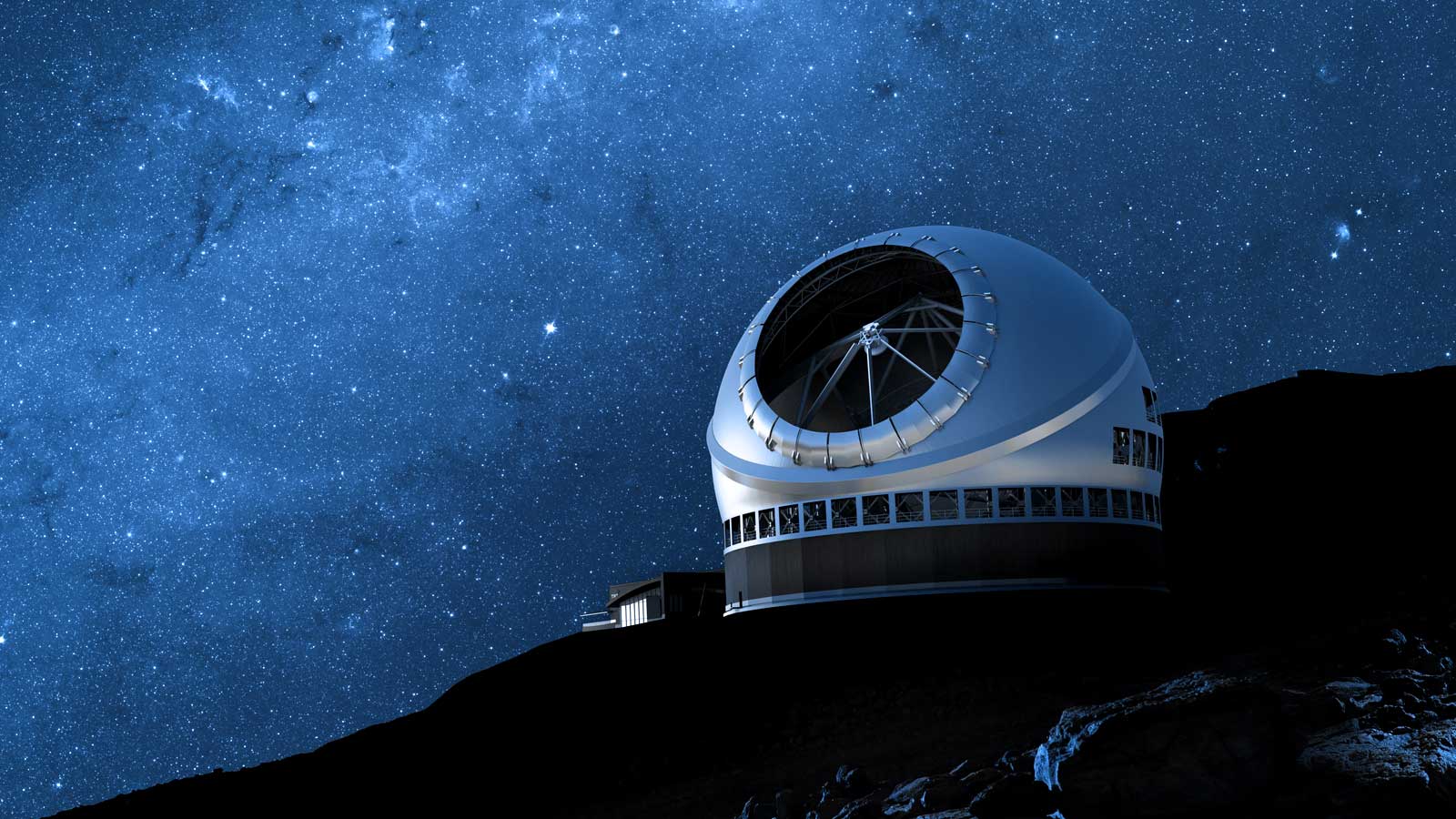
Image (Credit): Artist’s rending of the Thirty Meter Telescope. (TMT International Observatory)

Here are some recent space-related stories of interest.

Sky & Telescope: Thirty Meter Telescope Considers Move to Spain

The Thirty Meter Telescope (TMT) was conceived more than two decades ago as the largest and most advanced telescope in the Northern Hemisphere. However, the telescope has encountered significant roadblocks, from funding uncertainties — now heightened by President Trump’s proposed budget cuts — to local resistance to building the telescope on Mauna Kea, a volcanic mountain in Hawai‘i that’s sacred to native communities. Now, the telescope might find a new home in La Palma on the Canary Islands of Spain. In July, the Spanish government offered to host the telescope, with an investment of up to €400 million ($460 million) to help cover some of the costs. In a brief statement posted on November 11th, the TMT announced that it is officially considering the move to La Palma.

Spaceflight Now: NASA, Boeing Pivot Starliner-1 Mission from 4-Person Astronaut Flight to Cargo-Only

In its latest shakeup to the Commercial Crew Program, NASA announced on Monday it has reduced the number of missions Boeing is required to fly to the International Space Station and changing the next flight from a crew mission to a cargo mission. The original contract NASA awarded to Boeing and SpaceX called for each to fly an uncrewed demonstration flight to the ISS, followed by a crewed demo mission and then conduct six regular crew rotation missions.

Vice: Moss Just Survived a Full Year Outside the International Space Station

In the airless, radiation-saturated void outside of the International Space Station, researchers tested whether a common moss species known as Physcomitrium patens could survive at all, and if it could, for how long. The answers are yes and probably forever if it wants...Tomomichi Fujita, the study’s lead author, thinks moss could last up to 15 years in space, knowledge that could help build future extraterrestrial farms or entire ecosystems on the Moon or Mars.

Video: Reasons to Settle Mars

If you are interested in the idea of settling Mars, and the book A City on Mars has not scared you away, then you should plan on tuning into the upcoming 25-part video series by the Mars Society.

In a news release, the Mars Society defines the new series in this way:

Created for a broad public audience, each video offers a clear, accessible look at how Mars exploration drives scientific discovery, technological innovation, economic growth, and long-term planetary resilience.

I recommend you view the series, but also read the book cited above. The authors of that book seem to think we should have a Mars plan that will settle humans in the next few centuries rather than they next few decades. Or maybe we should be settling on a space station or asteroid, as suggested in the book The Giant Leap, though I expect that a society with “Mars” in its name might disagree.

I’m just trying to keep an open mind.

Stay tuned.

Movie: The Astronaut

Credit: The Wonder Company/Grinder Monkey

The recent film The Astronaut did not stay in theaters very long, but then again very few films do these days. Even so, if you are looking for something inspiring, such as a space adventure that takes us away from Earth, you will be disappointed. This astronaut is from the International Space Station, not Mars, so we do not even make it to the Moon.

If the trailer is not clear enough, here is the main story from Deadline:

When astronaut Sam Walker (Mara) returns from her first space mission, she’s found miraculously alive in a punctured capsule floating deep off the coast of the Atlantic Ocean. General William Harris (Fishburne) arranges for her to be placed under intense NASA surveillance in a high security house for rehabilitation and medical testing. However, when disturbing occurrences begin happening around the property, she fears that something extraterrestrial has followed her back to Earth.

Without giving away the whole plot, just think of it as a gruesome ET: The Extraterrestrial. Critics were not impressed, with the Tomatometer showing only 42 percent approval. In general, a rating between 40 and 59 percent is considered mixed or mediocre, with the average film achieving something in the low 70s.

Matt Donato from Collider did not have high praise for writer/director Jess Varley’s first film:

The Astronaut has sky-high ambitions that go up in flames during the home stretch. Everything’s chugging along fine, then the tone implodes, and Varley’s command over scenes disintegrates...I haven’t seen a movie shoot itself in the foot like this in a wee bit, and that’s a shame.

The selection of films of this genre are slim, so you may have a desire to see it anyway. That’s fine, but you have been warned.

Professor Loeb is Not Convinced by NASA Statements About 3I/ATLAS

Image (Credit): October 2, 2025 image of comet 3I/ATLAS as captured by the High Resolution Imaging Science Experiment (HiRISE) camera aboard NASA’s Mars Reconnaissance Orbiter. (NASA/JPL-Caltech/University of Arizona)

Harvard Professor Avi Loeb is not satisfied with NASA’s comments this week that the interstellar object streaming through our Solar System is a normal comet.

In his blog, Professor Loeb stated:

NASA’s representatives should have emphasized what we do not understand about 3I/ATLAS rather than insist that it is a familiar comet from a new birth environment…We should not “judge a book by its cover,” because we all know about the Trojan Horse which appeared unthreatening to the guardians of the City of Troy. When monitoring an interstellar visitor, we should not fall prey to traditional thinking but scrutinize new interpretations. The public resonates with science as a learning experience, where the collection of evidence leads the way to new knowledge rather than reinforces variants on past knowledge.

Trojan Horse? That is certainly an alarming way of looking at this foreign object. Professor Loeb is not backing down one bit on his concerns, and refers back to his 12 puzzles, one of them being:

Its nucleus is about a million times more massive than 1I/`Oumuamua, an interstellar object discovered in 2017, and a thousand times more massive than 2I/Borisov, discovered in 2019, while moving faster than both, altogether with a likelihood of less than 0.1 per cent (see here and here). This suggests that it may have targeted the inner solar system rather than being drawn from the reservoir of icy rocks.

Again, using terms like “targeted” is certainly garnering a lot of interest by outside observers.

Maybe this will be settled next month with new images. Or maybe this will be a continuing controversy. Even if it goes nowhere, I think we can expect another book from Professor Loeb.