Pic of the Week: Wolf-Rayet Apep

Image (Credit): Dust spirals surrounding Wolf-Rayet Apep, as captured by the JWST. (NASA, ESA, CSA, STScI, Y. Han (Caltech), R. White (Macquarie University), A. Pagan (STScI))

This week’s embryonic image comes from the James Webb Space Telescope (JWST). It shows what NASA calls “four serpentine spirals of dust” around a pair of Wolf-Rayet stars. Such stars are rare, with NASA estimating that only a thousand can be found in our galaxy consisting of hundreds of billions of stars. And binary Wolf-Rayet stars are even rarer.

NASA notes that the JWST, or Webb, provided a much better image of the spiraling dust:

Observations taken prior to Webb only detected one shell, and while the existence of outer shells was hypothesized, searches using ground-based telescopes were unable to uncover any. These shells were emitted over the last 700 years by two aging Wolf-Rayet stars in a system known as Apep, a nod to the Egyptian god of chaos...Webb also confirmed that there are three stars gravitationally bound to one another in this system. The dust ejected by the two Wolf-Rayet stars is “slashed” by a third star, a massive supergiant, which carves holes into each expanding cloud of dust from its wider orbit. (All three stars are shown as a single bright point of light in Webb’s image.)

Video: Cool Worlds Discusses Interstellar Comet 3I/ATLAS 

With all the ongoing stories about interstellar comet 3I/ATLAS, you may enjoy an earlier video from Cool World Labs titled “Could 3I/ATLAS Be Technological?” Columbia University Associate Professor David Kipping looks at the claims by Harvard Professor Avi Loeb that the comet is not only from another solar system, but it may in fact be a spacecraft.

Professor Kipping focuses his discussion on an earlier paper by Professor Loeb titled Is the Interstellar Object 3I/Atlas Alien Technology? The points discussed in the video are broken down into three categories: (1) trajectory, (2) speed, and (3) excessive size. In each case, he provides plenty of technical points, but the main point seems to be that the evidence is often arbitrary or contradictory. Professor Kipping also notes those occasions where the paper goes “off the rails” to make the idea of a spacecraft possible.

All of these points continue to bounce around as we learn more about the comet, but it is interesting to see the scientific community represented here by Professor Kipping doing a great job of parsing the evidence while keeping all of it professional. He made it clear throughout the video that he has great respect for Professor Loeb’s work over the years, even if this particular theory about a spacecraft does not seem plausible.

Check it out for yourself.

Astronomy Question: The Asteroid Belt

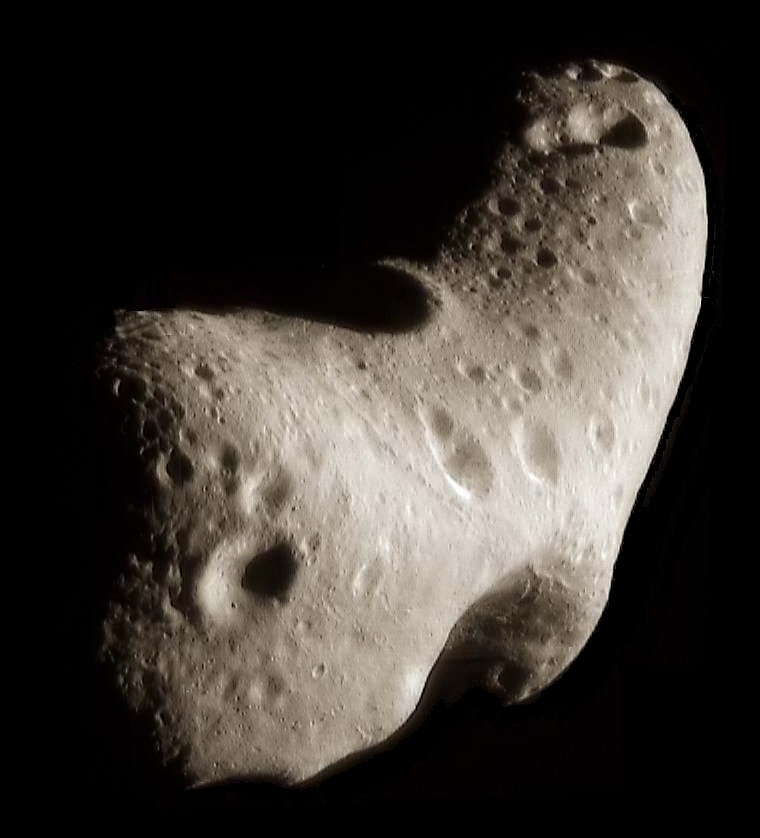
Image (Credit): Asteroid 433 Eros, which is the first asteroid ever orbited by a spacecraft, Near Earth Asteroid Rendezvous – Shoemaker (NEAR Shoemaker), in 1998. (NASA)

Multiple Choice: What is the average distance between the asteroids located in the asteroid belt between Mars and Jupiter?

A. 4,000 miles
B. 50,000 miles
C. 600,000 miles
D. 1.1 million miles

Take a guess and then check your answer by going to the “Astronomy Question Answer Sheet” page.

Space Stories: Threat to Chinese Space Station, Solar Storms on the ISS, and Dream Chaser Prep Continues

Credit: Image by Clker-Free-Vector-Images from Pixabay

Here are some recent space-related stories of interest.

Time: China’s Imperiled Astronauts Illustrate the Dangers of Space Debris

No trip to space can be counted a success unless you make it safely back to Earth…And it’s a lesson that was learned anew this week by the taikonauts—Chinese astronauts—Chen Dong, Chen Zhongrui, and Wang Jie. The trio arrived at China’s Tiangong Space Station aboard their Shenzhou-20 spacecraft on April 24, and were set to come home on Nov. 5, handing the keys to the station over to the three-person crew of Shenzhou-21, who arrived on Oct. 31. But that was not to be. Not long before Shenzhou-20 was set to carry the three home it was struck by a piece of space debris, leaving cracks in one of its windows. That can be deadly in a spacecraft that is supposed to remain airtight both in the vacuum of space and in the steadily thickening atmosphere as it returns to Earth.

Yahoo News: Russian Cosmonauts Take Shelter on International Space Station During Severe Solar Storm

A powerful geomagnetic storm that dazzled skywatchers across the Northern Hemisphere earlier this month also affected life aboard the International Space Station (ISS). During the Nov. 11-12 solar storm, Russian cosmonauts temporarily relocated their sleeping quarters as a precaution against increased radiation exposure, NASA confirmed.

Space News: Dream Chaser Completes Key Tests Ahead of First Flight

Sierra Space has completed key testing milestones for its Dream Chaser vehicle as the company explores both civil and national security missions for the spaceplane. The company announced Nov. 13 that the first Dream Chaser vehicle, Tenacity, completed electromagnetic interference and compatibility testing at NASA’s Kennedy Space Center...While Sierra Space is emphasizing national security uses, the company is keeping open the option of using Dream Chaser to support the ISS or future commercial space stations, known as commercial low Earth orbit destinations, or CLDs.

Study Findings: Not All Sub-Neptune Exoplanets Have Magma Oceans

Credit: Image by Enrique from Pixabay

Abstract of the study findings:

The evolution and structure of sub-Neptunes may be strongly influenced by interactions between the outer gaseous envelope of the planet and a surface magma ocean. However, given the wide variety of permissible interior structures of these planets, it is unclear whether conditions at the envelope–mantle boundary will always permit a molten silicate layer or whether some sub-Neptunes might instead host a solid silicate surface. In this work, we use internal structure modeling to perform an extensive exploration of surface conditions within the sub-Neptune population across a range of bulk and atmospheric parameters. We find that a significant portion of the population may lack present-day magma oceans. In particular, planets with a high atmospheric mean molecular weight and large envelope mass fraction are likely to instead have a solid silicate surface, since the pressure at the envelope–mantle boundary is high enough that the silicates will be in solid postperovskite phase. This result is particularly relevant given recent inferences of high-mean molecular weight atmospheres from JWST observations of several sub-Neptunes. We apply this approach to a number of sub-Neptunes with existing or upcoming JWST observations and find that in almost all cases, a range of solutions exist that do not possess a present-day magma ocean. Our analysis provides critical context for interpreting sub-Neptunes and their atmospheres.

Citation: Bodie Breza et al. Not all sub-Neptune exoplanets have magma oceans. ApJL 993 L46 (2025).

https://doi.org/10.3847/2041-8213/ae0c07

Study-related stories:

Universe Today – “It Looks Like All Mini-Neptunes Aren’t Magma Oceans After All”

University of Chicago – “New Study Revises Our Picture of the Most Common Planets in the Galaxy”

Space.com – “Is Our Dream of Finding Ocean-Covered Exoplanets Drying Up?”