You might find it comforting that more Americans believe in aliens than Bigfoot. Or maybe not.
A recent YouGov poll found some interesting facts about Americans when it comes to aliens, including:
56% of Americans believe aliens definitely or probably exist;
47% of Americans believe aliens have definitely or probably visited Earth at some point.;
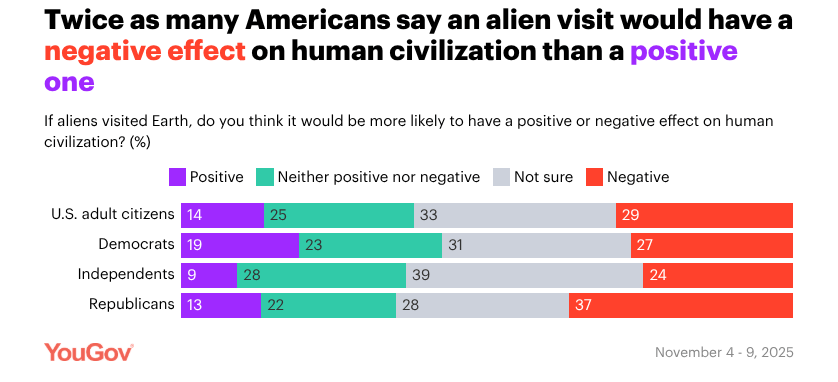
29% of Americans an alien visit would have a negative effect on human civilization (see below);
21% of Americans have seen something they thought was a UFO; and
Only 13% of Americans think the government would tell the public if it had evidence supporting the existence UFOs.
These negative feeling towards both aliens and the government seem to be reflected in most of the recent television series and movies. The new TV series Alien: Earth may be the most representative of this feeling, where the corporate tech geeks are the government and also believe they can control alien species. As with all things Alien, the mess is spectacular.
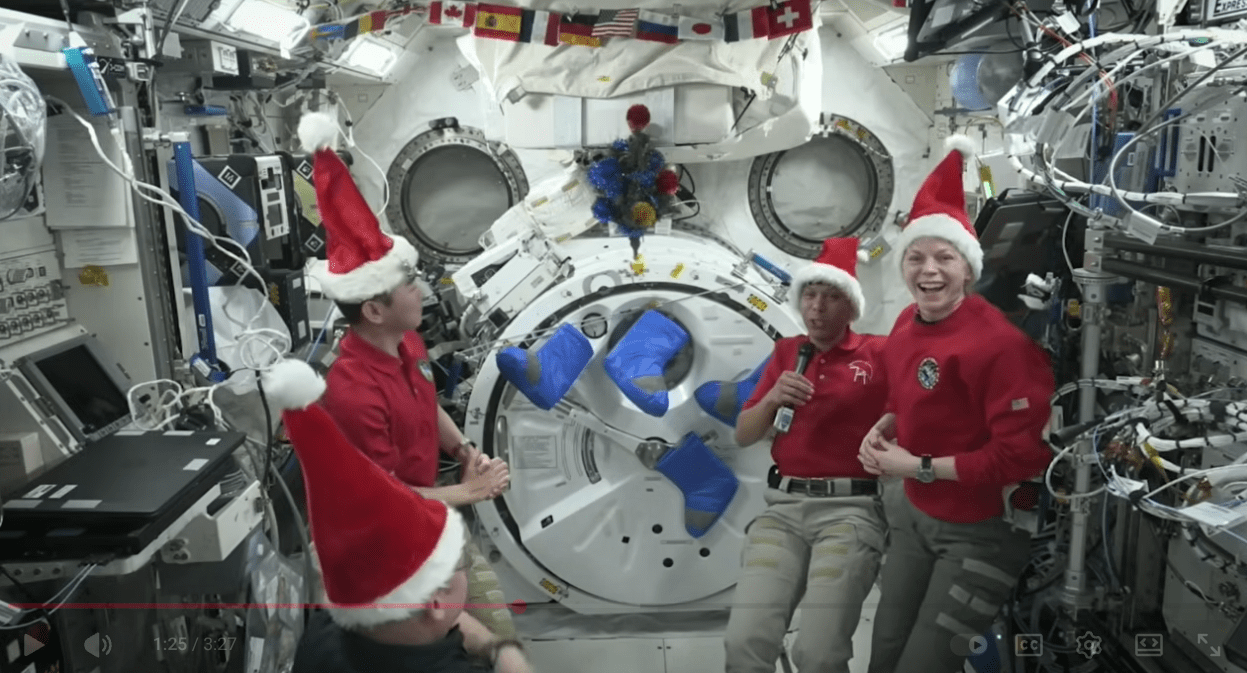
Image (Credit): Astronauts aboard the ISS showing the boots ready for Santa. (NASA)
Santa’s gift-giving territory is pretty wide, but it is not clear whether he will make it to the International Space Station (ISS). However, the astronauts are ready if he does show up. They have hung their space boots by the airlock with cheer.
For the complete ISS holiday message, play this video from NASA astronauts Mike Fincke, Zena Cardman, and Chris Williams, along with Japan Aerospace Exploration Agency (JAXA) astronaut Kimiya Yui. The message was recorded on December 17, 2025.
“The comparison I often like to make is with the East India Company: a private British enterprise that became so powerful it could shape the politics of nations and at times had an army twice the size of Britain’s. It began as trade; it ended in domination. Could a similar dynamic unfold locally in our solar system, where a handful of today’s tech giants and billionaires control access to orbit, communications, and eventually, extraterrestrial resources? A monopoly in space would be dangerous for humanity. The challenge is to encourage innovation and investment without ceding ownership of the cosmos to a few individuals or organisations.”
Image (Credit): A portion of the International Space Station’s Russian segment is pictured with docked spacecraft including Europe’s Automated Transfer Vehicle (ATV) and the Soyuz TMA-20 crew vehicle. (NASA)
Here are some recent space-related stories of interest.
For several years now, in discussing plans for its human spaceflight program beyond the International Space Station, Russian officials would proudly bring up the Russian Orbital Station, or ROS…Oleg Orlov, director of the Institute of Biomedical Problems of the Russian Academy of Sciences, said ROS will no longer be composed of entirely new modules. Rather, its core will be the Russian segment of the International Space Station. “The Scientific and Technical Council of Roscosmos supported this proposal and approved the deployment of a Russian orbital station as part of the Russian segment of the ISS,” Orlov reportedly said.
NASA is losing critical communication links with its Mars missions. After recently losing contact with the MAVEN spacecraft, the agency faces the impending loss of the Mars Odyssey orbiter, which has been circling the Red Planet for over two decades. As both orbiters approach the end of their operational lifespans, NASA will soon have to find ways to maintain data relay capabilities for its rovers and other missions on the fourth planet.
A key discovery from NASA’s Cassini mission in 2008 was that Saturn’s largest moon Titan may have a vast water ocean below its hydrocarbon-rich surface. But reanalysis of mission data suggests a more complicated picture: Titan’s interior is more likely composed of ice, with layers of slush and small pockets of warm water that form near its rocky core. Led by researchers at NASA’s Jet Propulsion Laboratory in Southern California and published in the journal Nature on Wednesday, the new study could have implications for scientists’ understanding of Titan and other icy moons throughout our solar system.




 Our Awesome Universe