
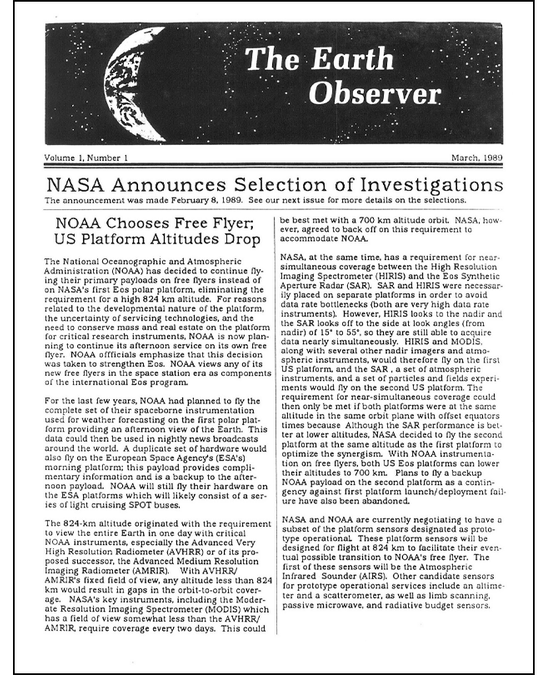
While most of the press stories have been focused on this week’s closing of a NASA largest research library located at the Goddard Space Flight Center in Maryland, NASA is quietly shutting down a key news source called The Earth Observer. This newsletter was a source of information and data related to the multiple satellites surrounding the Earth and monitoring its health.
In its October to December 2025 edition, Executive Editors Alan Ward stated:
It is with a heavy heart that I announce that NASA Earth Science Communications has directed The Earth Observer to conduct an orderly shutdown of the publication. No new content will be published after Dec. 31, 2025.
This comes at a time when the White House is drastically cutting the Earth science programs at NASA, somehow assuming that if we don’t know what it happening with our planet then we do not need to worry. NASA is being told to shift its focus to other distant worlds where we will probably never go instead of helping to preserve the only world we have.
Space Daily reported that we have already witnessing the end of three critical satellites monitoring Earth as a natural product of time – Terra, Aqua, and Aura – but they are not being replaced to keep the monitoring alive.
In the article, Space Daily noted:
Satellite aging was expected. What was not, Earth scientists say, is the policy shift coming from Washington. The FY26 presidential budget request would cut NASA’s Science Mission Directorate by nearly half, with Earth science funding falling from about 2.14 billion dollars to roughly 1.04 billion dollars, a 52 percent reduction. Commentators and advocacy groups describe the proposal as the steepest single year hit to NASA science since the post Apollo drawdown.
Shutting libraries, deleting data, and ending investments in the future will come back to bite us. Many in the world are interested in keeping this world vibrant and alive, and will do so with our without the United States. While cost-cutting can be justified if it done intelligently, the ongoing scientific suicide is something else entirely.
As Carl Sagan said in his very relevant book, The Demon-Haunted World: Science as a Candle in the Dark:
We’ve arranged a global civilization in which most crucial elements profoundly depend on science and technology. We have also arranged things so that almost no one understands science and technology. This is a prescription for disaster. We might get away with it for a while, but sooner or later this combustible mixture of ignorance and power is going to blow up in our faces.
 Our Awesome Universe