
Here are some recent space-related stories of interest.
—Fox54 News: “NASA to Begin Modernization at Marshall Space Flight Center: Historic Structures to be Demolished Starting this Weekend“
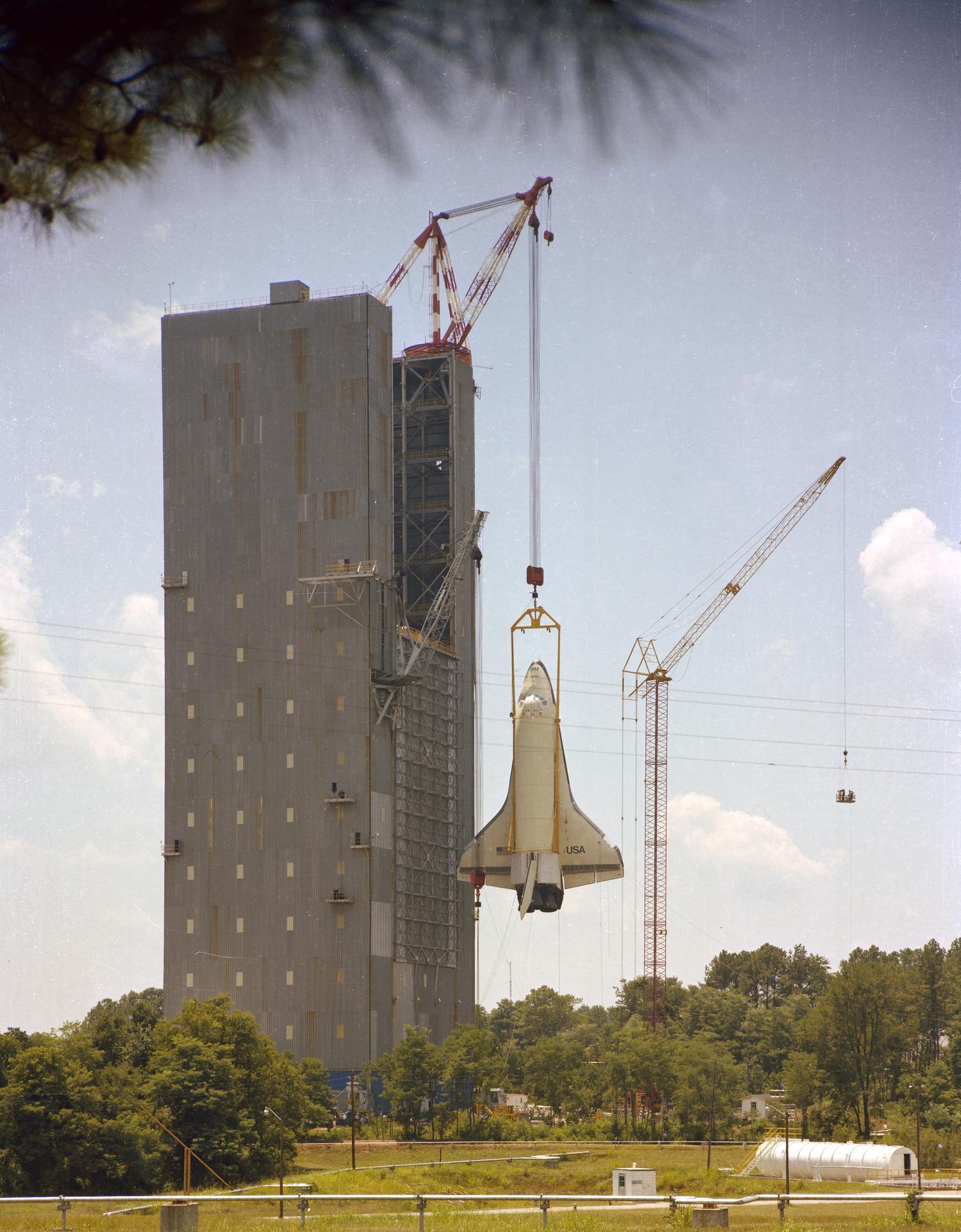
With NASA Administrator Jared Isaacman in place, the agency is spearheading a major infrastructure modernization initiative, starting with the demolition of historic testing facilities at Marshall Space Flight Center. The space agency will tear down the Dynamic Test Stand and the Propulsion and Structural Test Facility, known as the T-Tower, beginning Jan. 10. The move marks the first phase of removing 25 outdated structures at the Alabama center.
—Sky & Telescope: “Rogue Saturn Discovered Floating Through the Milky Way“
Most planets orbit comfortably around their stars, but some worlds are not so lucky. Astronomers have discovered a number of these rogue planets, which float through the Milky Way untethered to a solar system. Now, for the first time, they’ve directly measured the mass of one of these worlds, finding that it’s around Saturn’s mass. The planet might’ve been flung far from its star through a past gravitational interaction. But such encounters are surprising for a planet with such a hefty mass.
—McDonnell Center for the Space Sciences: “Jupiter’s Moon Europa has a Seafloor that May Be Quiet and Lifeless“
The giant planet Jupiter has nearly 100 known moons, yet none have captured the interest and imagination of astronomers and space scientists quite like Europa, an ice-shrouded world that is thought to possess a vast ocean of liquid salt water. For decades, scientists have wondered whether that ocean could harbor the right conditions for life, placing Europa near the top of the list of solar system bodies to explore. A new study led by Paul Byrne, an associate professor of Earth, environmental, and planetary sciences, throws cold water on the idea that Europa could support life at the seafloor. Using calculations that consider the moon’s size, the makeup of its rocky core, and the gravitational forces from Jupiter, Byrne and a team of scientists conclude that Europa likely lacks the tectonic motion, warm hydrothermal vents, or any other sort of underwater geologic activity that would presumably be a prerequisite for life.
 Our Awesome Universe