
Nature Astronomy abstract of study findings:
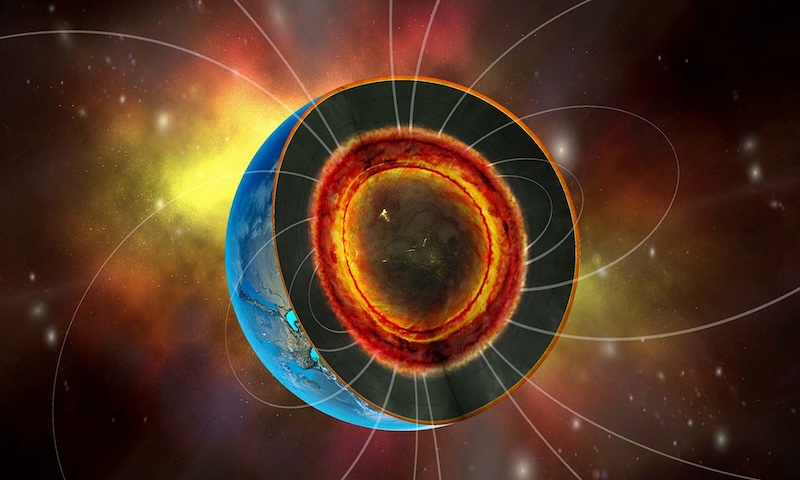
During planet formation, planets undergo many impacts that can generate magma oceans. When these crystallize, part of the magma densifies via iron enrichment and migrates to the core–mantle boundary, forming an iron-rich basal magma ocean (BMO). The BMO could generate a dynamo in early Earth and super-Earths if the electrical conductivity of the BMO, which is thought to be sensitive to its Fe content, is sufficiently high. To test this hypothesis, here we conduct laser-driven shock experiments on ferropericlase (Mgx,Fe1−x)O (0.95 ≤ x ≤ 1) as an Fe-rich BMO analogue, perform density functional theory molecular dynamics simulations on MgO and calculate the long-term evolution of super-Earths. We find that the d.c. conductivities of MgO and (Mg,Fe)O are indistinguishable between 467 GPa and 1,400 GPa, despite previous predictions. We predict that super-Earths larger than 3–6 Earth masses can produce BMO-driven dynamos that are almost one order of magnitude stronger than core-driven dynamos for several billion years.
Citation: Nakajima, M., Harter, S.K., Jasko, A.V. et al. Electrical conductivities of (Mg,Fe)O at extreme pressures and implications for planetary magma oceans. Nat Astron (2026).
https://doi.org/10.1038/s41550-025-02729-x
Study-related stories:
University of Rochester – “Hidden Magma Oceans Could Shield Rocky Exoplanets from Harmful Radiation”
Earth Sky – “Powerful Magnetic Fields on Super-Earths Could Boost Chances of Life”
Universe Today – “Deep Magma Oceans Could Help Make Super-Earths Habitable”
 Our Awesome Universe