
Here are some recent space-related stories of interest.
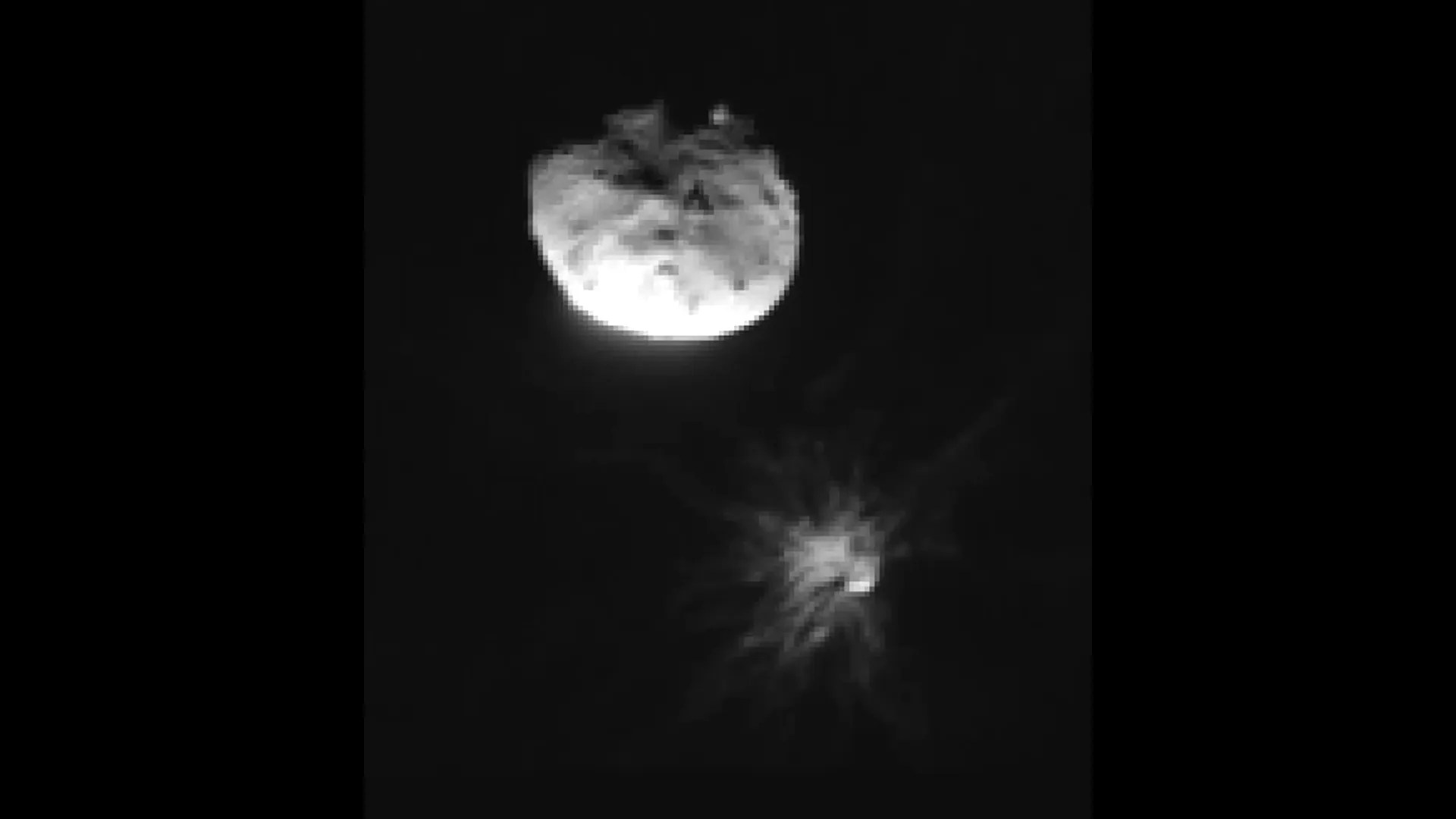
—Nautilus: “NASA’s DART Mission Offers Proof of Protection Against Asteroid Impacts“
In November 2021, NASA launched the Double Asteroid Redirection Test (DART) aimed at finding out whether or not we could redirect the trajectory of a near-Earth object simply by crashing into it…The mission was a success, making it the first time a human-made object has altered a celestial body’s path around the sun, but it would take more time to find out the magnitude of the success. Now, two years later, NASA scientists have calculated that DART’s collision with Dimorphos shortened the orbit of both asteroids by around 33 minutes.
—SciTechDaily: “The Moon Was Hit Again: NASA Scientists Discover a Newly Formed Crater“
Researchers working with the Lunar Reconnaissance Orbiter Camera found one such crater by comparing detailed photographs of the same lunar locations taken at different times. By examining images captured before December 2009 and others taken after December 2012, they were able to narrow down when the impact occurred, even though no one actually observed the collision. The crater measures 22 meters in diameter, comparable to a large house. What makes it particularly striking is not its size but its brightness. The collision ejected material tens of meters from the crater rim, creating distinctive rays that spread outward in a sunburst pattern. This bright, fresh material contrasts sharply with the surrounding darker regolith, making the crater stand out like a new freckle on familiar skin.
—Daily Galaxy: “In a First, Private Investors Will Fund a Telescope Bigger Than Hubble for $500 Million“
A new private space observatory, the Lazuli Space Telescope, is on track to surpass Hubble with its larger mirror and cutting-edge technology. Funded by former Google CEO Eric Schmidt and his wife Wendy, the project is already turning heads in the space community…At its core, Lazuli’s three-meter mirror will make it one of the largest space telescopes ever built, capable of observing both optical and infrared light.
 Our Awesome Universe