
Auditors with NASA’s Office of the Inspector General (OIG) evaluated three aspects of the Human Landing System (HLS) to be used with the Artemis Moon landing: (1) the extent to which the HLS providers are meeting cost, schedule, and performance goals; (2) the HLS Program’s implementation of the insight/oversight model; and (3) the Program’s identification and mitigation of risks to astronaut safety.
In its report, NASA’s Management of the Human Landing System Contracts, the auditors found issues in all three areas. In particular, the report stated:
…both SpaceX and Blue Origin have experienced schedule delays and face technical and integration challenges that have the potential to further impact lander costs and delivery schedules. In particular, SpaceX’s lander will not be ready for a June 2027 lunar landing.
It is possible that the draft version of this audit report was already the desk of NASA Administrator Isaacman right before he decided to move the Moon landing date again. Pending audit reports have a tendency to stir action.
Yet, even once we get to the moon, the auditors identified some safety issues. Specifically, the auditors stated:
We also observed limitations in the Agency’s approach to crew survival analyses—the evaluation of available crew survival capabilities to counter a catastrophic event—due to functional constraints and the availability of resources…While NASA is taking steps to prevent catastrophic events from occurring, ultimately, should the astronauts encounter a life-threatening emergency in space or on the lunar surface, NASA does not have the capability to rescue the stranded crew.
None of this is too surprising with a new approach like this one. Delays are inevitable, and even the best of plans cannot account for everything, as Apollo 13 demonstrated. It also shows that NASA has a tough balancing act, with the need for speed weighed against the mechanisms to ensure the safety of the astronauts.
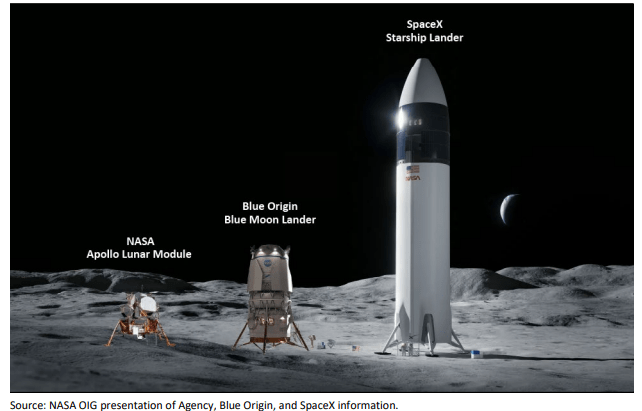
One of the safety concerns stated later in the report really should have been its own report. It discussed the height of the HLS. As shown in the image above, the Starship Lander is huge compared to the Apollo lander and even Blue Origin’s Blue Moon Lander. Here are the dimensions per the report:
Landers may also encounter hazards such as boulders or mounds that are too large or depressions that are too deep for the landing legs and stability design. For example, steep slopes of up to 20 degrees on the lunar South Pole present navigation and landing challenges. Given Starship’s height of 171 feet— about the equivalent of a 14-story tall commercial building—there is a risk that its momentum will continue after landing causing it to tip over. Blue Moon—standing at 53 feet tall—also faces landing risks, including exceeding the lander’s tilt tolerance for safe and effective execution of critical crew functions. Surpassing the tilt tolerance for either lander, which NASA established as not to exceed 8 degrees to support all post-landing crew activities, could impact the operation of equipment such as the hatch used by the crew to exit and enter the vehicle. By comparison, the Apollo Lunar Module stood 23 feet tall.
This is scary given the multiple spacecraft we have already witness toppling over onto the lunar surface just last year. Why would we ever want to land a 14-story tall rocket with an elevator on the Moon as our first attempt after 50 years? I can understand Elon Musk proposing this ridiculous idea, but it is not clear how the original planners could have gone along with it. This is a “catastrophic event” waiting to happen.
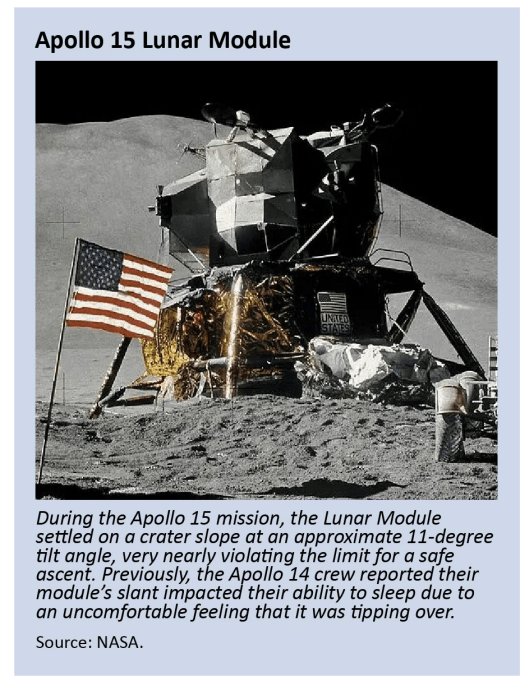
The auditors also added a Apollo 15 Lunar Module story (shown below) to the report. After reading this report and the Apollo 15 clip, I think I will also have trouble sleeping tonight due to an uncomfortable feeling that the current Artemis approach was a mess (if not doomed) from the start.
 Our Awesome Universe