
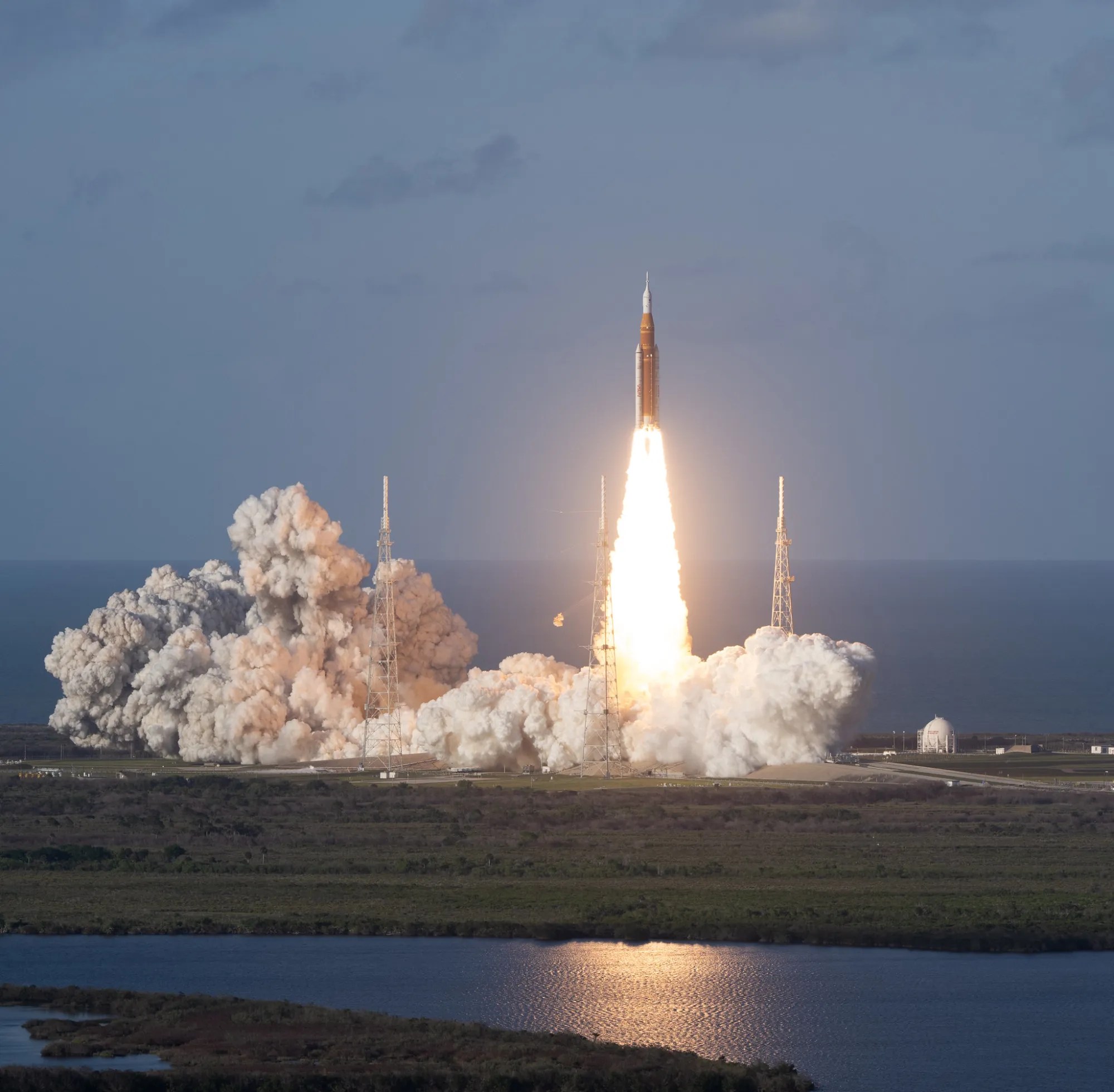
The second phase of our return to the Moon, Artemis II, is underway after a successful launch from the Kennedy Space Center earlier today. Three American astronauts as well as one Canadian astronaut will circle the Moon in a 10-day mission to iron out any bugs in the Orion spacecraft.
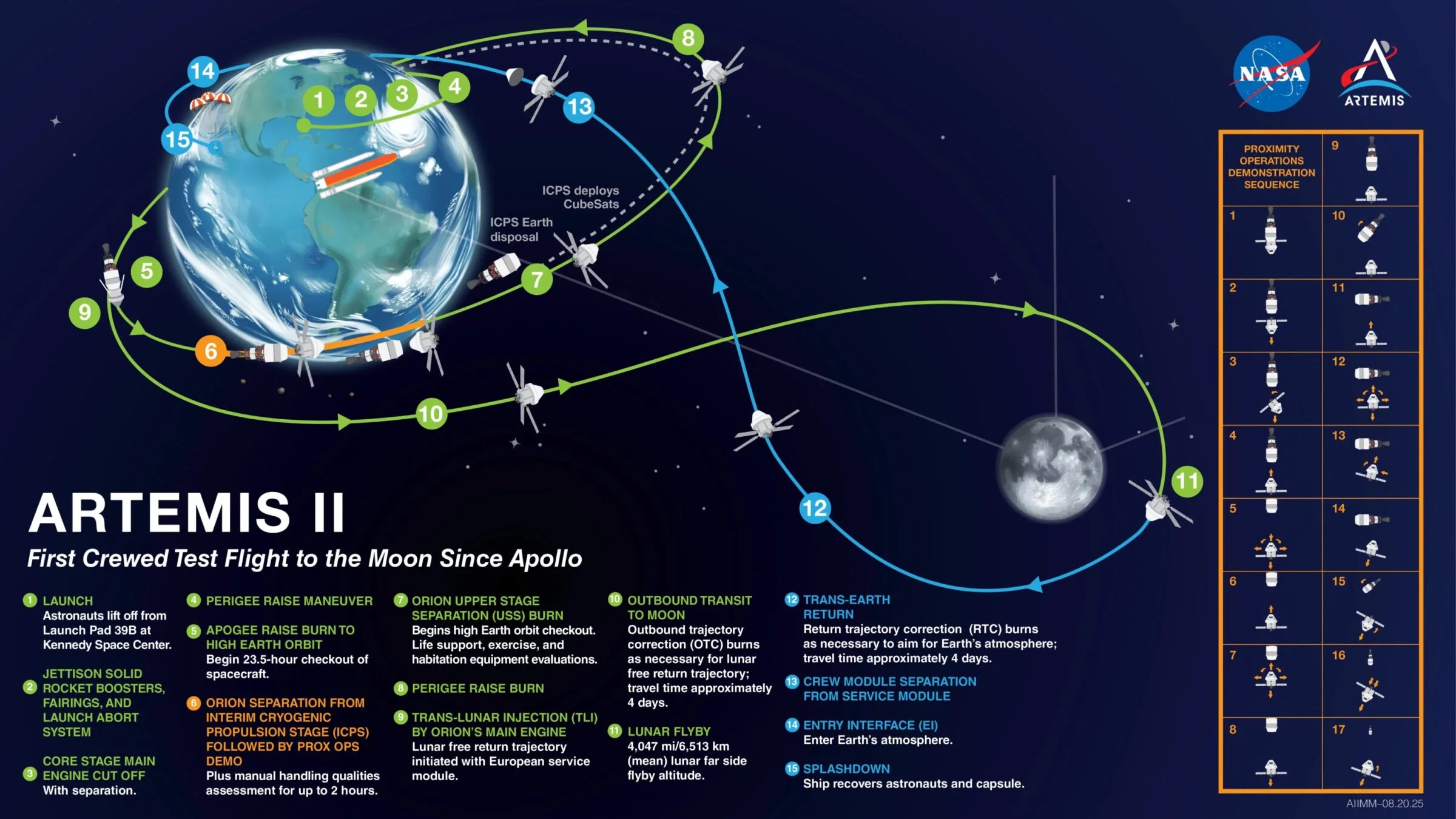
Here is a day-by-day schedule for the 10-day mission, with a graphic version below (provided on the Planetary Society’s website):
- Day 1: Over 24 hours in Earth orbit, the astronauts perform a proximity operations demo with the ICPS and make sure various spacecraft systems are working (water, toilet, carbon dioxide removal, communications). The crew sleeps in two four-hour periods.
- Day 2: Orion engines fire for several minutes, accelerating the spacecraft to escape velocity and sending the crew toward the Moon on their free-return trajectory. The crew also works out on a flywheel and do video calls with people on the ground.
- Days 3-5: Orion performs three trajectory corrections to fine-tune its approach to the Moon. The crew tests the medical kit and performs a CPR demo. On day 5, they test their spacesuits.
- Day 6: The crew flies by the Moon, coming within 6,400-9,600 kilometers (4,000-6,000 miles) of its far side. Their maximum distance from Earth is between 370,000-450,000 kilometers (230,000-280,000 miles), depending on their launch date. This may exceed the current human record set by Apollo 13. The crew takes photographs and videos of the Moon’s far side.
- Days 7-9: Orion performs three trajectory corrections to fine-tune its return to Earth. On day 7, the crew rests off-duty, and on day 8, the crew demonstrates the construction of a radiation shelter construction demo and performs manual piloting tests.
- Day 10: The crew dons spacesuits and compression garments to prepare for reentry. About 122,000 meters (400,000 feet) above Earth, Orion’s service module separates from the crew module, and Orion reenters Earth’s atmosphere at 40,000 kilometers per hour (25,000 miles per hour). Two drogue parachutes slow Orion to roughly 480 kilometers per hour (300 miles per hour). Then, three pilot parachutes, followed by three main parachutes, slow the capsule to 27 kilometers per hour (17 miles per hour). Artemis II splashes down off the coast of San Diego, California.
If you want to track the mission in real time, you can visit this NASA site.
 Our Awesome Universe