
Here are some recent space-related stories.
—Astronomy.com: “Could this Telescope Find Life on Alien Worlds?“
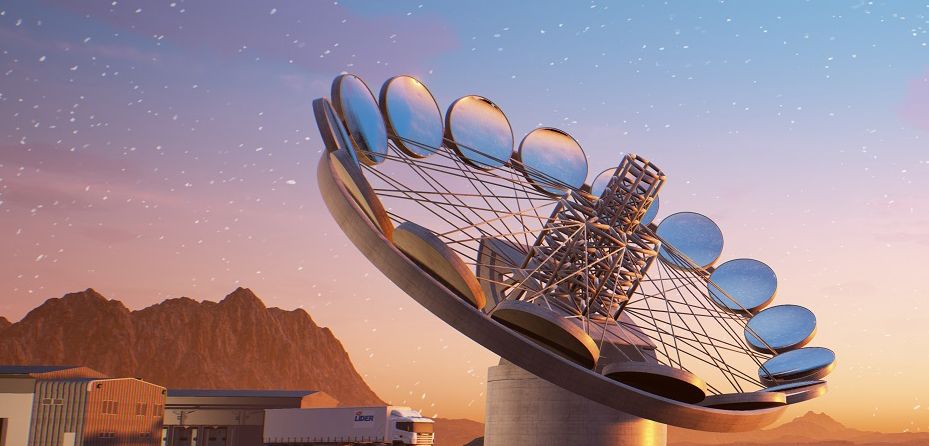
The ExoLife Finder (ELF) looks like no telescope ever built. A spectacular crown of 15 five-meter mirrors perches atop a sprawling metal lattice, resembling petals on a 10-story-tall mechanical flower — more sculpture than observatory. It is a fundamentally new type of telescope, one that its designers say could discover life on Earth-like planets beyond our solar system. The radical design is the brainchild of astrophysicist Jeff Kuhn of the University of Hawai‘i. For now, it exists only in renderings. To build it, Kuhn and the team he’s assembled must first develop and perfect techniques and technologies never before used in astronomy.
—EarthSky: “Walking Robots on Mars Could Speed Up Life Search“
Robotic rovers have become the go-to way to explore our neighbor planet, Mars. And they’ve been super successful. But they’re also big, heavy and slow. They have to move carefully across the rocky and sandy terrain of Mars. Plus, communication delays between the rovers and Earth – and data transfer limitations – also affect their missions. Is there a better way? On March 31, 2026, researchers in Switzerland and the Netherlands announced a new idea: walking Mars robots. The research team said these robotic explorers would be semi-autonomous. This means they wouldn’t need regular assistance from humans back on Earth. And, their makers say, they could explore their surroundings – on both Mars or the moon – faster than rovers.
—The Times of India: “Mars Could be Warm Enough for Humans in 15 Years; A Discovery that Changes Everything“
Mars has been viewed as a multi-millennial effort to terraform since the inception of the term, but there is new evidence that the time frame has changed dramatically. A published study in Science Advances gives new hope to those wishing to terraform Mars through nanoscopic engineered aerosol-like dust particles made from iron and aluminium found abundantly in the soils of Mars. Specifically, scientists feel that if we inject these engineered aerogels into the atmosphere, the resulting greenhouse effect will raise Mars’ surface temperature by over 50 degrees Fahrenheit in only 15 years.
 Our Awesome Universe