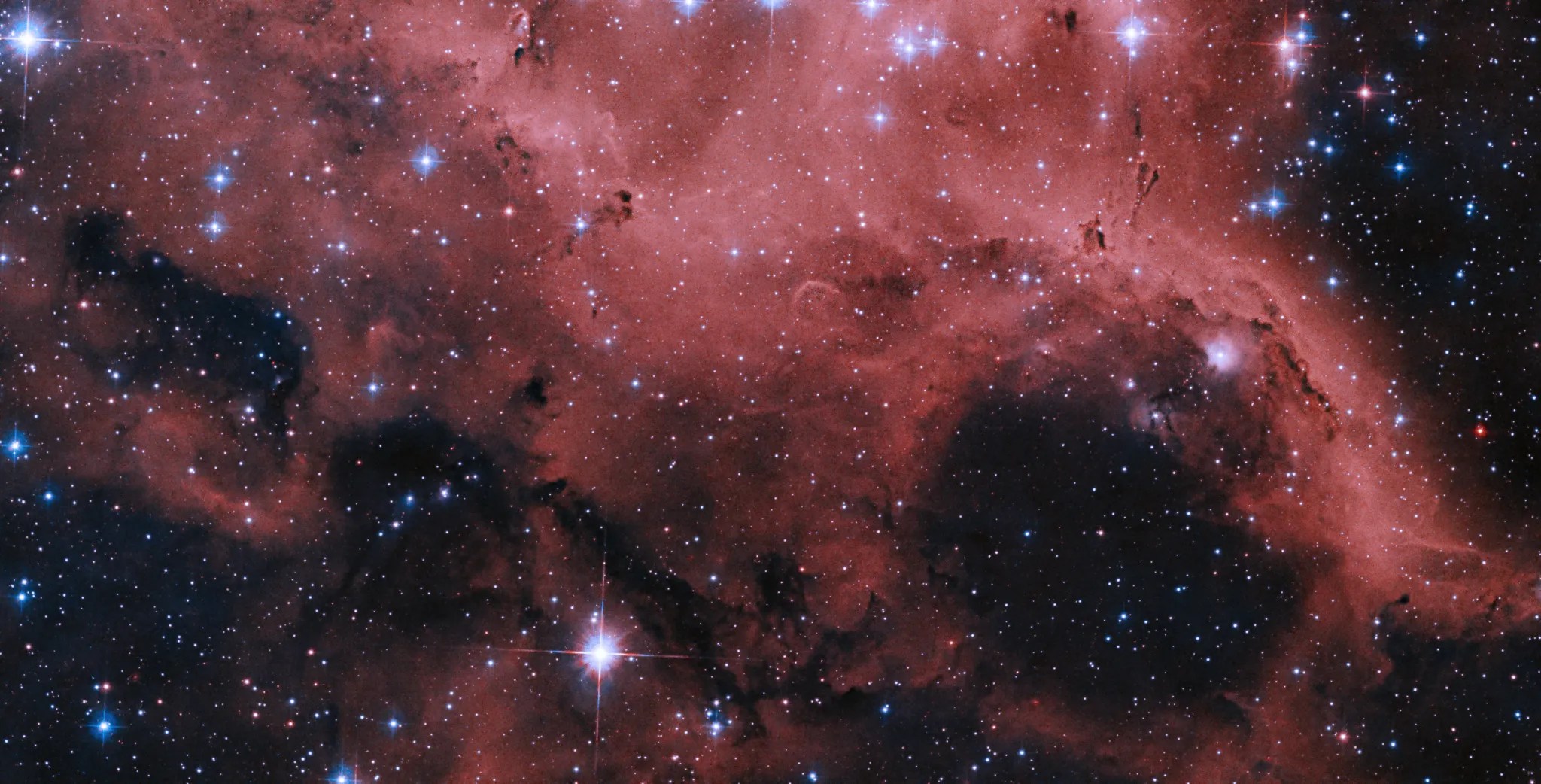
Pic of the Week: Sparkling Candy Floss

Image (Credit): The complex cluster of emission nebulae is known as N11. (NASA, ESA, J. M. Apellaniz from the Centro de Astrobiologia (CSIC/INTA Inst. Nac. de Tec. Aero., and Gladys Kober from NASA/Catholic University of America)

This week’s image is from the Hubble Space Telescope. It shows a cluster of stars that are about 160,000 light-years away in the Large Magellanic Cloud that orbits our Milky Way.

Here is the full story from NASA:

A bubbling region of stars both old and new lies some 160,000 light-years away in the constellation Dorado. This complex cluster of emission nebulae is known as N11, and was discovered by American astronomer and NASA astronaut Karl Gordon Henize in 1956. NASA’s Hubble Space Telescope brings a new image of the cluster in the Large Magellanic Cloud (LMC), a nearby dwarf galaxy orbiting the Milky Way.

About 1,000 light-years across, N11’s sprawling filaments weave stellar matter in and out of each other like sparkling candy floss. These cotton-spun clouds of gas are ionized by a burgeoning host of young and massive stars, giving the complex a cherry-pink appearance. Throughout N11, colossal cavities burst from the fog. These bubbles formed as a result of the vigorous emergence and death of stars contained in the nebulae. Their stellar winds and supernovae carved the surrounding area into shells of gas and dust.

A Day in Astronomy: The Birth of Ray Bradbury

On this day in 1920, Ray Douglas Bradbury was born in Waukegan, Illinois. Mr. Bradybury would grow up to be a famous American author and screenwriter.

One of his science fiction works,The Martian Chronicles stories, tells the story of mankind’s colonization of Mars and the ultimate effect on the colonizers.

He wrote numerous other famous books and short story collections, including Fahrenheit 541, Something Wicked This Way Comes, The Illustrated Man, and Dandelion Wine.

Speaking on science fiction, Mr. Bradbury once stated:

Science fiction is any idea that occurs in the head and doesn’t exist yet, but soon will, and will change everything for everybody, and nothing will ever be the same again. As soon as you have an idea that changes some small part of the world you are writing science fiction. It is always the art of the possible, never the impossible.

Asked in a 2004 interview what he thought about the US space program, he stated:

It’s too late, isn’t it? We’ve let 30 years go by. It’s stupid. It’s stupid. We should have stayed on the moon. We should have made moon the base, instead of building space stations, which are fragile and which fly apart. The moon is a good, solid base to build a space travel organization in the community. Then we take off from the moon and we go to Mars. But it’s terribly late. We’ve let too much time go by. We’ve been busy with war instead of being busy with peace. And that’s what space travel is all about. It’s all about peace and exploration and wonder and beauty.

Fortunately, it is not too late to visit the Moon or Mars, as demonstrated by NASA’s Artemis program. It’s the art (and science) of the possible.

Television: The End of The Acolyte

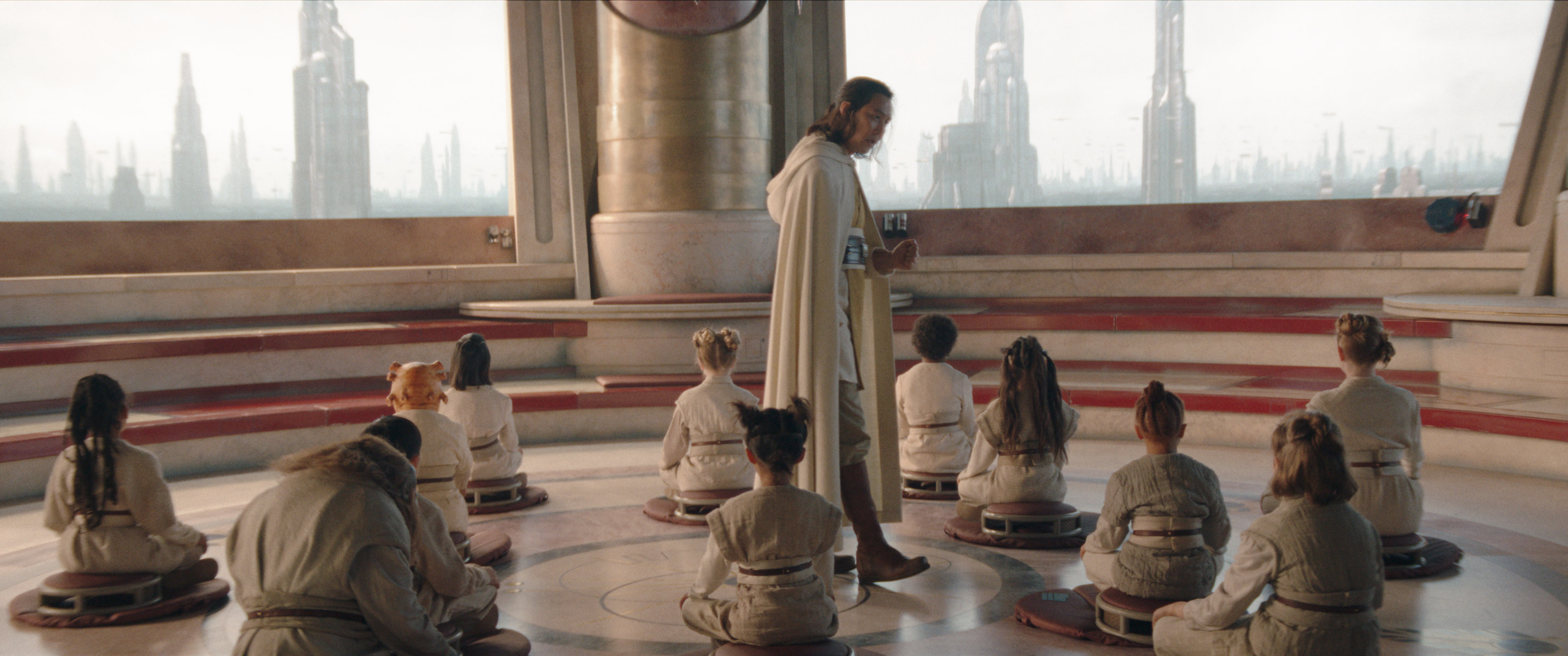
Image (Credit): Scene from Disney’s Star Wars: Acolyte television series. (Lucasfilm)

I cannot say I am surprised that Disney’s new Star Wars television series The Acolyte has been cancelled after only one season. I watched a few episodes and gave up.

Given that Disney has decided to spread the Star Wars series very thin over multiple storylines, it seems that the goal has been more TV rather than better TV. Even the trick of dropping in the occasional cameo, be it Luke Skywalker or various versions of Darth Vader, has worn thin.

So while the first series, The Mandalorian, is going into its fourth season, the other series are more or less limping along. The best of the lot, Andor, missed 2024 completely and will have its second and last season next year. What if Disney had concentrated more on Andor and less on these other spin-offs (The Book of Boba Fett, Obi-Wan Kenobi, and Ahsoka)? Maybe we would be talking about season three of Andor and the franchise would have some new and true fans.

With all of this busyness with little to show for it, I was surprised to read that Disney was putting out a Mandalorian feature film that mashes together some of the television storylines. Are we now milking to death the still struggling offspring of the Star Wars family? Why?

Disney needs to use its cash and creative talent to come up with new sci-fi series. Look at The Expanse for some ideas or just visit the sci-fi section of the library.

All I know is that turning Star Wars into a money pit is not the way to go.

Space Stories: Oceans on Ariel, Dinosaur-Killer Asteroid from Beyond Jupiter, and the Launch of the Polaris Dawn Mission

Image (Credit): Uranus and distant galaxies as seen by the James Webb Space Telescope. (NASA, ESA, CSA, STScI)

Here are some recent stories of interest.

ForbesNASA’s Webb Telescope Finds Evidence For An Ocean World Around Uranus

New observations by the James Webb Space Telescope suggest that an icy moon around Uranus may have an underground liquid ocean. Ariel is one of 27 moons around Uranus, the seventh planet from the sun and the third largest planet in the solar system. It’s one of four moons that scientists have long been interested in as part of a search for water across the solar system, the others being Umbriel, Titania and Oberon.

Nature: Dinosaur-killing Chicxulub Asteroid Formed in Solar System’s Outer Reaches

The object that smashed into Earth and kick-started the extinction that wiped out almost all dinosaurs 66 million years ago was an asteroid that originally formed beyond the orbit of Jupiter, according to geochemical evidence from the impact site in Chicxulub, Mexico. The findings, published on 15 August in Science, suggest that the mass extinction was the result of a train of events that began during the birth of the Solar System. Scientists had long suspected that the Chicxulub impactor, as it is known, was an asteroid from the outer Solar System, and these observations bolster the case.

Space DailyPolaris Dawn Mission Set for August 26 to Advance Commercial Space Exploration

The Polaris Program, focused on testing and developing new spaceflight technology, is preparing to launch its first mission, Polaris Dawn, aboard SpaceX’s Falcon 9 rocket on Monday, August 26, 2024. This mission marks a significant step forward in commercial space exploration. Key objectives include testing a next-generation spacesuit during the first commercial spacewalk, attempting to achieve the highest altitude for a human spaceflight since the Apollo missions, and evaluating a new communication system through Starlink.

One More Wrinkle Related to the Starliner Delay

Credit: NASA

As if NASA needed another issue with the Boeing Starliner stranded at the International Space Station (ISS), the media (particularly the Indian media) is now reporting that one of the Starliner astronauts is having eyesight issues.

According to one media source, Astronaut Sunita Williams is experiencing eyesight problems that may be linked to her exposure to microgravity. The issue, called Spaceflight Associated Neuro-ocular Syndrome (SANS), is not an uncommon symptom related to space flight. It can lead to blurred vision over time and worsens over time.

NASA has noted that:

Most astronauts’ eyes and brain structure change in space…Weightlessness causes blood and cerebrospinal fluid to shift toward the head. This fluid shift is believed to be the underlying cause of the eye and brain structural changes…The longer they are in space, the more they may be impacted. Many astronauts only experience effects in space, but some changes may be permanent in some astronauts.

This has only become an issue now that an 8-day tour has turned into a potential 8-month tour. This Gilligan’s Island tour needs to come to an end so that the ISS can return to regular operations.

Image (Credit): Scene from the television show Gilligan’s Island. (CBS Television Network)