Pic of the Week: The Safe Return of Crew-11

Image (Credit): NASA astronaut Mike Fincke as he exits the Dragon Endeavour spacecraft on January 15, 2025. (NASA)

This week’s image shows return of Crew-11 from the International Space Station (ISS). They landed safely on the morning of January 15th. As shown above, NASA astronaut Mike Fincke was the first member of the mission to exit the capsule. You can watch the entire video here.

Earlier this week, Mr. Fincke posted a few comments about the team’s early departure from the ISS:

What stands out most to me is how clearly NASA cares about its people. Flight surgeons, engineers, managers, and support teams came together quickly and professionally to chart the best path forward. The ground teams—across mission control centers and partner organizations around the world—have been extraordinary. We’re proud of the joint work we’ve done and the camaraderie we’ve shared, including some great songs and more than a few dad jokes.

ISS Astronauts on Their Way Home as Part of Medical Evacuation

Image (Credit): The official portrait of the four members of NASA’s SpaceX Crew-11 mission aboard the ISS. From left, are Roscosmos cosmonaut Oleg Platonov, NASA astronaut Mike Fincke, Japan Aerospace Exploration Agency (JAXA) astronaut, and NASA astronaut Zena Cardman. (NASA)

The Crew-11 mission departed the International Space Station (ISS) earlier today for their trip home. The four astronauts that are part of this medical evacuation – NASA astronauts Zena Cardman and Mike Fincke, Japan Aerospace Exploration Agency (JAXA) astronaut Kimiya Yui, and Roscosmos cosmonaut Oleg Platonov – are expected to splash down off the coast of California early Thursday morning.

Here is NASA’s schedule of events from yesterday covering both days:

Wednesday, Jan. 14

  • 3 p.m. – Hatch closure coverage begins on NASA+, Amazon Prime, and YouTube.
  • 3:30 p.m. – Hatch closing
  • 5 p.m. – Undocking coverage begins on NASA+, Amazon Prime, and YouTube.
  • 5:20 p.m. – Undocking

Following the conclusion of undocking coverage, NASA will distribute audio-only communications between Crew-11, the space station, and flight controllers during Dragon’s transit away from the orbital complex.

Thursday, Jan. 15

  • 2:15 a.m. – Return coverage begins on NASA+, Amazon Prime, and YouTube.
  • 2:51 a.m. – Deorbit burn
  • 3:41 a.m. – Splashdown
  • 5:45 a.m. – NASA Administrator Jared Isaacman will lead a Return to Earth news conference streaming live on NASA+, Amazon Prime, and the agency’s YouTube channel.

The remaining member of Expedition 74 will be commanded by Roscosmos cosmonaut Sergey Kud-Sverchkov, who will remain on board with Flight Engineers Sergei Mikaev (Roscosmos) and Chris Williams (NASA). The Crew-12 mission may be moved up to cover the gap caused by this early departure.

NASA is keeping quite about the underlying medical conditions, yet something will probably need to be said sooner rather than later. Maybe the news conference tomorrow will give us a few more details.

Sci-Fi Quote: Expect Some Fun with Starfleet Academy

Image (Credit): Paul Giamatti and Holly Hunter in Star Trek: Starfleet Academy. (Paramount+)

“I was immediately enthralled with reading it. I wanted to see what Paul was going to do next and could I do it with him? That was an unusual opportunity that was presented.”

Statement by actress Holly Hunter (playing the part of Starfleet Academy’s chancellor) regarding actor Paul Giamatti (playing the part of Klingon and Tellarite villain Nus Braka) in the new Star Trek: Starfleet Academy television series premiering on January 15th.

Regarding the involvement of Hunter in the series, Giamatti stated to his co-star:

I had heard that you were considering the part and that was very exciting to me because I thought it was a brilliant choice…I thought this makes a lot of sense. It’s going to fit right, but it’s going to be different. And I don’t know what she’s going to do with it, but it’s going to be something great. So it was a big selling point for me.

We can only hope that the rest of us have as much fun watching the series as they did making it. The filming of season two of this new series is almost complete as well. Hopefully, the jump to a second season is not presumptuous.

Space Stories: A Dead Galaxy, Newly Discovered Cloud-9, and Preparing for Artemis II

Image (Credit): GS-10578, also called Pablo’s Galaxy. (JADES Collaboration)

Here are some recent space-related stories of interest.

innovation News Network: Astronomers Discover Ancient “Dead Galaxy” Starved by its Supermassive Black Hole

Using observations from the James Webb Space Telescope (JWST) and the Atacama Large Millimeter Array (ALMA), researchers found that a growing supermassive black hole can slowly starve a galaxy rather than destroy it outright. The galaxy, catalogued as GS-10578 and nicknamed Pablo’s Galaxy, existed just three billion years after the Big Bang. Despite this early stage in cosmic history, it is enormous – around 200 billion times the mass of the Sun. Most of its stars formed between 12.5 and 11.5 billion years ago, indicating a rapid burst of star formation before the galaxy suddenly shut down.

CNN: Cloud-9’ is a Newly Discovered Celestial Object. It Could Help Solve a Cosmic Mystery

Astronomers may have discovered a previously unknown type of astronomical object, nicknamed “Cloud-9,” that could shed light on dark matter, one of the biggest mysteries in the universe. …Cloud-9 is thought to be a dark matter cloud that could be a remnant of galaxy formation from the early days of the universe, according to new research published Monday in The Astrophysical Journal Letters.

Space.com: NASA to Roll Out Rocket for Artemis 2 Moon Mission on Jan. 17

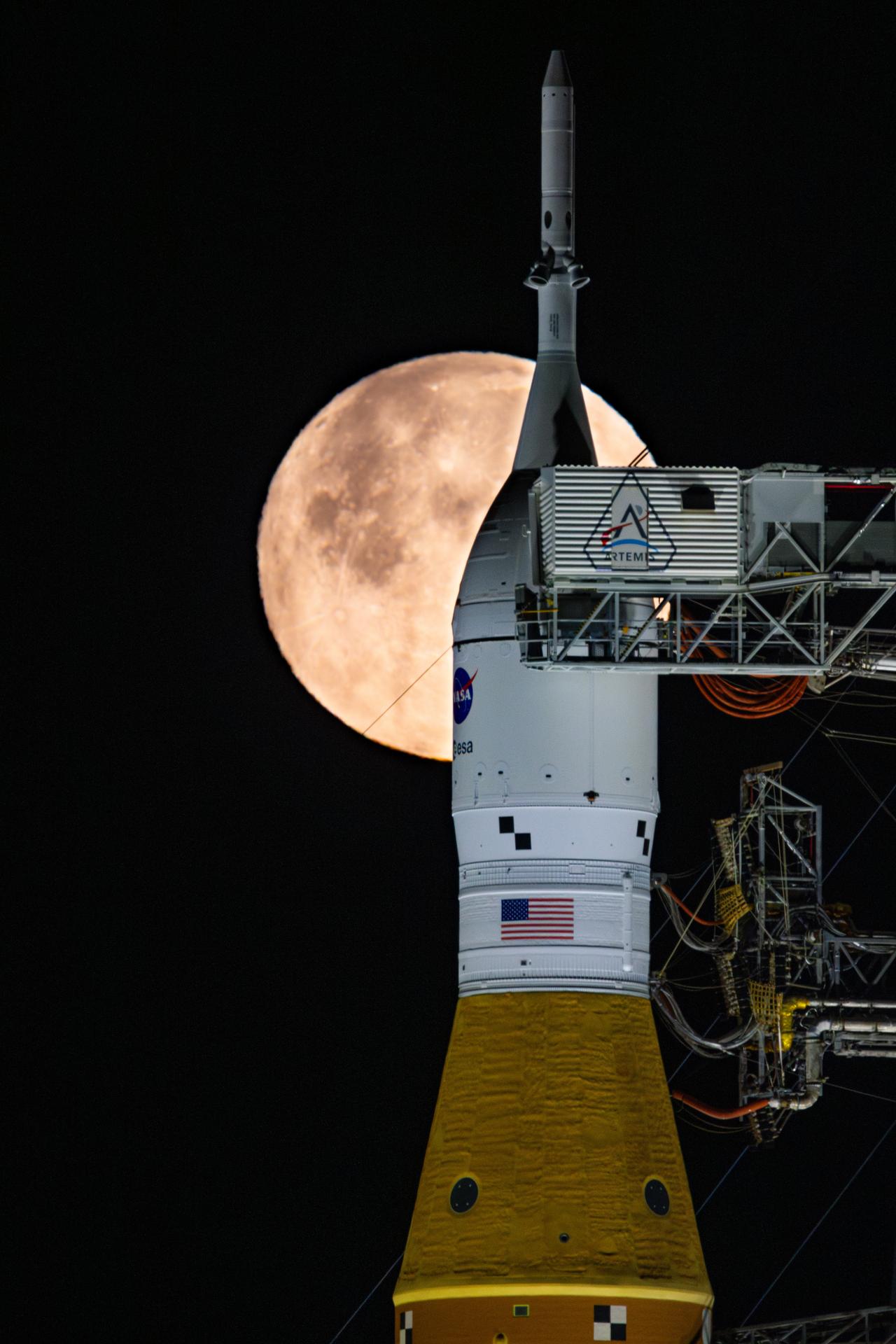
The first crewed moon mission in more than 50 years remains on track to launch as soon as Feb. 6. NASA announced on Friday evening (Jan. 9) that it plans to roll the Space Launch System (SLS) rocket and Orion spacecraft that will fly the Artemis 2 moon mission out to the pad for prelaunch checks on Jan. 17, weather and technical readiness permitting.

Pandora and Friends Start New Missions

Image (Credit): An artist’s rendering of NASA’s Pandora mission. (NASA)

Earlier today, NASA’s Pandora mission got its start aboard a SpaceX rocket launched from California’s Vandenberg Space Force Base.

The Pandora satellite, once fully operational, will view exoplanet atmospheres and their host stars to learn more about these exotic worlds. In its first year, the satellite will focus on approximately 20 known exoplanets. This NASA video describes the process.

The 716-pound Pandora satellite is much smaller than the 14,300-pound James Webb Space Telescope (JWST). Of course, the JWST has a much larger mission that expands over a much longer time period.

If you are looking for something small, you might be interested in the two CubeSats launched with Pandora. One is called the Star-Planet Activity Research CubeSat (SPARCS), which will study coronal mass ejections on small stars, while the second is named the Black Hole Coded Aperture Telescope (BlackCAT) with the mission of observing X-ray flares from active galaxies with supermassive black holes as well as gamma-ray bursts.

It was a successful Sunday for NASA and space enthusiasts everywhere.