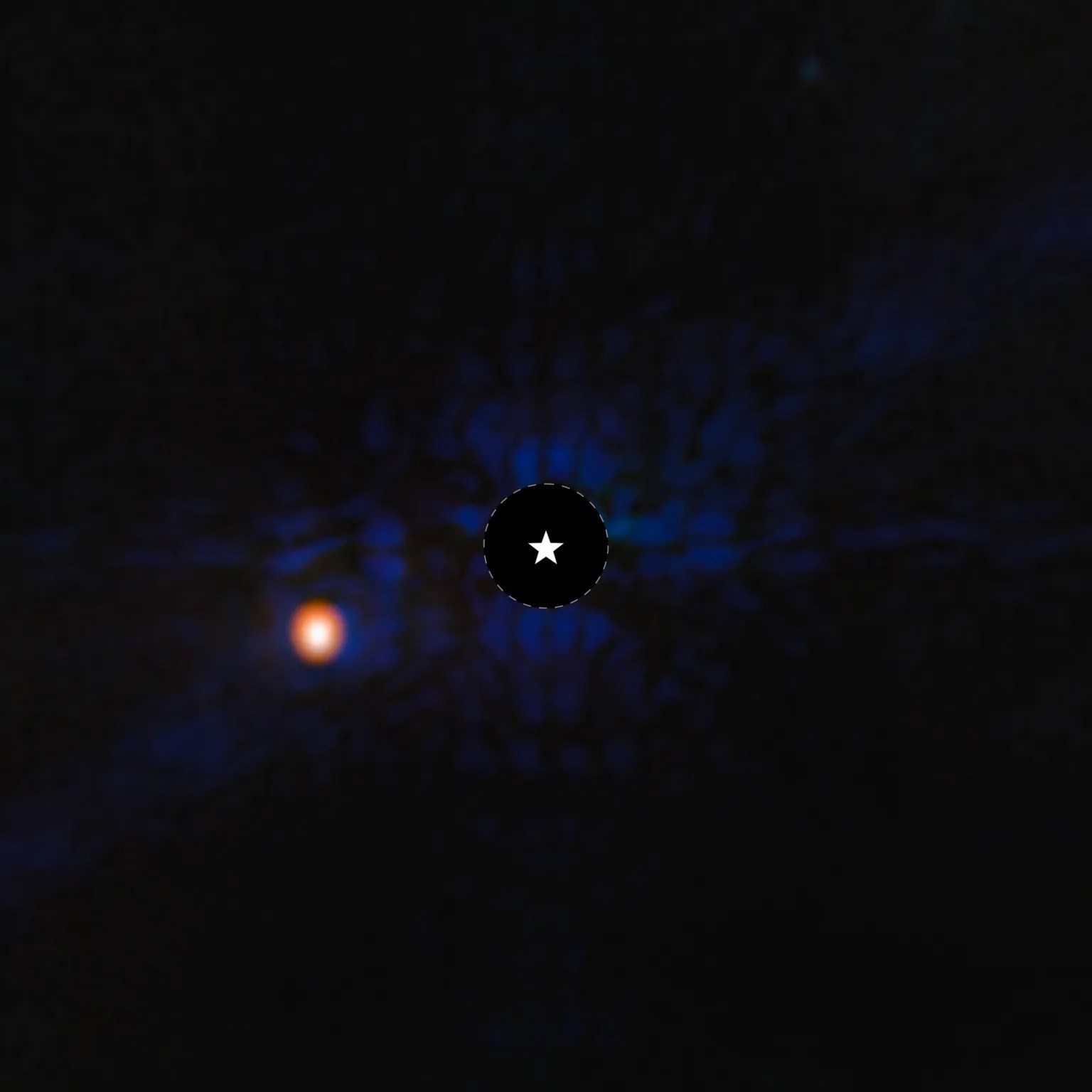
Image (Credit): JWST’s view of exoplanet Epsilon Indi Ab. (NASA, ESA, CSA, STScI, E. Matthews (Max Planck Institute for Astronomy))
This week’s image looks dark and simple, and yet it is an amazing sight provided by NASA’s James Webb Space Telescope (JWST). It shows a directly imaged exoplanets that resides about 12 light-years from us. It is called Epsilon Indi Ab and is several times the mass of Jupiter.
Here is an explanation from NASA about what you are seeing in the image:
This image of the gas-giant exoplanet Epsilon Indi Ab was taken with the on NASA’s James Webb Space Telescope’s MIRI (Mid-Infrared Instrument). A star symbol marks the location of the host star Epsilon Indi A, whose light has been blocked by the coronagraph, resulting in the dark circle marked with a dashed white line. Epsilon Indi Ab is one of the coldest exoplanets ever directly imaged. Light at 10.6 microns was assigned the color blue, while light at 15.5 microns was assigned the color orange. MIRI did not resolve the planet, which is a point source.
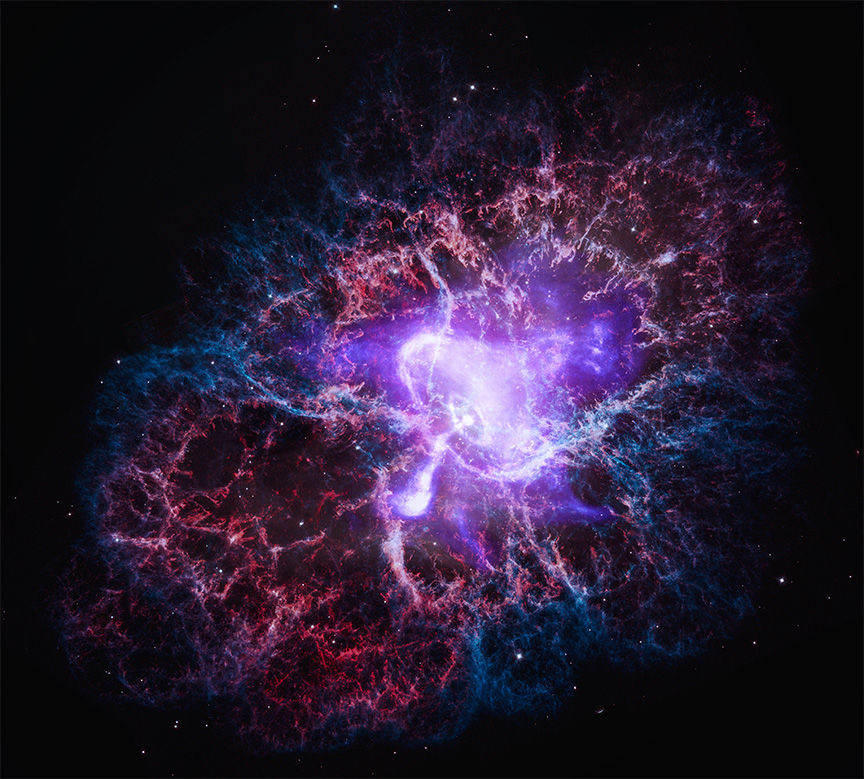
Image (Credit): The Crab Nebula captured by the Chandra X-ray Observatory. (X-ray: (Chandra) NASA/CXC/SAO, (IXPE) NASA/MSFC; Optical: NASA/ESA/STScI; Image Processing: NASA/CXC/SAO/J. Schmidt, K. Arcand, and L. Frattare)
The images released to celebrate the 25th anniversary of the Chandra X-ray Observatory are too beautiful to be visited only once. Above is another amazing image from the collection showing the Crab Nebula.
This composite image features the remnant of a supernova explosion, which resembles a neon purple mushroom at the heart of a colorful web of veins and filaments. Known as the Crab Nebula, the heavily veined blue and red cloud of gas is set against the blackness of space. At the core of the nebula is a pulsar, a rotating neutron star emitting electromagnetic radiation. Here, the pulsar appears as a bright white dot sitting in a neon purple cloud. Surrounding the dot are white rings. These are created by particles driven away from the pulsar and colliding with gas in the nebula to produce X-rays. From this angle, the rings and purple cloud combine to resemble a mushroom cap. Completing the look of a mushroom is a thin mushroom stem emerging from the white dot. This is a narrow beam of particles blasting away from the pulsar.
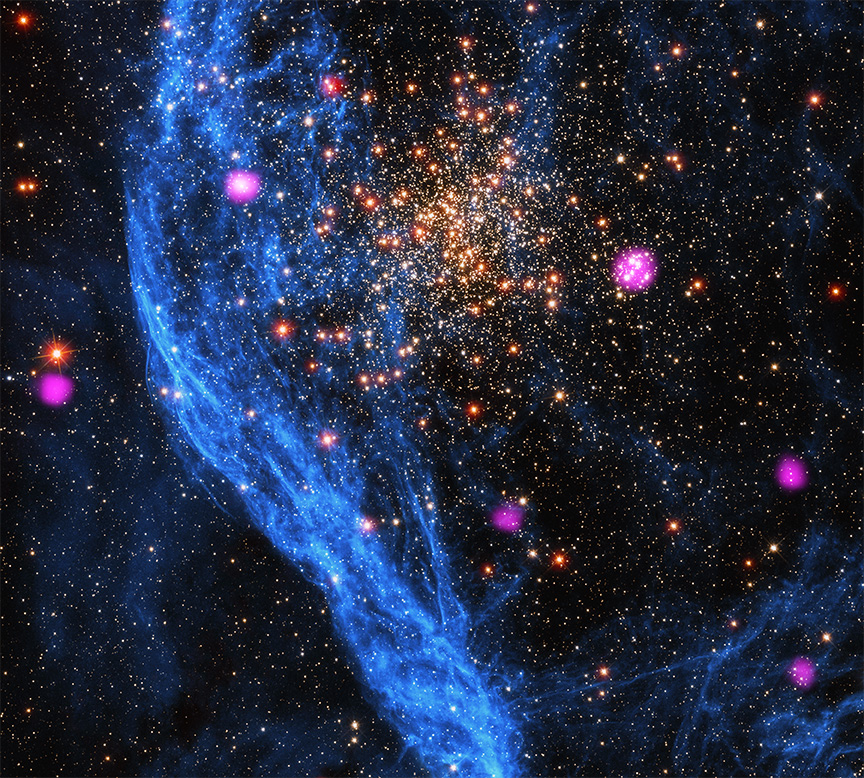
This composite image features a double star cluster, a blue-tinted cloud, and several neon purple dots. This double cluster is part of the Large Magellanic Cloud, a companion galaxy to the Milky Way. The bright, golden stars in the larger cluster fill the upper center of the image. The other cluster is much smaller and coincides with one of the neon purple circles located slightly above and to the right of the image’s center. This and the other purple circles are X-ray sources detected with Chandra. To our left of the combined cluster is a vertical streak of blue-tinted cloud. Extending beyond the upper and lower edges of the image, this section of cloud resembles wafting smoke from a cigarette.
Image (Credit): NGC 1850 captured by the Chandra X-ray Observatory. (X-ray: NASA/CXC/SAO; Optical: NASA/ESA/STScI; Infrared: NASA/JPL/CalTech/Spitzer; Image Processing: NASA/CXC/SAO/J. Major, K. Arcand)
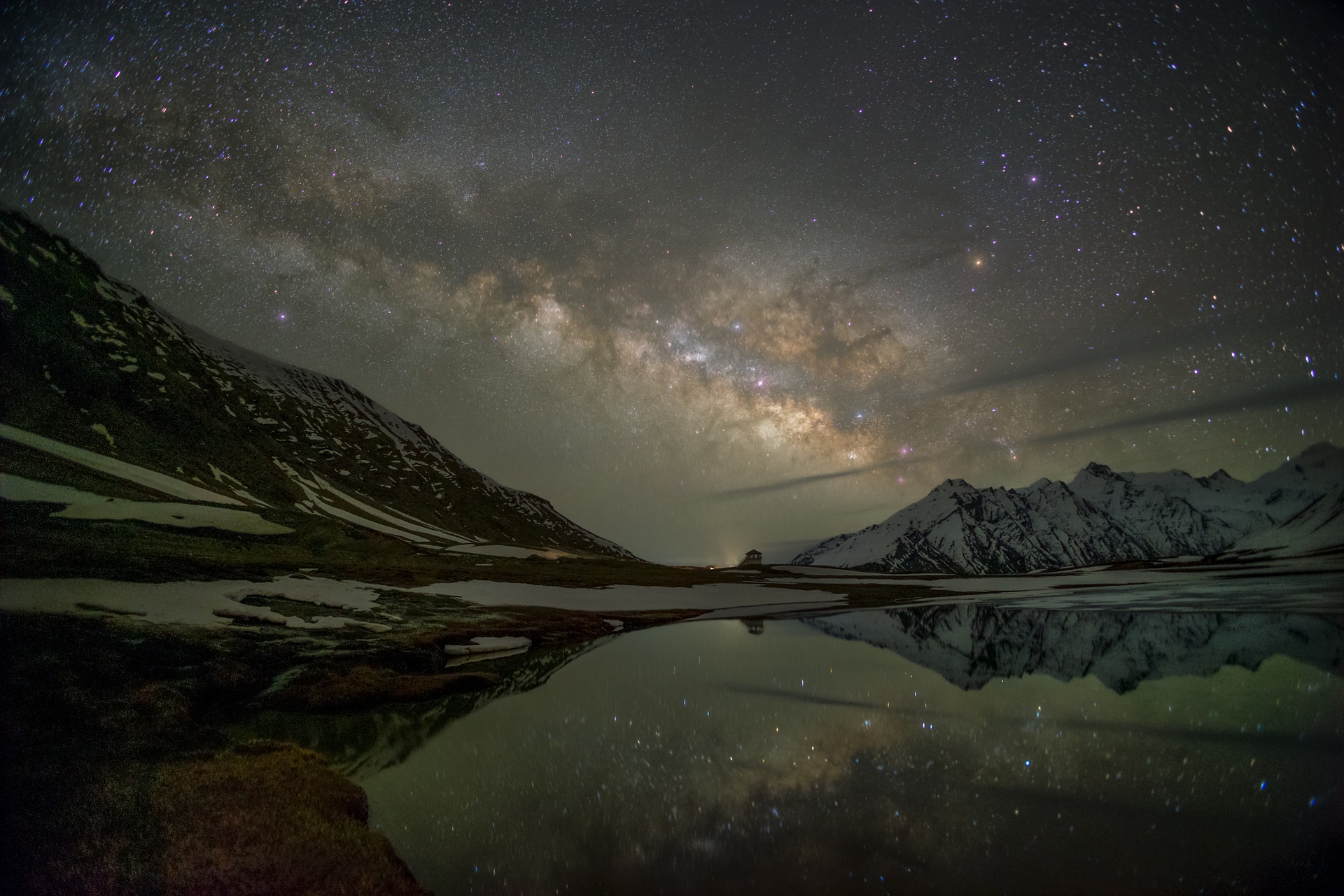
The arrival of August means two things for stargazers — “shooting stars” and the Milky Way. In 2024, you can see both at the same time if you know exactly where and when to look…This month, there’s a new moon on Aug. 4, which will keep the post-sunset sky dark until about Aug. 8. That makes the first week of August ideal for spotting “shooting stars” — while you also look for the Milky Way. True darkness won’t come until midnight for most of the Northern Hemisphere, but look to the southeast after dark, and you’ll have a chance of seeing the Sagittarius arm of the Milky Way arching across the night sky.
Using the James Webb Space Telescope (JWST), an MPIA-led team of astronomers imaged a new exoplanet that orbits a star in the nearby triple system Epsilon Indi. The planet is a cold super-Jupiter exhibiting a temperature of around 0 degrees Celsius and a wide orbit comparable to that of Neptune around the Sun. This measurement was only possible thanks to JWST’s unprecedented imaging capabilities in the thermal infrared. It exemplifies the potential of finding many more such planets similar to Jupiter in mass, temperature, and orbit. Studying them will improve our knowledge of how gas giants form and evolve in time.
Researchers are turning to techniques from astronomy to help spot computer-generated ‘deepfake’ images — which can look identical to genuine photographs at first glance. By analysing images of faces using methods that are usually used to survey distant galaxies, astronomers can measure how a person’s eyes reflect light, which can reveal telltale signs of image manipulation.
Tomorrow’s launch of a classified US Air Force payload will be the last use of the United Launch Alliance (ULA) Atlas V rocket for such missions. It will the rocket’s 100th national security launch.
The Atlas rocket, first built in 1957, is America’s longest-serving active rocket. Over the years, the rockets have launched numerous critical government and commercial missions, including NASA missions. For instant, it sent NASA’s Curiosity Rover to Mars. Most recently it sent the Boeing Starliner to the International Space Station (now the Starliner needs to find its own way back).
More Atlas V missions are planned even with the absence of national security missions, but the ULA’s focus is turning towards its new Vulcan rocket, which is still being tested.
The era of the Atlas rocket is quickly coming to a close.
If you are looking for something fun in a slightly cooler climate this summer, you may want to venture to the Maine Solar System Model. Its a joint science project created by the University of Maine and northern Maine communities.
Built between 1999 and 2003, this model allows you to better understand the distances between planets as you drive around the Maine countryside, starting with a model of the Sun in the north or Pluto about 40 miles to the south. You can also visit the dwarf planet Eris about 55 miles south of Pluto if you want to be adventurous.
This is much better than spotting cows or playing “I see something blue” on those longer car rides. You can learn something new while driving around a beautiful part of America.



 Our Awesome Universe