A JuMBO means Jupiter-mass binary objects, which is just part of the story in this video. The presentation starts with a finding from astronomers using the James Webb Space Telescope, who identify 520 rogue planet candidates. This is interesting in itself, but the intriguing part is that a number of these planets are found in pairs. This would not make a lot of sense if we believed these planets were once within a solar system before being pushing into space.
The video discusses the various theories explaining these JuMBOs and rogue planets in general. It also discusses the potential impact on our own solar system, such as whether we lost one of our own planets in the past and/or a nearby rogue planet (and its moons) is out there today waiting to be discovered.
As always, Cool Worlds Lab keeps astronomy even more interesting.
Image (Credit): NASA’s Perseverance Mars Rover. (NASA)
“Cheyava Falls is the most puzzling, complex, and potentially important rock yet investigated by Perseverance…On the one hand, we have our first compelling detection of organic material, distinctive colorful spots indicative of chemical reactions that microbial life could use as an energy source, and clear evidence that water — necessary for life — once passed through the rock. On the other hand, we have been unable to determine exactly how the rock formed and to what extent nearby rocks may have heated Cheyava Falls and contributed to these features.”
–Statement by Ken Farley, Perseverance project scientist of Caltech in Pasadena, regarding a recent finding by the Perseverance rover on Mars. The rock, labeled “Cheyava Falls,” may answer whether Mars was home to microscopic life in the distant past.
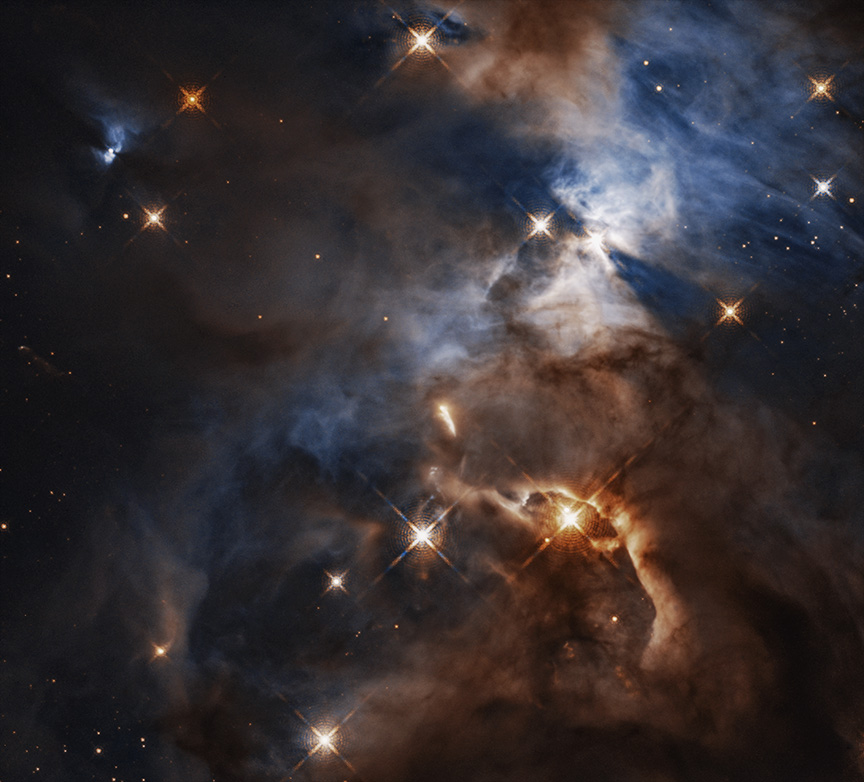
Image (Credit): Chandra X-ray Observatory image of the Bat Shadow. (X-ray: NASA/CXC/SAO; Optical: NASA/ESA/STScI; Image Processing: NASA/CXC/SAO/J. Major)
NASA’s Chandra X-ray Observatory is celebrating the 25th anniversary of the observatory, which means we get to view quite a few amazing images from over the years, such as the one above called the Bat Shadow.
Here is more from NASA on this image explaining the bat connection:
In this composite image, several pink and white stars gleam through murky cloud formations. These are young stars detected by Chandra. At our lower right, an opaque cloud resembling a veined slug rises out of a muddy brown mist. Blue and grey clouds with hints of brown stretch from our lower left, to our upper right. There, near the upper righthand corner, two long black triangles appear to burst from a central gleaming star. These triangles are in fact shadows from the young star, cast on distant blue and grey clouds. The eerie shape, reminiscent of the Batman call sign projected against a cloudy Gotham sky, has earned the phenomenon the nickname The Bat Shadow.
You still have time to sign up for the Mars Society’s 27th Annual International Mars Society Convention, happening from August 8-11 in Seattle, WA.
Some of the guests include:
Tiffany M. Morgan, Deputy Director of the Mars Exploration Program in NASA’s Science Directorate, who will give an address about “Exploring Mars Together, DRAFT Plan for a Sustainable Future for Science at Mars.”
Howard Hu, the Orion Program Director at NASA, who will give an address about “NASA’s Artemis plans for returning to the Moon and beyond,”
Brig. General (Ret.) Dr. S. Pete Worden, Chairman of the Breakthrough Prize Foundation, who will give an address about “Life in the Universe and Private Sector Space Science Initiatives.”
Dr. Alan Stern, a renowned planetary scientist and commercial astronaut, who will give an address about “The Other Red Planet” focusing on Pluto.
These are just a few of the names and presenters this year. You can also watch the presentations from prior conventions if you want to see what you missed.
Two astronauts aboard Boeing’s Starliner remain stuck in space as the mission exceeded its 45-day battery window being docked at the International Space Station. The capsule, which arrived at the space station on June 6, was initially approved to stay for up to 45 days but with no return date set, the astronauts’ stay has been “extended indefinitely,” NBC affiliate WESH reported. NASA and Boeing said the capsule’s batteries are performing well despite the extended stay. Tuesday marked 47 days since they’ve been at the ISS.
NASA says its next spacewalk will be delayed indefinitely until engineers understand more about what caused a coolant leak on June 24. Tracy Dyson, a NASA astronaut, had a brief spacesuit leak a month ago while still in the hatch of the International Space Station (ISS). She and Mike Barrett had just opened the door for a 6.5-hour spacewalk for maintenance activities, when showers of ice particles erupted from a spacesuit connection to the ISS. The spacewalk was suspended, but the astronauts were never in any danger, NASA has emphasized.
Two years after stating there were no plans to save artifacts from the destructive end of the International Space Station (ISS), NASA is now in the early stages of identifying what small parts of the orbiting laboratory to preserve. Agency officials on Wednesday (July 17) shared the preliminary details during a media briefing about the space station’s end of life in 2030 and the selection of SpaceX to build the vehicle that will move the massive complex out of orbit such that it mostly burns up in Earth’s atmosphere and plunge any surviving fragments into a remote area of the ocean.



 Our Awesome Universe