Image (Credit): Drinks at the Disney Star Wars: Galactic Starcruiser. (Disney)
The Disney hotel lasted for less than two years, but for more than four hours you can experience it on YouTube.
Opened in March 2022, Disney’s Star Wars: Galactic Starcruiser was an expensive, all-inclusive hotel that brought Star Wars adventures directly to the well-heeled. By September 2023, the fun was over when Disney shuttered the hotel forever after failing to attract enough customers.
The YouTube video, The Spectacular Failure of the Star Wars Hotel, follows Jenny Nicholson, who paid $6,000 for a two-night stay at the hotel. You get to see the experience for yourself and get deep into the highs and lows of her adventure.
Since most of us either lacked the funds or chutzpah to check into this hotel, this is the next best thing. You may never see such an adventure again. Of course, maybe the Alien franchise will see something to build on. After all, that series is all about the gullible checking in but not checking out.
Take a look at the image above. Can you determine where this image originated? Take a guess and then check your answer by going to the “Where is This? The Answer Sheet” page.
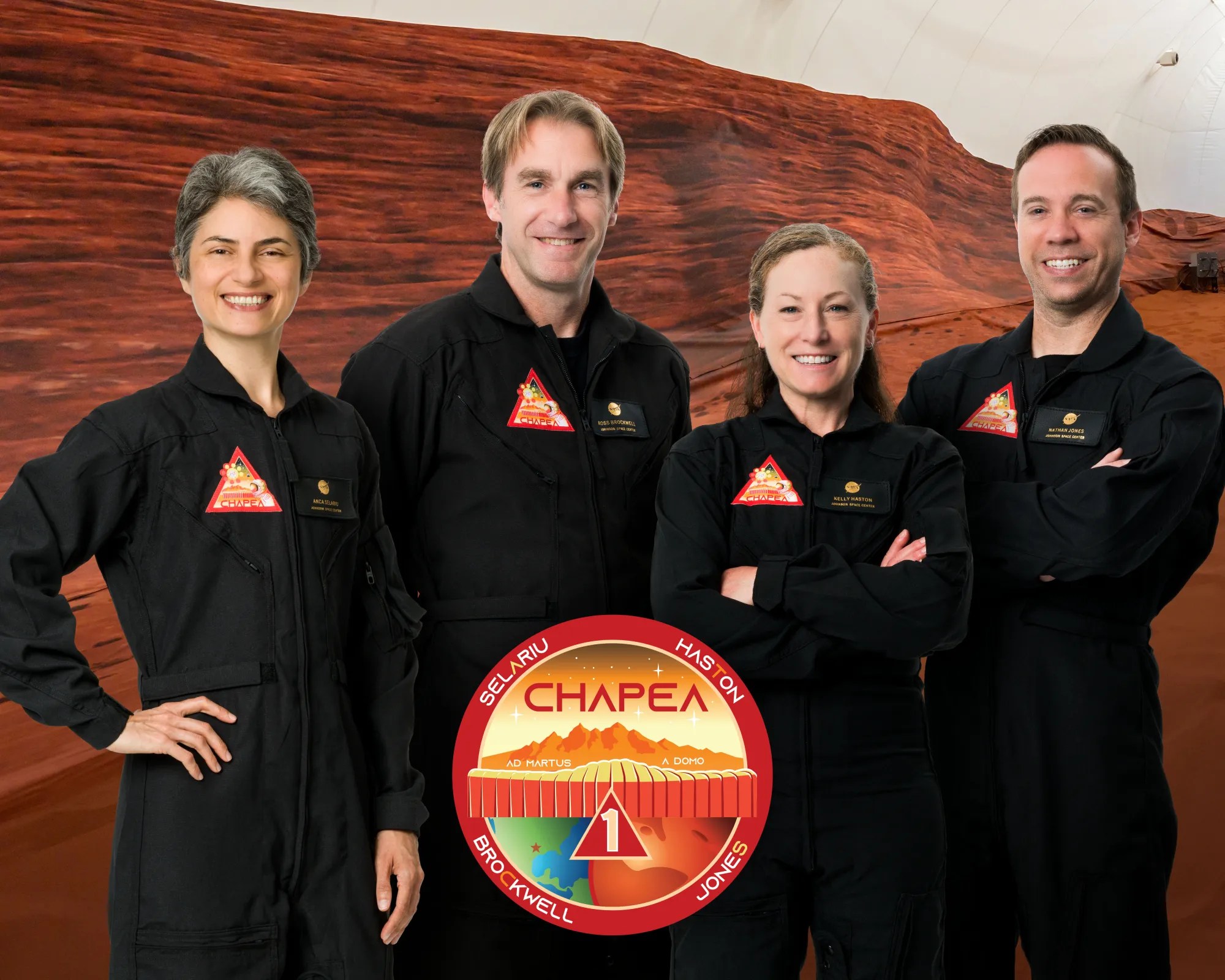
Image (Credit): Official mission 1 CHAPEA crew portrait (from left to right: Anca Selariu, Ross Brockwell, Kelly Haston, Nathan Jones). (NASA)
“”It would still cause me a great deal of thought, but I think my answer now is it would be very difficult to leave my partner, to leave my people, for that amount of time, because it would be far more than a year…That commitment, it’s going to be a tremendous effort when people go, and I really applaud whoever gets to do that. But I’m not sure it’ll be me.”
–Statement by Kelly Haston, a Canadian research scientist, after spending 378 days as part of NASA’s yearlong Mars simulation project. She was part of a team of four individuals who lived together during this period at the Johnson Space Center in Houston in what is called the Crew Health and Performance Exploration Analog (CHAPEA) project. The next simulation mission is planned for next year.
Several potential subsurface openings have been observed on the surface of the Moon. These lunar pits are interesting in terms of science and for potential future habitation. However, it remains uncertain whether such pits provide access to cave conduits with extensive underground volumes. Here we analyse radar images of the Mare Tranquillitatis pit (MTP), an elliptical skylight with vertical or overhanging walls and a sloping pit floor that seems to extend further underground. The images were obtained by the Mini-RF instrument onboard the Lunar Reconnaissance Orbiter in 2010. We find that a portion of the radar reflections originating from the MTP can be attributed to a subsurface cave conduit tens of metres long, suggesting that the MTP leads to an accessible cave conduit beneath the Moon’s surface. This discovery suggests that the MTP is a promising site for a lunar base, as it offers shelter from the harsh surface environment and could support long-term human exploration of the Moon.
Citation: Carrer, L., Pozzobon, R., Sauro, F. et al. Radar evidence of an accessible cave conduit on the Moon below the Mare Tranquillitatis pit. Nat Astron (2024). https://doi.org/10.1038/s41550-024-02302-y
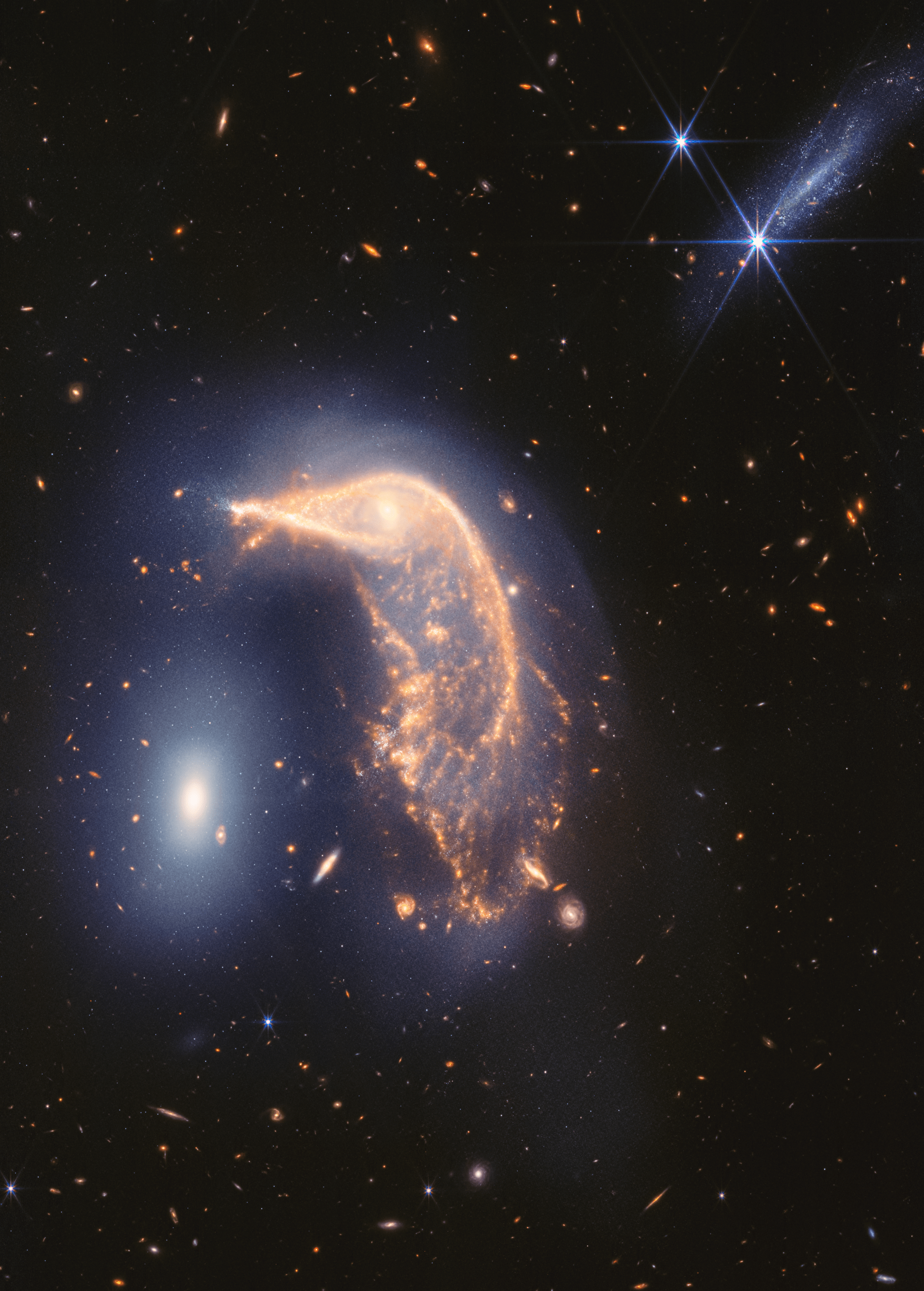
Image (Credit): The Penguin and Egg galaxies, known jointly as Arp 142. (NASA, ESA, CSA, STScI)
This week’s fun image comes from the James Webb Space Telescope. Called the Penguin and the Egg, these two galaxies of similar mass are locked together.
Before their first approach, the Penguin held the shape of a spiral. Today, its galactic center gleams like an eye, its unwound arms now shaping a beak, head, backbone, and fanned-out tail.
Like all spiral galaxies, the Penguin is still very rich in gas and dust. The galaxies’ “dance” gravitationally pulled on the Penguin’s thinner areas of gas and dust, causing them to crash in waves and form stars. Look for those areas in two places: what looks like a fish in its “beak” and the “feathers” in its “tail.”
Surrounding these newer stars is smoke-like material that includes carbon-containing molecules, known as polycyclic aromatic hydrocarbons, which Webb is exceptional at detecting. Dust, seen as fainter, deeper orange arcs also swoops from its beak to tail feathers.
In contrast, the Egg’s compact shape remains largely unchanged. As an elliptical galaxy, it is filled with aging stars, and has a lot less gas and dust that can be pulled away to form new stars. If both were spiral galaxies, each would end the first “twist” with new star formation and twirling curls, known as tidal tails.
Another reason for the Egg’s undisturbed appearance: These galaxies have approximately the same mass or heft, which is why the smaller-looking elliptical wasn’t consumed or distorted by the Penguin.
It is estimated that the Penguin and the Egg are about 100,000 light-years apart — quite close in astronomical terms. For context, the Milky Way galaxy and our nearest neighbor, the Andromeda Galaxy, are about 2.5 million light-years apart. They too will interact, but not for about 4 billion years.




 Our Awesome Universe