Study Findings: Not All Sub-Neptune Exoplanets Have Magma Oceans

Credit: Image by Enrique from Pixabay

The Astrophysical Journal Letters abstract of the study findings:

The evolution and structure of sub-Neptunes may be strongly influenced by interactions between the outer gaseous envelope of the planet and a surface magma ocean. However, given the wide variety of permissible interior structures of these planets, it is unclear whether conditions at the envelope–mantle boundary will always permit a molten silicate layer or whether some sub-Neptunes might instead host a solid silicate surface. In this work, we use internal structure modeling to perform an extensive exploration of surface conditions within the sub-Neptune population across a range of bulk and atmospheric parameters. We find that a significant portion of the population may lack present-day magma oceans. In particular, planets with a high atmospheric mean molecular weight and large envelope mass fraction are likely to instead have a solid silicate surface, since the pressure at the envelope–mantle boundary is high enough that the silicates will be in solid postperovskite phase. This result is particularly relevant given recent inferences of high-mean molecular weight atmospheres from JWST observations of several sub-Neptunes. We apply this approach to a number of sub-Neptunes with existing or upcoming JWST observations and find that in almost all cases, a range of solutions exist that do not possess a present-day magma ocean. Our analysis provides critical context for interpreting sub-Neptunes and their atmospheres.

Citation: Bodie Breza et al. Not all sub-Neptune exoplanets have magma oceans. ApJL 993 L46 (2025).

https://doi.org/10.3847/2041-8213/ae0c07

Study-related stories:

Universe Today – “It Looks Like All Mini-Neptunes Aren’t Magma Oceans After All”

University of Chicago – “New Study Revises Our Picture of the Most Common Planets in the Galaxy”

Space.com – “Is Our Dream of Finding Ocean-Covered Exoplanets Drying Up?”

Space Quote: Goddard Space Flight Center Threatened by Cuts

Image (Credit): Sign for NASA’s Goddard Space Flight Center in Greenbelt, Maryland. (NASA)

“…actions taken during the last nine months threaten the workers at Goddard and their ability to lead the world in this science and exploration. Between unnecessary voluntary separations, deferred resignations, reductions in force, and other pressure, thousands of civil servants and contractors are no longer working at GSFC. Other countries with space programs from our political allies to our adversaries have been recruiting our top scientists and researchers with massive salaries, research budgets, and the promise of stability. Where the US has considered stepping back, China has made clear they are eager to step in. We can and must re-invest in the people and centers that make America the global space leader and that starts with Goddard.”

-Statement in a November 13th letter from Maryland’s Senators and Representatives to NASA’s Acting Administrator Sean Duffy regarding recent cuts at NASA’s Goddard Space Flight Center (GSFC) in Greenbelt, Maryland. The letter included four questions to be answered by November 17th.

Really?: Star Trek Author Tied to Jeffrey Epstein Emails

Credit: Basic Books

This is really getting ridiculous. With the reopening of the federal government, the public has moved onto a new topic, and once again it is sex offender Jeffrey Epstein and his emails. However, this time it touches upon an popular cosmologist who wrote a book about Star Trek.

According to recent news stories, cosmologist Lawrence Krauss, author of The Physics of Star Trek, wrote to Mr. Epstein back in 2018 asking for ways to handle sexual harassment complaints against him. Mr. Epstein was a financial supporter of a program run by Dr. Krauss at Arizona State University (ASU). That same year, Dr. Krauss announced his retirement as professor at ASU while dealing with such charges. Dr. Krauss was also a contributor to Scientific American magazine and sat on Scientific American’s board of advisers, but was removed from the board in 2018 for reasons related to allegations of sexual misconduct.

As has been reported endlessly, Mr. Epstein engaged with a very large group of individuals, so Dr. Krauss is not alone. Still, it is not something you want on your resume.

You can still find Dr. Krauss sharing ideas on his podcast, The Origins Podcast with Lawrence Krauss, as well as his substack, Critical Mass. Whether this Epstein topic comes up on either the podcast or substack is anyone’s guess.

Dr. Krauss once stated:

For, after all, in science one achieves the greatest impact (and often the greatest headlines) not by going along with the herd, but by bucking against it.

I don’t believe he was talking about these latest headlines.

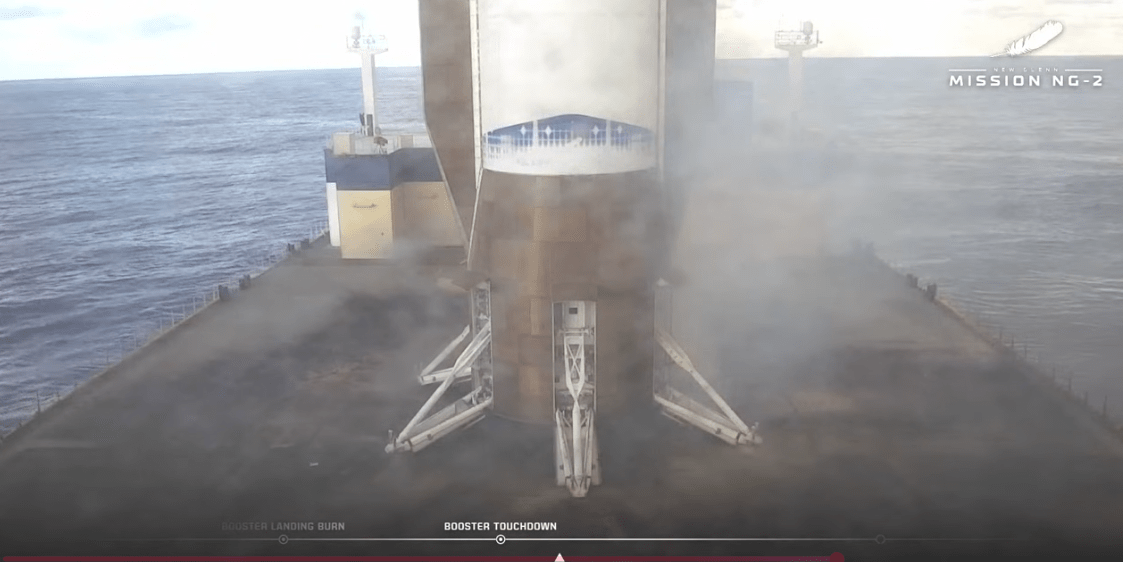
Pic of the Week: The New Glenn Rocket Booster Returns

Image (Credit): The New Glenn booster after it landed on a platform in the Atlantic Ocean. (Blue Origin)

Today’s image comes from Blue Origin, which successfully completed it second launch of it New Glenn rockets, sending two NASA Martian probes into orbit. The image shows the reusable rocket booster right after it landed on a platform in the Atlantic Ocean.

Acting NASA Administrator Sean Duffy stated:

Congratulations to Blue Origin, Rocket Lab, UC Berkeley, and all of our partners on the successful launch of ESCAPADE…This heliophysics mission will help reveal how Mars became a desert planet, and how solar eruptions affect the Martian surface. Every launch of New Glenn provides data that will be essential when we launch MK-1 through Artemis. All of this information will be critical to protect future NASA explorers and invaluable as we evaluate how to deliver on President Trump’s vision of planting the Stars and Stripes on Mars.

SpaceX now has another competitor for military and space missions, which is good for everyone (including SpaceX since it will keep them focused).

A Day in Astronomy: The Death of Percival Lowell

Image (Credit): Percival Lowell’s mausoleum just steps away from the Lowell Observatory in Flagstaff, AZ. (Atlas Obscura)

On this day in 1916, American astronomer Percival Lowell died at the age of 61 in Flagstaff, AZ. He will forever be remembered for his incorrect theory concerning canals on Mars as well as his better theory about a ninth planet, which contributed to the discovery of Pluto 14 years by Clyde Tombaugh, who was working at the Lowell Observatory in Flagstaff.

Some interesting facts about Mr. Lowell’s life includes:

  • After graduating from Harvard with a degree in mathematics yet spent six years running a cotton mill;
  • He traveled extensively to Asia and wrote numerous books about the region;
  • He was a dedicated pacifist; and
  • His greatest contribution to astronomy related to the preferred placement of observatories.

Mr. Lowell was far from the mark when he said this about Mars:

Speculation has been singularly fruitful as to what these markings on our next to nearest neighbor in space may mean. Each astronomer holds a different pet theory on the subject, and pooh-poohs those of all the others. Nevertheless, the most self-evident explanation from the markings themselves is probably the true one; namely, that in them we are looking upon the result of the work of some sort of intelligent beings. . . . The amazing blue network on Mars hints that one planet besides our own is actually inhabited now.

Yet it is too early to say he was also dreaming when he made this comment:

Now when we think that each of these stars is probably the centre of a solar system grander than our own, we cannot seriously take ourselves to be the only minds in it all.