This week’s image is from the Royal Observatory Greenwich’s Astronomy Photographer of the Year 2022 contest. The image above is the winner of the 2022 contest. It is titled “Disconnection Event,” captured by Gerald Rhemann.
Here is the language accompanying the winning image:
Comet Leonard was discovered by GJ Leonard on 3 January 2021. It made its closest pass on 12 December 2021 and, having left the solar system, won’t be seen from Earth again. On 25 Dec 2021, a piece of the comet’s tail was pinched off and carried away by the solar wind – a dramatic tail disconnection event. “Astronomy, myth and art come together beautifully in this shot. It holds great value to scientists, as it elegantly captures a disconnection event” – Imad Ahmed
Please visit The Guardian site for images from all of the winners.
Former astronaut Walter Cunningham, who flew into space on Apollo 7, the first flight with crew in NASA’s Apollo Program, died early Tuesday morning in Houston. He was 90 years old. “Walt Cunningham was a fighter pilot, physicist, and an entrepreneur – but, above all, he was an explorer. On Apollo 7, the first launch of a crewed Apollo mission, Walt and his crewmates made history, paving the way for the Artemis Generation we see today,” said NASA Administrator Bill Nelson. “NASA will always remember his contributions to our nation’s space program and sends our condolences to the Cunningham family.”
NASA’s Curiosity rover has discovered opal on Mars. The deposits may prove to be valuable to future Martian explorers not as jewelry but as a potential source of water. Opal is formed when water weathers silica-rich rocks, forming a solution that settles into cracks and crevices in the rock. Over time, this solution hardens into a solid lump that can be cloudy and dull or a dazzling display of color. Most supplies come from either Australia or Ethiopia, but now a new source has been discovered – Mars.
NASA’s Juno probe is continuing to recover its memory at Jupiter after a data disruption interrupted communications between the spacecraft and its operators on Earth following a flyby of the giant planet in December. The Juno spacecraft’s latest flyby of Jupiter, its 47th close pass of the planet, was completed on Dec. 14. But as its operators at NASA’s Jet Propulsion Laboratory were receiving science data from the flyby they found they could no longer directly access the spacecraft’s memory.The team successfully rebooted Juno’s computer and on Dec. 17 they placed the spacecraft into “safe mode” with only essential systems operating as a precaution.
Both Andy Weir (author of The Martian, Artemis, and Project Hail Mary) and Rob Manning (Chief Engineer at the Jet Propulsion Laboratory) were shooting the you-know-what as they chatted about science fiction books they read as teenagers, the role of real science in fictional tales, astronomical conspiracy theories, and mankind’s need to expand into the unknown.
It was interesting to hear Andy Weir talk about curiosity being humanity’s survival mechanism. He pointed out that curiosity has allowed humanity to survive disasters here on Earth because we were all spread out rather than clustered on one flood plain. The same applies to expansion beyond the Earth.
Check it out for yourself. You may want to check out some of the earlier podcasts as well, such as:
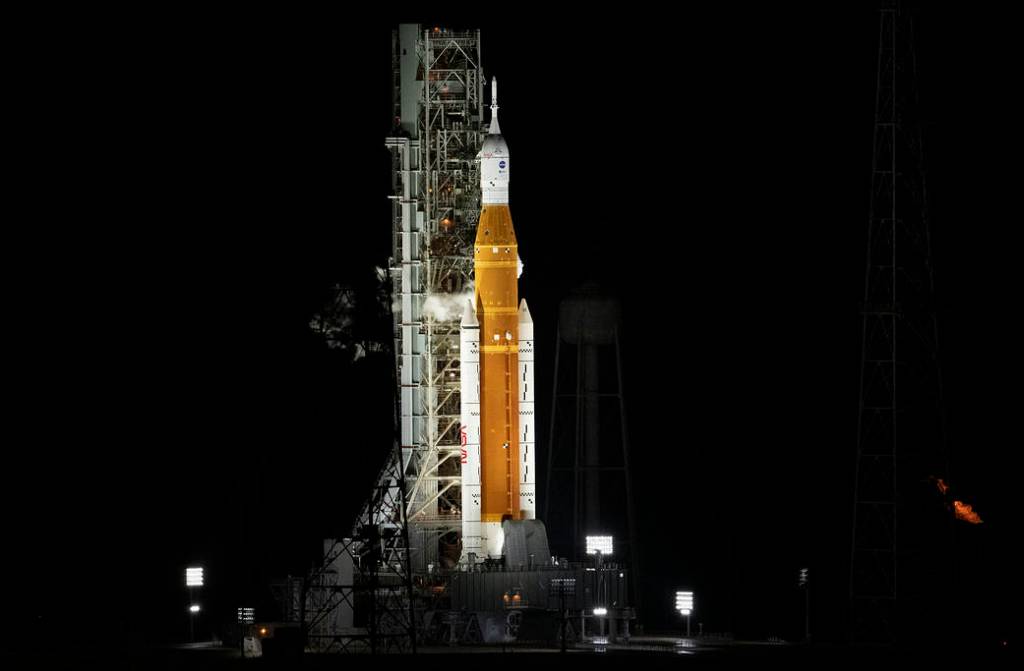
Image (Credit): The Space Launch System (SLS) rocket with the Orion spacecraft aboard is seen atop the mobile launcher at Launch Pad 39B, Monday, August 29, 2022. (NASA)
A recent Politico interview with NASA Administrator Bill Nelson covered old ground about the Chinese taking possession of the Moon and yet seemed to get some media play in the quiet post-holiday period. As I said, it is nothing new (see this earlier news clip) nor should it be a surprise. Yes, the U.S. is in a space race again, and it is a good thing. We needed the pressure in the 1960s and apparently we need it again today, 50 years after the last man stepped on the lunar surface.
For some reason, Administrator Nelson has a thousand excuses for why the Chinese may get to the Moon first – the Orion capsule from Artemis I needs to be reused for Artemis II (which should be seen as a good thing, at least by those that want to reduce costs and increase efficiencies), the space suits may not be ready, SpaceX may need more time, and on and on. Get a grip, man!
And then the Administrator has this comment regarding Chinese behavior: “If you doubt that, look at what they did with the Spratly Islands.” That is not the only model available. One only needs to look the Outer Space Treaty to see that China and others have agreed not to make claims on the Moon. Another treaty worth viewing is the Antarctic Treaty that relates to real exploration on a cold, distant body. About 50 permanent active research stations representing 32 countries are already conducting science on Antarctica without issue. China, the U.S., Russia and others have shown that they can play well together.
So maybe we need less chest-pounding and more attention to the Artemis project at hand. The U.S. dropped the ball 50 years ago. It seems a little silly to get all upset now when other nations have shown an interest all these years later.
Image: Emblem represents the Antarctic Treaty System.
Image (Credit): The stellar nursery 30 Doradus, nickname of the Tarantula Nebula, captured by the James Webb Space Telescope. (webb.nasa.gov)
Given that 2022 was a busy year, I thought I would highlight the top astronomy stories on the site – the good and the bad covering space missions to TV shows. Unlike other websites, I waited until the new year to create the list just in case we were visited by extraterrestrials. In this way, we now have a full catalog of the 2022 happenings.
Here is the list in no particular order other than science first, politics and commercial space second, and entertainment third.





 Our Awesome Universe