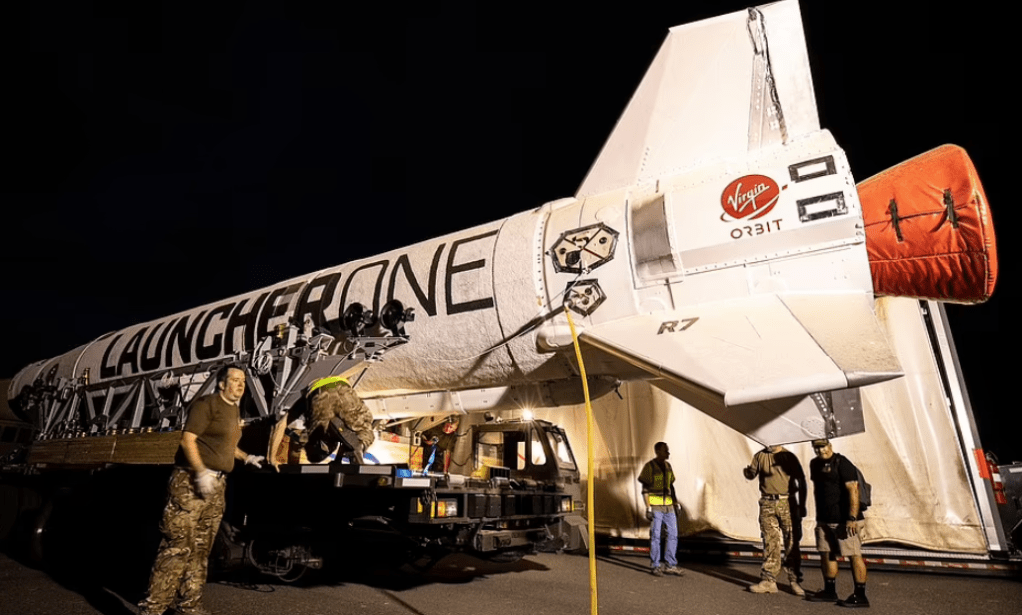
Image (Credit): LauncherOne rocket after arriving in Cornwall, England. (UK Space Command)
Later this year, the United Kingdom (UK) is getting into the commercial space business with Virgin Orbit’s launch of the LauncherOne rocket. The 70-foot long rocket stuffed with a satellites will be loaded onto Virgin Orbit’s Boeing 747 (called the “Cosmic Girl”) for a mid-air launch. It will be the first satellite launch from the UK.
While the launch was planned for earlier this year, Virgin Orbit is still dealing with some bureaucratic delays. Nonetheless, the use of Space Cornwall is an achievement for the UK and Europe as they plan more space missions from the continent.
Late last year, the Guardian wrote about planned space missions from the UK. The article, “The Great British Race to Space,” highlights plans for rocket launches from England, Wales, and Scotland. For instance, B2Space in Wales has plans to launch rockets from a helium balloon floating 20 miles up. The balloon could save about 70 percent of fuel and other costs related to a typical satellite launch.
It seems reusable rockets are just one of many innovations for lowering the cost of satellite launches. Watch out, SpaceX.
Image (Credit): A test flight for the B2Space balloon. Picture: (B2Space)
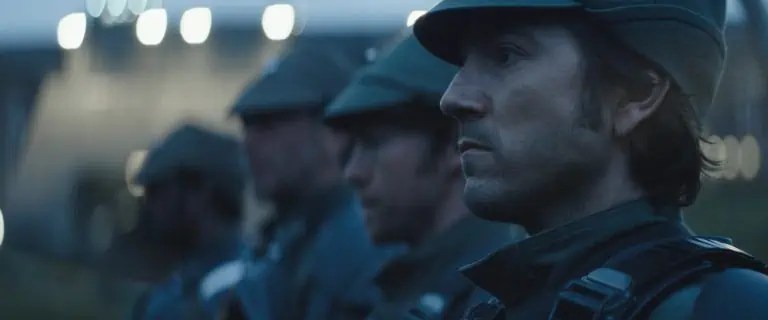
Image (Credit): Scene with Diego Luna from Star Wars: Andor. (Lucasfilm)
I am 10 episodes into Disney+’sStar Wars: Andor series and I love it. I am impressed that Disney+ finally dug a little deeper into the Star Wars material to find a new perspective, for now we get to see the Imperial bureaucracy in action.
This is the first of the four new live action Star Wars series that does not lean on the stars from the earlier movies – no Baby Yoda, Luke Skywalker, Princess Leia, Darth Vader, Tusken Raiders, or Jabba the Hutt. Instead, you get an original story, similar to how the Star Wars movie Rouge One took its own path.
Of course, the series has Storm Troopers, but they are there to lock down the period rather than becoming comic relief by allowing our “heroes” to blast away 50 of them at a time while coming away unharmed. Instead, the new series slowly kills off some of the heroes to demonstrate the true stakes involved.
The acting and dialogue is also much improved from earlier Star Wars iterations. Thankfully, Disney kept away from horrible Lucas-talk, never assuming that laser fights would cover over weak dialogue and a flimsy plot. Even the business side of Star Wars here is so much more interesting than the trade federation blather from The Phantom Menace. In Andor, the trade and smuggling is an important and believable thread carefully wound into the overall story.
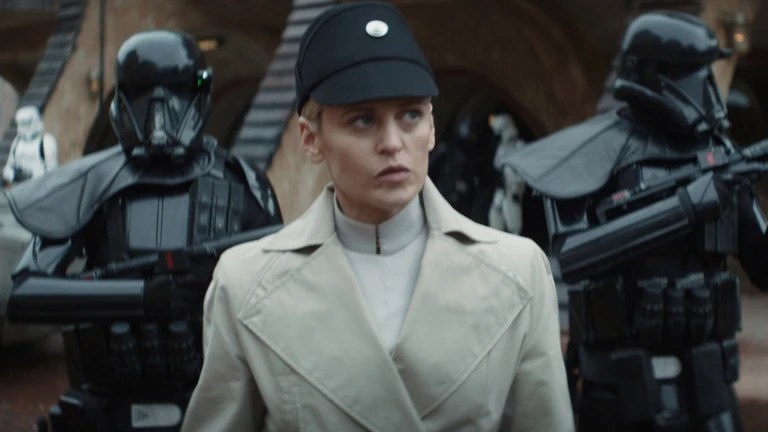
But best of all, Andor gives us an inside look at Imperial operations. Your massive, mind-numbing bureaucracy here represents a form of slavery within the machine doing the oppressing. The back-biting among the off-white-clad officers of the Imperial Security Bureau is fun to behold, even without a Darth Vader ending each meeting with someone being choked to death.
The Imperial “justice” system is another fascinating story line, showing how the Empire’s reaction to terrorist attacks leads to gang-pressing innocent citizens. It’s a perfect merging of Putin and a Tesla factory. All the while, political intrigue continues in the Senate and family dynamics are used as a poisonous glue.
This is not to say the series lacks action scenes. If you are looking for shootouts and space battles, they are in the story. But they assist the plot rather than being the main plot. Andor is about the people (software) behind the Empire more than the hardware.
I am not saying all of the spin-off series need to follow the Andor model. I’m just glad an Andor exists at all. It’s about time the adults had something to watch that meshes more with their reality – less flash, more angst. You can put Baby Yoda to bed with the kids and stay up late with Andor.
I look forward to watching the remaining two episodes of this season as well as the next and final season. I also ask Disney to keep the adults in mind as it develops more StarWars programs. You have an eager fan base.
Image (Credit): Scene with Denise Gough from Star Wars: Andor. (Lucasfilm)
Image (Credit): Challenger STS-51L crew members Michael J. Smith, front row left, Francis R. “Dick” Scobee, Ronald E. McNair; Ellison S. Onizuka, back row left, S. Christa McAuliffe, Gregory B. Jarvis, and Judith A. Resnik. (NASA)
“The crew of the space shuttle Challenger honored us by the manner in which they lived their lives. We will never forget them, nor the last time we saw them, this morning, as they prepared for their journey and waved goodbye and ‘slipped the surly bonds of earth’ to ‘touch the face of God.'”
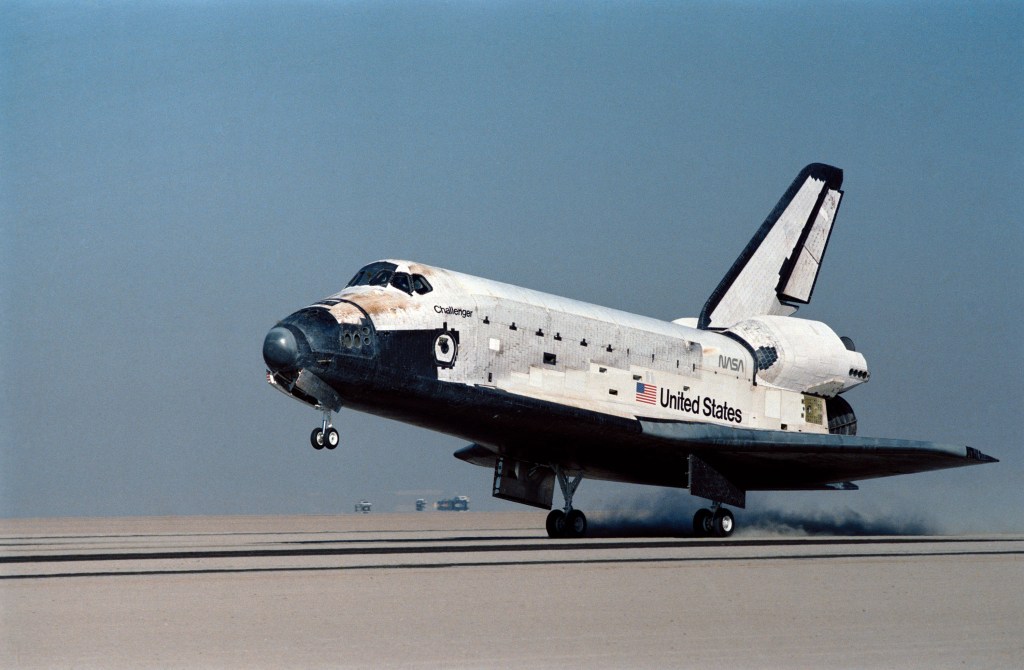
-Statement by President Ronald Reagan addressing the nation from the Oval Office at the White House on January 28, 1986 following the space shuttle Challenger disaster. It seems like a good time to remember the crew given the news this week about debris recovered from the space shuttle. You can find the entire White House address here.
NASA leaders recently viewed footage of an underwater dive off the East coast of Florida, and they confirm it depicts an artifact from the space shuttle Challenger. The artifact was discovered by a TV documentary crew seeking the wreckage of a World War II-era aircraft. Divers noticed a large humanmade object covered partially by sand on the seafloor. The proximity to the Florida Space Coast, along with the item’s modern construction and presence of 8-inch square tiles, led the documentary team to contact NASA.
China has completed a first hot fire test of a fully-assembled powerful new engine that could power new launch vehicles and boost the country’s space capabilities. The full system test of the 500-ton-thrust, dual nozzle kerosene-liquid oxygen staged combustion cycle engine took place on Nov. 5, marking a milestone for the rocket engine.
A Northrop Grumman capsule delivered several tons of supplies to the International Space Station on Wednesday despite a jammed solar panel. The shipment arrived two days after launching from Virginia. Only one of the cargo ship’s two round solar panels opened following liftoff. Flight controllers tried in vain to open the stuck panel, but managed to draw enough power for the flight with just one.
Image (Source): View of the Pacific from the ISS. More information provided below. (NASA)
This week’s image is from the International Space Station (ISS). It shows an October 1, 2022 photo of European Space Agency (ESA) astronaut Samantha Cristoforetti enjoying a view of the Pacific Ocean off the coast of Peru. She is sitting in the ISS’s so called “window to the world.” You can learn more about photo’s taken from this window via this short NASA video.