RIP: Astronaut James A. McDivitt

Image (Credit): Astronaut James A. McDivitt. (HUM Images/Universal Images Group via Getty Images)

Back on October 13th we lost another Apollo astronaut. James McDivitt, age 93, passed away in his sleep.

Mr. McDivitt, a veteran fighter pilot from the Korean War, was a key part of the Gemini and Apollo missions. Part of NASA’s second class of astronauts, he was commander of the Gemini IV mission in June 1965, which conducted the first U.S. space walk, as well as the commander of Apollo 9, which set the stage for astronauts to land on the Moon.

As Andy Weir, author of The Martian, stated, “Astronauts are inherently insane. And really noble.” We should all remember the noble work of Mr. McDivitt and his peers in the early space program.

For more on Mr. McDivitt’s life, you can visit this NASA press release as well as this Washington Examiner obituary.
Movie: Good Night Oppy

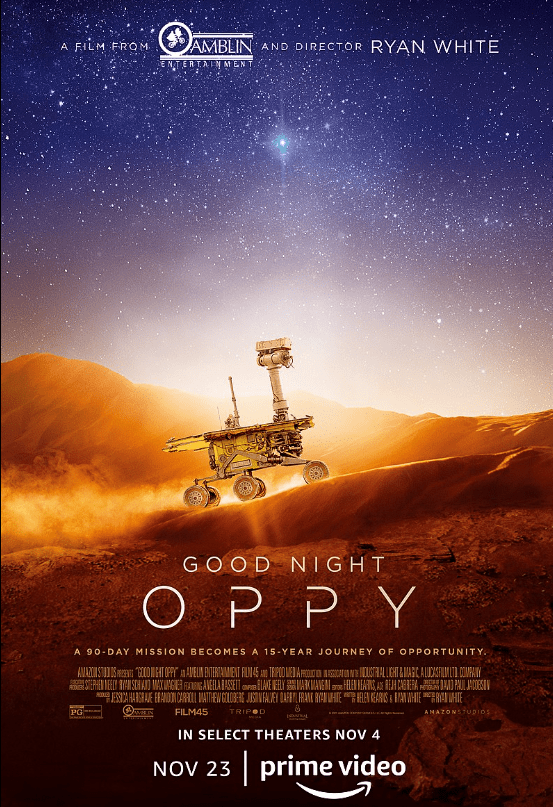
Image (Credit): Movie poster for Good Night Oppy. (Amazon Studies)

Here is a new space movie that should keep the crowds happy, and it is based on a true success – our mission to Mars. Good Night Oppy, produced by Amazon Studios, is the story of NASA’s Opportunity Mars rover. You can watch a preview here.

Amazon Studies has this preview:

Good Night Oppy tells the inspirational true story of Opportunity, a rover that was sent to Mars for a 90-day mission but ended up surviving for 15 years. The film follows Opportunity’s groundbreaking journey on Mars and the remarkable bond forged between a robot and her humans millions of miles away.

The film, narrated by Angela Bassett, has the same feel as the 1985 film The Dream is Alive, which was narrated by Walter Cronkite and covered the space shuttle missions. While one might claim these are simple feel good movies, I say spread the word about the space missions far and wide. We should be proud of what we have done as well as where we plan to go.

The film will be available in selected theaters today and on Amazon Prime November 23, 2022.

You can learn more about the Opportunity rover here, and its sister rover Spirit here.

Image (Credit): DVD cover of the firm The Dream is Alive. (Threshold Corporation)

Pic of the Week: Marian Dust Devils

Image (Credit): Dust devils swirling across Jezero Crater, as viewed by NASA’s Perseverance Mars rover. (NASA/JPL-Caltech/SSI)

This week’s image is from earlier this year when NASA’s Perseverance Mars rover captured whirling dust on the Red Planet’s surface. Here is more on the dust devils from NASA:

During its first couple hundred days in Jezero Crater, NASA’s Perseverance Mars rover saw some of the most intense dust activity ever witnessed by a mission sent to the Red Planet’s surface. Not only did the rover detect hundreds of dust-bearing whirlwinds called dust devils, Perseverance captured the first video ever recorded of wind gusts lifting a massive Martian dust cloud.

A paper recently published in Science Advances chronicles the trove of weather phenomena observed in the first 216 Martian days, or sols. The new findings enable scientists to better understand dust processes on Mars and contribute to a body of knowledge that could one day help them predict the dust storms that Mars is famous for – and that pose a threat to future robotic and human explorers.

“Every time we land in a new place on Mars, it’s an opportunity to better understand the planet’s weather,” said the paper’s lead author, Claire Newman of Aeolis Research, a research company focused on planetary atmospheres. She added there may be more exciting weather on the way: “We had a regional dust storm right on top of us in January, but we’re still in the middle of dust season, so we’re very likely to see more dust storms.”

Space Stories: A New Martian Crater, the Final Piece of China’s Space Station, and the Falcon Heavy Flies Again

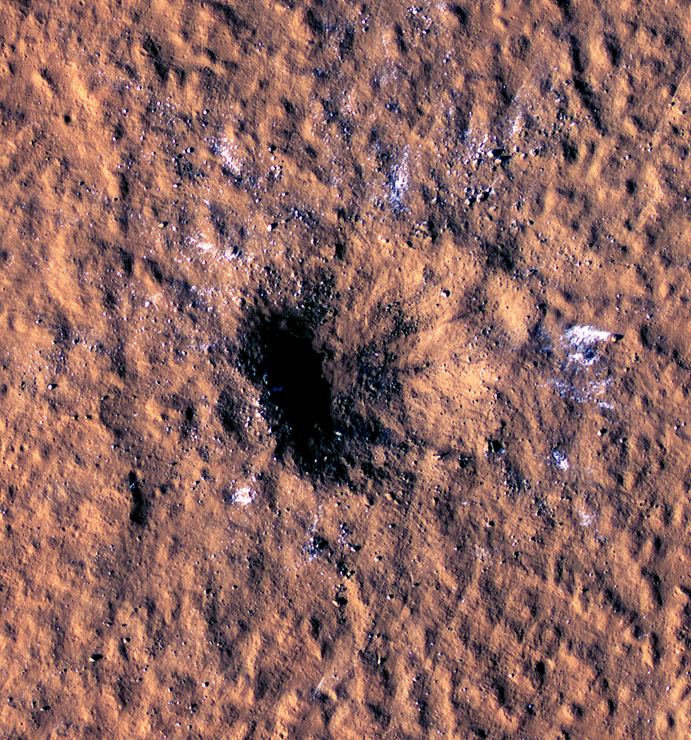
Image (Credit): Recent impact crater on the surface of Mars. It was formed on December 24, 2011 in the Amazonis Planitia region. (NASA/JPL-Caltech/University of Arizona)

Here are some recent stories of interest.

—NASA: “NASA’s InSight Lander Detects Stunning Meteoroid Impact on Mars“

NASA’s InSight lander recorded a magnitude 4 marsquake last Dec. 24, but scientists learned only later the cause of that quake: a meteoroid strike estimated to be one of the biggest seen on Mars since NASA began exploring the cosmos. What’s more, the meteoroid excavated boulder-size chunks of ice buried closer to the Martian equator than ever found before – a discovery with implications for NASA’s future plans to send astronauts to the Red Planet.

—Aljazeera: “Final Module Docks at China’s ‘Heavenly Palace’ Space Station“

The final module required for the completion of China’s Tiangong space station has successfully docked with the core structure, state media say, a key step in Beijing’s ambitious plans for space exploration…The module – named Mengtian, which means “heavenly dream” – was launched on Monday on a Long March 5B rocket from the Wenchang launch centre on China’s tropical island of Hainan, CCTV reported.

—Wall Street Journal: “SpaceX’s Falcon Heavy Rocket, World’s Most Powerful Rocket, Launches After Three-year Hiatus“

SpaceX’s Falcon Heavy — a towering, three-pronged vehicle that is the most powerful operational rocket in the world — returned to the skies on Tuesday for the first time since mid-2019. The rocket launched at 9:41 a.m. ET from NASA’s Kennedy Space Center in Florida, hauling satellites to space for the US military in a secretive mission dubbed USSF-44.

Look Up, Again: An Asteroid is Really Coming

Image (Credit): Artist’s version of the Chicxulub crater at the time of the meteorite’s impact. (NASA)

Yes, you have heard it all before – a “planet killer” asteroid is coming our way. Well, in this case it appears to be true, but the 1.1km to 2.3km asteroid will only cross our path rather than hit us, at least for now.

The asteroid, named the ever-boring 2022 AP7, is among the top 5 percent of the potentially hazardous asteroids ever found.’

Scott Sheppard from the Carnegie Institution for Science, and one of the authors of a recent paper on 2022 AP7, stated in The Guardian:

Any asteroid over 1km in size is considered a planet killer…The Earth’s surface would likely cool significantly from sunlight not getting to the planet. It would be a mass extinction event like hasn’t been seen on Earth in millions of years.

Fortunately, we should have a few centuries to watch this asteroid before we start worrying about a collision.

Let’s hope we have a Super DART spacecraft sweeping the solar system by then keeping us clear from this asteroid and any other.

And now back to our regularly scheduled programming.