Take a look at the image above. Can you determine where this image originated? Take a guess and then check your answer by going to the menu and selecting the “Where is This? The Answer Sheet” page.

Take a look at the image above. Can you determine where this image originated? Take a guess and then check your answer by going to the menu and selecting the “Where is This? The Answer Sheet” page.

October 1 is a significant date for two of the world’s largest space agencies.
On this day in 1958, NASA had its first day of operations after being created a few months earlier by President Eisenhower in the National Aeronautics and Space Act of 1958. Here is more about the creation of the Agency as noted by NASA’s History Division:
On this date the National Aeronautics and Space Administration began operation. At the time it consisted of only about 8,000 employees and an annual budget of $100 million. In addition to a small headquarters staff in Washington that directed operations, NASA had at the time three major research laboratories inherited from the National Advisory Committee for Aeronautics-the Langley Aeronautical Laboratory established in 1918, the Ames Aeronautical Laboratory activated near San Francisco in 1940, and the Lewis Flight Propulsion Laboratory built at Cleveland, Ohio, in 1941-and two small test facilities, one for high-speed flight research at Muroc Dry Lake in the high desert of California and one for sounding rockets at Wallops Island, Virginia. It soon added several other government research organizations.
Today NASA has a budget of about $24 billion and approximately 17,000 employees.
And on this day in 2003, the Japan Aerospace Exploration Agency (JAXA) was formed from a merger of three previous Japanese space agencies – the Institute of Space and Astronautical Science, the National Aerospace Laboratory of Japan, and National Space Development Agency of Japan.
Here is more information about JAXA today:
With about 1,500 staff, JAXA carries out the following main activities:


The Washington Post reports that NASA and SpaceX are looking into the idea of extending the life of the NASA/ESA Hubble Space Telescope, which has already been in service more than 30 years. The space telescope’s orbit has been deteriorating since 2009, when it was last visited for repairs. The current orbit should be okay until the mid-2030s, and then it will fall to Earth.
To keep the Hubble in service for even more years, it would need to be pushed into a higher orbit. This is where SpaceX comes in. It can assist NASA by moving Hubble just 40 miles higher in order to get another 15 to 20 years out of the space telescope.
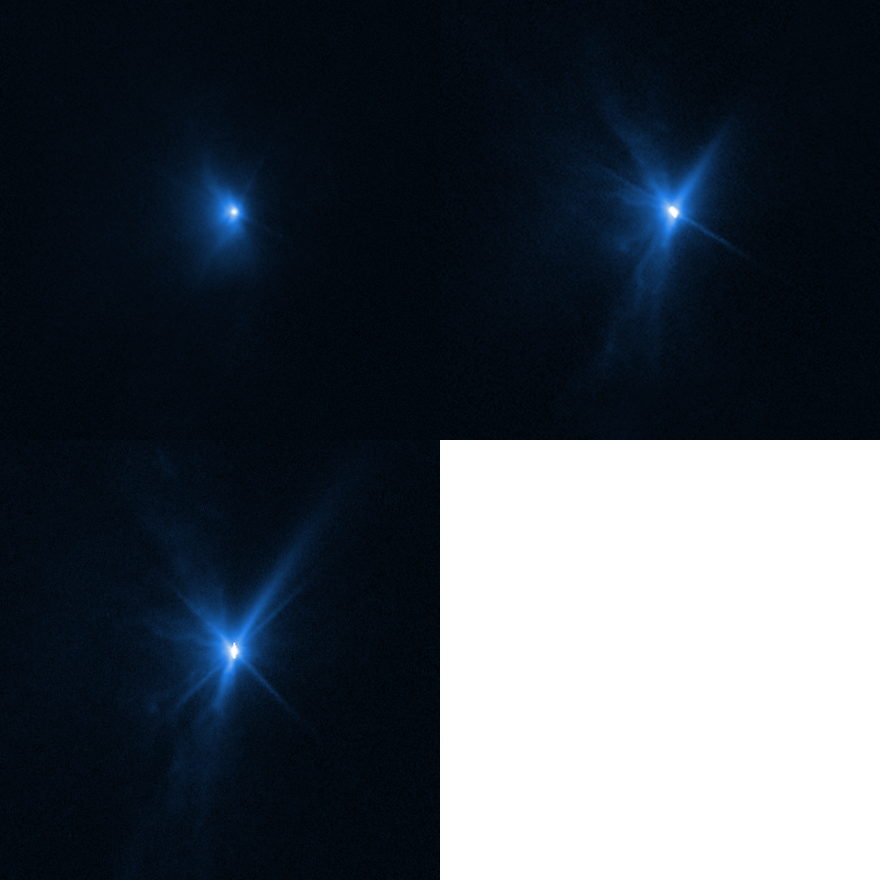
The article notes that the James Webb Space Telescope (JWST) was not developed to replace Hubble but rather to complement it. Hence, the extra life for Hubble means more and better astronomical observations over additional years in conjunction with the JWST. For instance, we will get more shots like the one below where the Hubble captured the Double Asteroid Redirection Test (DART) mission before and after it struck the asteroid.
Update: I have also included the JWST DART image below just to show the two space telescopes can work in tandem.
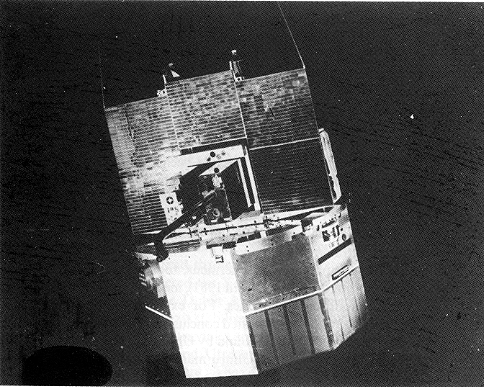
On this day in 1971, NASA launched the Orbiting Solar Observatory 7 satellite to study the Sun. It successfully completed its mission and remained in orbit through July 9, 1974.
According to a December 31, 1972 report by Ball Brothers Research Corporation, the goal of the Orbiting Solar Observatory program was to make observations and measurements contributing to:
You can read more about the Orbiting Solar Observatory 7 mission here.
NASA launched eight successful Orbiting Solar Observatory missions in all, but the program had some problems along the way. One satellite launched in 1965 failed to reach orbit, with the satellite burning up in the atmosphere. In another case, a rocket motor test in 1964 went awry, killing three men and wounding eight others.

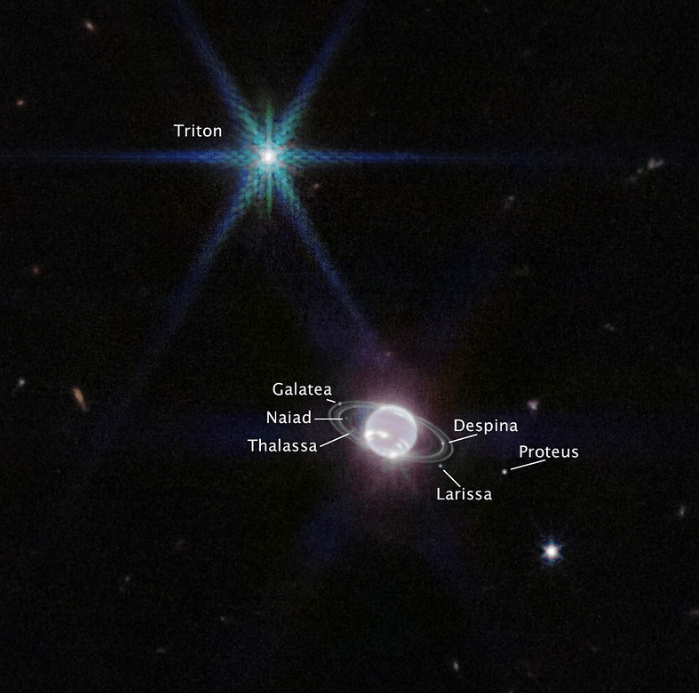
This week’s image is from the James Webb Space Telescope (JWST). It clearly shows the rings of Neptune as well as a number of its moons (the image below is a broader shot labeling those moons). It is an impressive shot by the JWST within our solar system, similar to the space telescope’s recent image of Jupiter.
Here is more about the image from NASA:
In this Webb image, Neptune resembles a pearl with rings that look like ethereal concentric ovals around it. There are 2 thinner, crisper rings and 2 broader, fainter rings. A few extremely bright patches on the lower half of Neptune represent methane ice clouds. Six tiny white dots, which are six of Neptune’s 14 moons, are scattered among the rings. The background of the image is black.
The Neptune image was uploaded to the NASA website on September 21, just a few days shy of the actual date in the calendar when Neptune was observed for the first time ever – September 23. The year was 1846 and the observer was German astronomer Johann Galle.