Television: Check Out Strange New Worlds

Credit: Paramount.

Tonight is the premiere of Star Trek: Strange New Worlds. If you are a Trekkie, then there is nothing strange about Captain Pike and the earlier adventures of the U.S.S. Enterprise. We have been waiting for the rest of the story since Star Trek appears in 1966.

You probably already saw Captain Pike in the second season of Star Trek: Discovery, but now it will be all Pike all the time. The most recent trailer is proof that you an expect a return to the fun early days was more like James Bond than the more serious captains that came later. The actors engaged with this series are top notch: Anson Mount as Captain Christopher Pike, Rebecca Romijn as Number One, and Ethan Peck as Science Officer Spock.

Yes, there are multiple Star Trek series now playing on Paramount, as one could also say about the Star Wars series on Disney+. And yet, with Star Trek each one has its place and time that makes plenty of sense without any overlapping confusion. I am not sure whether we really needed a movie on the origins of Han Solo, but the original adventures of Captain Pike seems like a void that needed to be filled.

I would even forgo more Star Trek movies as long as we can have quality television series. Beside, the movies blew apart the time line (creating the Kelvin Timeline), so I have less interest in what they have to say these days even though that bastardized timeline has infected the timeline in Star Trek: Discovery. Don’t get me started.

Image (Credit): The pre-Kirk crew of the U.S.S. Enterprise. (Paramount)

Pic of the Week: Comet Over Stonehenge

Image/(Credit): Comet Neowise as seen flying over Stonehenge. (James Rushforth)

This week’s photo is from photographer James Rushforth who caught Comet Neowise over Stonehenge. The comet was discovered by astronomers on March 27, 2020 during the NEOWISE mission of the Wide-field Infrared Survey Explorer (WISE) space telescope

Mr. Rushforth’s photo was one of about 4,500 photos entered into the 2021 annual Royal Observatory Greenwich astronomy photography competition. His image above made the shortlist. You can see other shortlisted entries here. The winning entry, announced last September, is shown below.

Image/(Credit): Titled “The Golden Ring,” the image shows an annular solar eclipse taken in the Ali region of Tibet on June 21, 2020. (Shuchang Dong)

A Day in Astronomy: Lunar Orbiter 4

Image (Credit): An artist’s image of NASA’s Lunar Orbiter at the Moon. (NASA)

On this day in 1967, NASA launched Lunar Orbiter 4 to continue a survey of the Moon (also conducted by three previous Lunar Orbiter missions) in preparation of the Apollo Moon missions. While NASA lost contact with the spacecraft on July 17th, the mission was a success. On October 6th, the spacecraft crashed onto the Moon’s surface. A total of five such missions were conducted, which mapped 99 percent of the Moon.

The rest is history with the successful Apollo missions, still the only program to land humans on the Moon. We shall see who follows in our footsteps, though we will be back on the Moon soon enough as part of the Artemis Program.

You can read more about the Lunar Orbiter missions at this NASA history link. The conclusion on the Lunar Orbiter missions states:

On September 2 Homer E. Newello Associate Administrator for Space Science and Applications, certified that the fifth mission was an unqualified success according to prelaunch objectives. Deputy Administrator Robert C. Seamans, Jr., concurred on September 6. Both NASA officials also assessed the whole program as successful; five missions had been flown out of five planned. Indeed the final Orbiter had capped an impressive effort by the Office of Space Science and Applications to bring man closer to stepping down upon the lunar soil and understanding where it was that he would be landing in the near future…

Five Orbiters had enabled the Manned Space Flight Network to train personnel in tracking and to check out equipment and computer programs for the manned lunar missions beginning with Apollo 8 in December 1968 and including Apollo 10 through 17, of which all but Apollo 10 and 13 landed on the Moon. (Apollo 10 tested the complete spacecraft in lunar orbit and Apollo 13 aborted its landing mission because an onboard oxygen tank exploded in cislunar space.) The Office of Manned Space Flight could not have obtained the needed tracking experience at a timely date if NASA had not flown the five Lunar Orbiter spacecraft.

Another Member of the Reusable Rocket Club

Credit: Rocket Lab

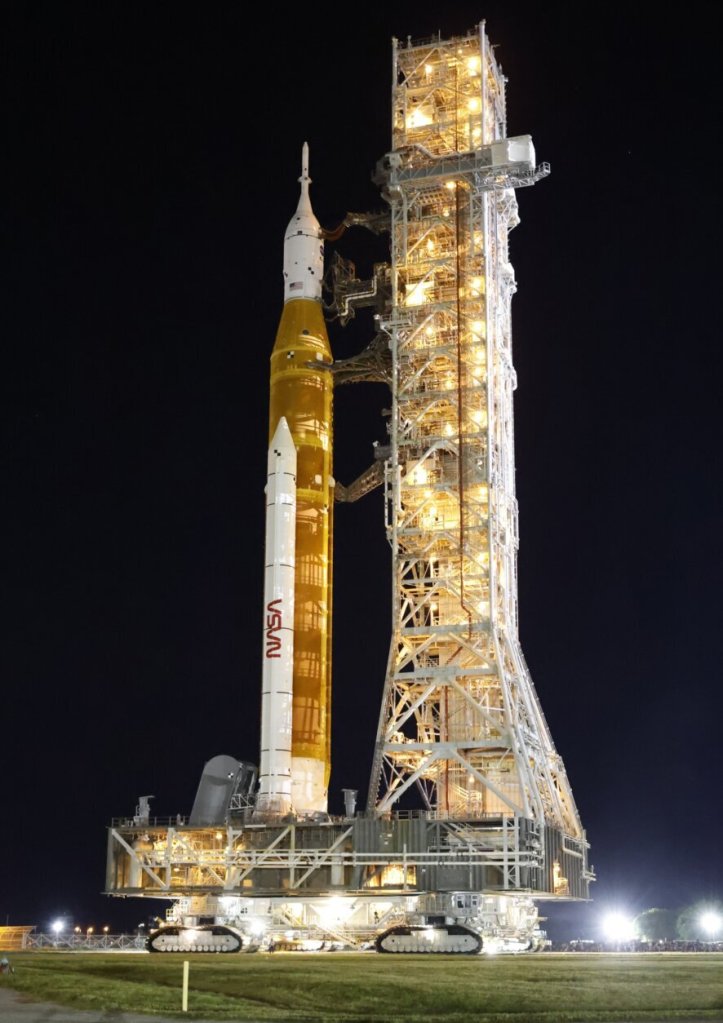
Blue Origin did it, SpaceX did it, and now Rocket Lab wants to do it. The “it” is to successfully retrieve rocket boosters so they can be reused in the future. Back on April 6th, Rocket Lab stated:

For the first time, Rocket Lab will also attempt a mid-air capture of Electron’s first stage as it returns from space after launch, the next major step in the Company’s development program to make Electron a reusable rocket. Rocket Lab will be attempting the catch with a customized Sikorsky S-92, a large twin engine helicopter typically used in offshore oil & gas transport and search and rescue operations.

According to CNN, after a few delays the Rocket Lab mission called “There and Back Again” was successful in grabbing the rocket booster. Time will tell whether the captured booster is in fact reusable. As of this posting, Rocket Lab had yet to post its own press release on the mission.

It seems like a risky approach to use pilots rather than a self-controlled landing, but Rocket Lab has explained that its Electron rocket is too small to carry the amount of fuel necessary to land itself. The CNN article also pointed out that the U.S. retrieved material mid-air in the past when planes were used to capture film canisters dropped from spy satellites.

Rocket Lab has been a quiet player so far in the space race, but its showing steady gains. It’s website stated it has already launched 146 satellites, and another 1,700+ satellites in orbit are using Rocket Lab technology. It is great to have some depth in the commercial space market.