Image (Credit):Star Trek panel at the San Diego Comic Con in July 2022. (Films that Rock)
This week’s image shows Patrick Stewart (Captain Picard) and Gates McFadden (Dr. Beverly Crusher) discussing Star Trek at the 2022 Comic Con in San Diego, CA. You can watch the full panel discussion here. You can also watch the season three (and final season) trailer for Star Trek: Picardhere, indicating our favorites from The Next Generation will be returning one more time.
If you are looking for a heavy story, just listen into this week’s StarTalk podcast, “Nuclear Winter with Ann Druyan and Brian Toon.” You can hear all about the Future of Life award given to Carl Sagan and others for “reducing the risk of nuclear war by developing and popularizing the science of nuclear winter.” Yes, a great award for a bleak topic.
Ann Druyan (co-writer of the original Cosmos TV series, producer of the remade Cosmos, and Carl Sagan’s wife) and Brian Toon (Atmospheric Science Professor and one of the awardees) discuss the science that went into the nuclear winter idea back in the 1970s, as well as later briefings of the Vatican and Soviet government. Sadly, it appears the Russian’s were more open to the science than the Americans. Dr. Sagan and others battled with many leaders in the U.S. Government. Some things don’t change (or don’t change fast enough), so this battle within the U.S. Government continues. Of course, Putin is no Gorbachev, so who knows that he is thinking.
In other words, the United States has built and is building launch sites for nuclear missiles on the Russian border. This fact has been widely reported on Russian TV and has infuriated the Russian public. In June, Russian President Putin specifically warned that Russia would be forced to retaliate against this threat.
While Russian officials maintain that its actions are normal and routine, Russia now appears to be preparing for war. On October 5, 2016, Russia conducted a nation-wide civil defense drill that included 40 million of its people being directed to fallout shelters. Reuters reported two days later that Russia had moved its Iskander nuclear-capable missiles to Kaliningrad, which borders Poland.
Of course, our ability to survive as a civilization is a big part of the Drake Equation, which tells us the number of planets in the galaxy hosting intelligent life. So far, we are the only planet with intelligent life that we know about, and we cannot even agree whether launching a nuclear war will end our civilization. It is not a hopeful start to the quest for intelligent life.
Image (Credit): Antares rocket on the launch pad. (Northrop Grumman)
Northrop Grumman is switching from Russian-made rocket engines to U.S.-made rocket engines for its Antares rocket ships that bring supplies to the U.S. International Space Station (ISS). Russia has not shipped any engines since March following its invasion of Ukraine, so Northrop Grumman needs an alternative. It can fly two more missions with the Russian-made rockets in its inventory.
Firefly’s propulsion technology utilizes the same propellants as the current Antares rocket, which minimizes launch site upgrades. The Antares 330 will utilize seven of Firefly’s Miranda engines and leverage its composites technology for the first stage structures and tanks, while Northrop Grumman provides its proven avionics and software, upper-stage structures and Castor 30XL motor, as well as proven vehicle integration and launch pad operations. This new stage will also significantly increase Antares mass to orbit capability.
Fortunately, we have some redundancy in ISS cargo missions, with SpaceX able to pick up slack as necessary. In fact, Northrop Grumman will be contracting with SpaceX to handle three of its missions as it prepares for the new Antares system for mid-to-late 2024.
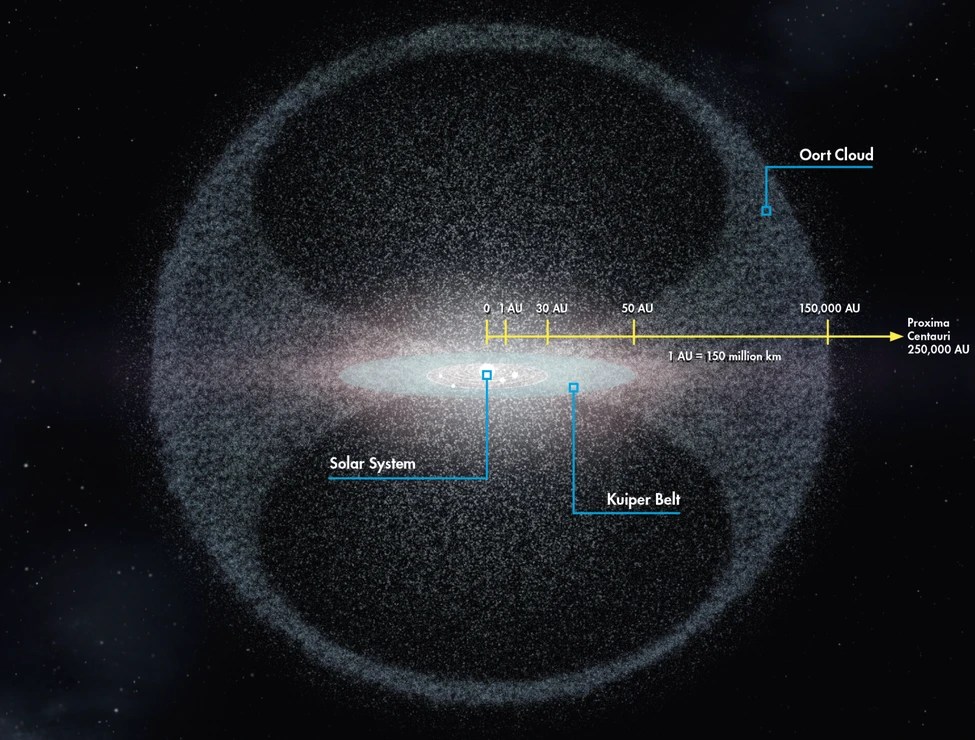
While NASA does not have any plans to send a specific missions to study the Oort Cloud, the most distant region in our solar system containing trillions of frozen objects, it has already sent five spacecraft in that direction. Two Voyager spacecraft, two Pioneer spacecraft, and the New Horizons spacecraft are all heading that way, but it is quite a distant.
For example, the Voyager spacecraft will not hit the Oort Cloud for another 300 years and will continue to travel through the cloud for another 30,000 years before escaping the solar system. As a result, all of these spacecraft will be dead as a rock before ever hitting that region and of no use to anyone back here, yet they will still carry messages from all of us to the stars. So in that sense, they still have a mission to perform should anyone be out there.
The Oort Cloud is still a theory since it has not been observed, but there is plenty evidence regarding its existence, including the comets that come into the center of our solar system from that region. The cloud itself is believed to be a sphere rather than on the same plane as the planets, so it forms a protective ring around the planets potentially becoming a hazard to any incoming or outgoing spacecraft. What this will mean for interstellar space travel, should that day come, is anyone’s guess at this point.
Image (Credit): The new James Webb Space Telescope Forever stamp. (U.S. Postal Service)
“It is like humanity just got a brand-new pair of eyeglasses for the distant universe…We are suddenly seeing that those green areas on the tops of trees are actually made of thousands of individual leaves. We suspected it, but we are now seeing it for the first time.”