Should We Name the Moon’s New Crater After Mr. Musk?

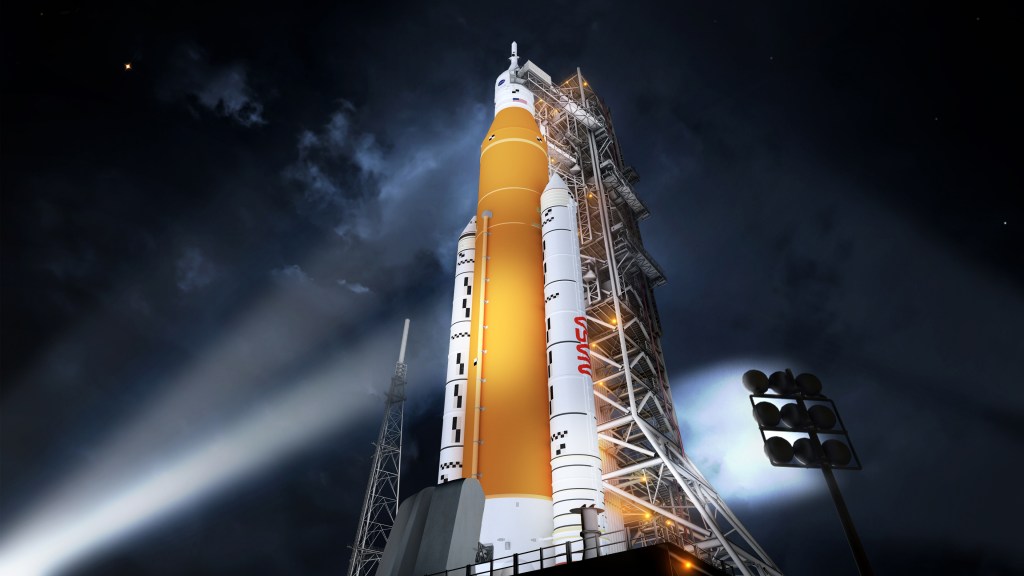
Source: SpaceX Rocket from NASA.

In the early days of March, a SpaceX rocket booster is expected to crash into the surface of the Moon just north of its equator. Part of a rocket launched in 2015, the booster has been floating around ever since.

In general, the Moon has not been used for trash storage beyond the lunar missions. Moreover, SpaceX likes to be known for landing its boosters back on Earth rather than sending them off into the wild blue (or black) yonder.

This could be an opportunity for SpaceX to claim it has created one of the first unintentional man-made craters on the Moon. The small crater could be known as the Musk Mini-Basin.

Luckily, Mr. Musk’s Tesla Roadster, launched in 2018, made it past the Moon with little incident (and then overshot Mars). We did not need an Elon Musk Parking Lot on the moon, yet the little red car would have been quite a sight for NASA’s Lunar Reconnaissance Orbiter (LRO).  

Source: LRO from NASA.

Extra: Visit this Sky & Telescope story for LRO images of the six Apollo landing sites on the Moon.

Update: Recent news indicates that the object about to hit the Moon is not a SpaceX rocket booster but rather a Chinese rocket part from the Long March 3C that launched the Chang’e 5-T1 lunar mission. I guess we will need to rethink the naming of that new crater.

Follow-up: Other Anti-Satellite Tests

Source: Indian Space Research Organization.

In an earlier posting, I pointed out that both China and Russia have left debris in orbit after conducting anti-satellite tests. To be fair, they are not alone. Back in March 2019, India also blew up one of its satellites with a ground-based missile, spreading debris and jeopardizing its own space program as well as that of others. Luckily, the explosion happened at a height that does not threaten the International Space Station or the majority of satellites in orbit. Moreover, most of the pieces of debris were expected to burn up and disappear quickly.

There have been other such anti-satellite missions as well, with the U.S, Russia, and China in the lead. So who started all of this, you may ask. The same Forbes story cited above makes it clear that the U.S. began this space arms race more than 60 years ago:

The U.S. tested its first anti-satellite missile in 1959, when the space lanes were mostly empty. Russia followed suit in the late 1960s and early 1970s, but after the end of the Cold War, space warfare mostly fell off the defense policy radar. 

The radar is active again given the continuing series of destructive anti-satellite missions in Earth’s orbit. You can add to this the various other secret spacecraft believed to already be in orbit to enhance each nation’s ability to kill another nation’s satellites. Things are pretty ugly on the ground these days, and the heavens above seem to be fair game as well.

Pic of the Week: Jupiter and the Juno Spacecraft

Source: Jupiter image from NASA.

The image above was taken by NASA’s Juno spacecraft on June 8, 2021. You can watch the full flyby video here that starts with the Juno spacecraft going past Jupiter’s moon Ganymede on June 7, 2021 before moving onto Jupiter. The violence of the storms in Jupiter’s atmosphere are smoothed into the beautiful giant marble we see from a great distance.

Launched by NASA in 2011, Juno’s goal is to improve our understanding of the solar system’s beginnings by revealing the origin and evolution of Jupiter. With its primary mission completed last July, the spacecraft will continue to operate through at least 2025 by continuing to observe Jupiter, its rings, and its moons.

Sidebar: Naming the James Webb Space Telescope

Source: James Webb Space Telescope from NASA.

Now that the James Webb Space Telescope (JWST) is settling in at its new location 1 million miles away, we will be hearing that name for at least a decade every time NASA has new findings related to distant planets. It is worth noting that some people are not so pleased with the spacecraft’s designated name.

A recent article in Scientific American magazine highlighted some resistance to allowing former NASA administrator James Webb’s name to be part of the new space telescope. In the article, “NASA Won’t Rename the James Webb Space Telescope—and Astronomers Are Angry,” we are told that more than 1,200 individuals, “including scientists,” signed a petition asking for a new name. The petition stated that Mr. Webb was in key government positions during a period when gay and lesbian federal employees were fired due to their sexual orientation.  NASA later reported it did not have any evidence to support such a name change and considered the matter closed.

I will admit that I liked the name Hubble for the space telescope being replaced by the JWST. It seemed appropriate to name the telescope after Edwin Hubble, who proved there were galaxies beyond our Milky Way. That is an impressive accomplishment, whereas Mr. Webb was a successful Washington bureaucrat. Maybe another scientist would have been more appropriate.

That said, getting space programs funded is no easy task, so even if they want to name a space telescope after a U.S. Senator I will not issue an objection if that senator can get the job done. And let’s remember that we do have many perfect people for naming rights. Even Edwin Hubble, for all of his great accomplishments, was under a cloud of suspicion regarding a questionable redaction of part of a translation of George’s Lemaître’s 1927 paper that first reported what is today know as Hubble’s Law. While Hubble was eventually cleared of any questionable deeds, had it been raised at the time NASA was naming the space telescope it could have become an issue.

You may recall that NASA has used other questionable names for its missions in the past. For example, the god Apollo has many misadventures involving innocent women. Just ask Cassandra. And Mercury was far from innocent. The pesky god was known for rape and even Pandora’s Box. For some reason, I do not believe any of the gods would pass the test today.

Source: “Pandora” by Charles Edward Perugini, 1839-1918.

Podcast: Interview with William Shatner

Source: Etonline.com.

On this week’s StarTalk Radio podcast, Neil deGrasse Tyson interviewed William Shatner (aka Captain Kirk) about his acting career and recent trip into space on a Blue Origin rocket. If you saw the Amazon Prime show called Shatner in Space, you have seen the Blue Origin drama (or the infomercial, if you prefer). In his chat with Dr. Tyson, you learn more about this short voyage, including his reluctance to go on the second rocket trip rather than the first, his uneasy stomach once in space, and the travails of being the oldest “astronaut.”

It is always fun to hear from the man who helped to create a growing interest in space travel from his first days as Captain James T. Kirk on Star Trek back in the mid-1960s. We need both scientists and science fiction to keep the dream alive. And just as Neil deGrasse Tyson has stepped into the shoes of Carl Sagan on Cosmos, we have seen Patrick Stewart’s Captain Picard and others step into the shoes of Mr. Shatner on Star Trek. Hopefully, we can continue to create such spirited pairings in the years to come.

Source: iHeart.com.