The Future of Mauna Kea and its Telescopes

Image (Credit): Observatories on Mauna Kea in Hawaii. (EastVillage Images/Shutterstock)

Finding the right place to build a telescope is crucial in a time of growing cities and brighter skies, which is why the telescopes atop of Mauna Kean in Hawaii are a great resource. Is that about to change? It is not clear, but a Hawaiian State bill is attempting to transfer ownership of the site. Here is a summary of House Bill 2400:

Establishes the Mauna a Wakea stewardship authority as the sole authority for management of state-managed lands on Mauna a Wakea. Requires the authority to develop a single plan that dictates the management of land uses; human activities, uses, and access; stewardship; education; research; disposition; and overall operations. Requires the authority to develop a framework to limit astronomy development on Mauna a Wakea. Allows the authority to prohibit certain commercial use and activities on Mauna a Wakea. Requires an application and fee for all recreational users of Mauna a Wakea. Establishes the Mauna a Wakea management special fund. Repeals the Mauna Kea lands management special fund. Appropriates funds.

The telescopes have been the subject of debate among Native Hawaiians who do not want to see more construction on the mountain, nor like what is already there. The land beneath the multiple observatories is under lease from the state of Hawaii’s Board of Land and Natural Resources (BLNR) and administered by the University of Hawaii. In 1968, BLRN provided a 65-year lease to the University of Hawaii. The bill is looking to change this arrangement by creating a new authority to oversee the use of the land. The astronomy community is generally against this bill as it would add to restrictions on the use of the land and put control of the site primarily into the hands of parties opposed to the telescopes.

The bill follows the completion of a working group study on the matter. The expectation among many in the community has been that the mountain would eventually be returned to its natural state. The working group study makes this clear: “All observatories on Mauna a Wākea shall plan for and finance their decommissioning process as a condition for any lease on Mauna a Wākea.”

Will the approved House bill pass the full Senate? That’s a whole other matter, though it has been approved by a number of committees. Only time will tell if astronomy will die a slow death on a mountain top.

What is the Galileo Project?

After mentioning this organization in a previous post, I thought I would look a little further at its work. The Galileo Project was set up for one purpose:

…to bring the search for extraterrestrial technological signatures of Extraterrestrial Technological Civilizations (ETCs) from accidental or anecdotal observations and legends to the mainstream of transparent, validated and systematic scientific research. This project is complementary to traditional SETI, in that it searches for physical objects, and not electromagnetic signals, associated with extraterrestrial technological equipment.

I do not see the acronym ETC very often, but maybe like SETI it will become commonly known someday. It certainly sounds more sophisticated than terms such as UFO or Unidentified Aerial Phenomena (UAP) as it looks for “technological equipment,” aka spacecraft. The ‘Oumuamua interstellar object is the first potential ETC that helped to stimulate this group.

The Project’s three areas of activity are:

  1. Obtain High-resolution, Multi-detector UAP Images, Discover their Nature;
  2. Search for and In-Depth Research on ‘Oumuamua-like Interstellar Objects; and
  3.  Search for Potential ETC Satellites.

For instance, the third area of activity discusses using telescopes to discover “…potential 1 meter-scale or smaller satellites that may be exploring Earth, e.g., in polar orbits a few hundred km above Earth…”

We are no longer talking about listening for signals from another planet or monitoring distant objects rolling through our solar system, but instead searching for Earth-focused intelligence gathering by a distant civilization. Where is the Jodie Foster movie for this one?

Space Quote: Keeping an Open Mind

Image (Credit): An artist’s rendering of ‘Oumuamua. (European Southern Observatory / Science Photo Library)

“Human history is very often driven by a group of people feeling superior to another group of people. If we find that we are not the smartest kid on the cosmic block, it will give us a different perspective. All the differences between humans will become irrelevant.”

-Harvard University Professor Avi Loeb quoted in the Independent discussing his search for extraterrestrial life and his new effort called The Galileo Project. His book,  Extraterrestrial: The First Sign of Intelligent Life Beyond Earth, on the the mysterious object ‘Oumuamua that visited our solar system has caused quite a stir.

Cosmonauts Arrive at the International Space Station

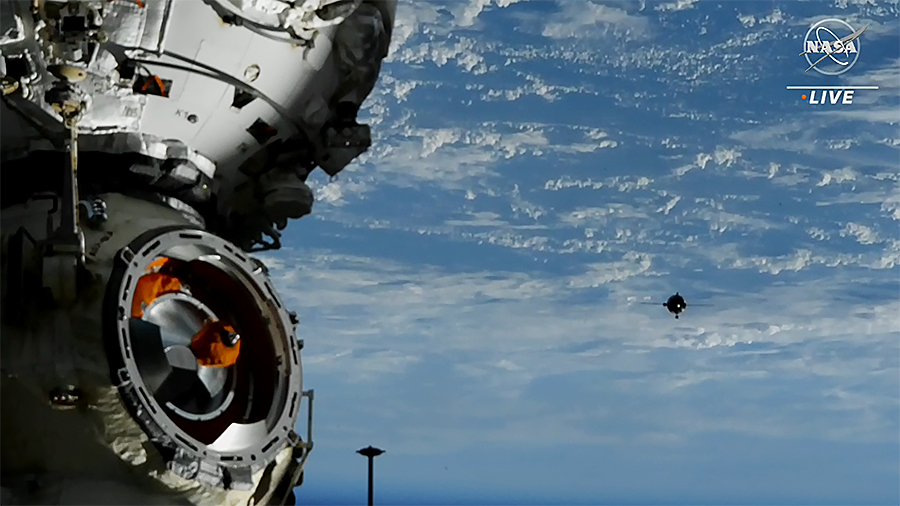
Image (Credit): The Soyuz MS-21 crew ship with three cosmonauts aboard approaches the International Space Station. (NASA)

On Friday, a Soyuz space capsule arrived at the International Space Station (ISS) with three Russian cosmonauts –  Oleg Artemyev, Denis Matveev, and Sergey Korsakov. This will bring the ISS crew to 10. On March 30th, three crew members will return to the surface of the Earth – NASA astronaut Mark Vande Hei and Russian cosmonauts Pyotr Dubrov and Anton Shkaplerov. You can read more about the mission here.

With the ongoing disagreements between the Russian and Western governments regarding Ukraine, it is good to see some normal operations related to the ISS. Let’s hope the science can continue in space while discussions continue back here on Earth to end the ongoing war.

Update: The media was abuzz regarding the blue and yellow outfits of the three astronauts arriving at the station. Was it support for Ukraine or their alma mater? One cosmonaut said there was simply an excess of yellow material. Another space mystery.

The Chairwoman of the UAE Space Agency and the Mission to Mars

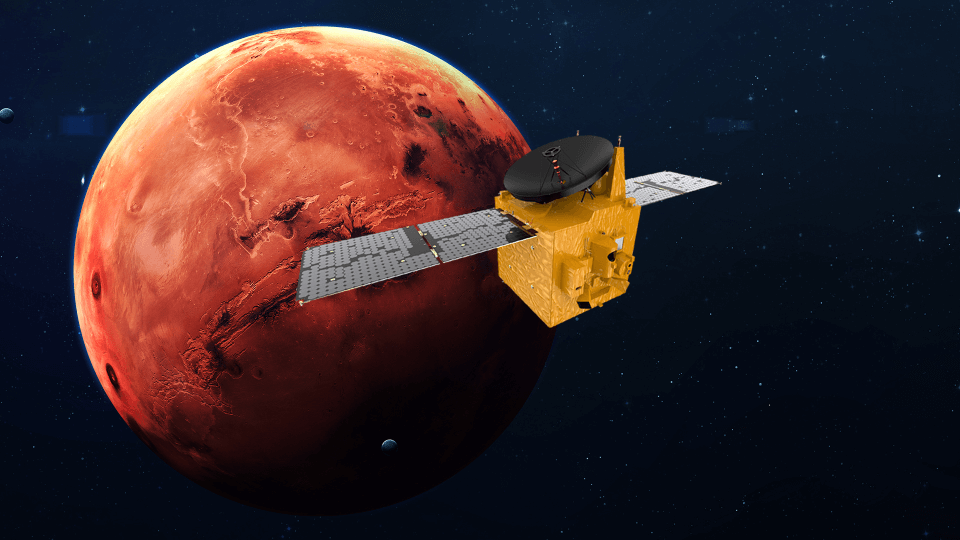
Image (Credit): Artist’s image of UAE’s Hope probe orbiting Mars. (UAE Space Agency)

You may want to visit Time magazine and view the article “The Woman Who Took the UAE to Mars.” It summarizes Sarah Al Amiri’s efforts related to the United Arab Emirates’ mission to Mars as well as her plans for the country’s space agency, which she now heads as Chairwoman.

Prior to becoming Chairwoman, Ms. Amiri was deputy project manager of a mission to map the Martian atmosphere. Her team, which was 80 percent female, developed the Hope probe to accomplish this goal. The probe was launched aboard a Japanese rocket in July 2020 and now orbits Mars. The data obtained from this mission is being shared openly to assist others studying the Martian atmosphere.

Another mission mentioned in the Time article by Chairwoman Amiri is a tour of seven asteroids as well as a flyby of Venus. A UAE space page defines the mission in this way:

The spacecraft will undertake a 3.6 billion-kilometre, five-year journey, which will see it perform gravity assist manoeuvres by orbiting first Venus, then Earth in order to build the velocity required in order to reach the main asteroid belt, located beyond Mars…The mission will study seven main belt asteroids…The mission will make its first close planetary approach orbiting Venus in mid-2028, followed by a close orbit of Earth in mid-2029. It will make its first fly-by of a main asteroid belt object in 2030, going on to observe a total of seven main belt asteroids before its final landing on an asteroid 560 million kilometres from Earth in 2033. This will make the Emirates the fourth nation to land a spacecraft on an asteroid.

What was not mentioned in the story but is available via another UAE government page is plans for several other space endeavors, including:

  • Sending a rover to the Moon in 2024. The rover’s name is Rashid, named in honor of the late Sheikh Rashid bin Saeed Al Maktoum, former Ruler of Dubai.
  • Establishing a settlement on Mars by 2117, and building a Mars Science City within the UAE to make this Martian mission possible.