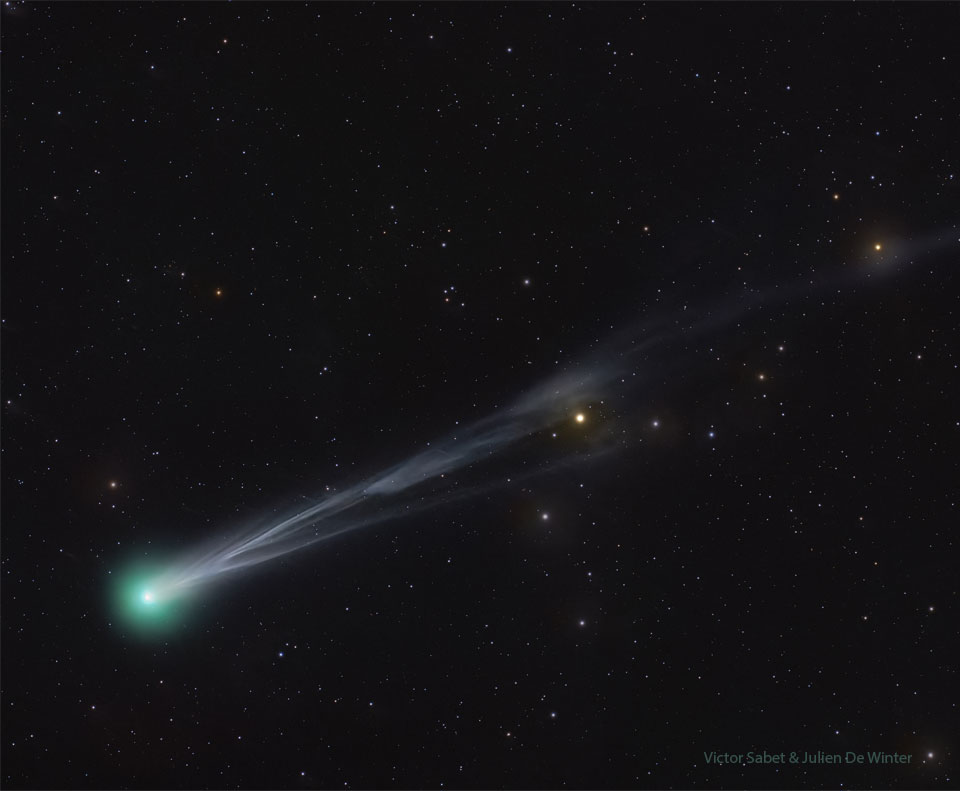
Now is your chance to view Comet Lemmon before it cycles its way though the solar system over the course of 1,350 years. You might even be able to view it over the next few weeks with the naked eye if you are lucky.
Wired magazine has a story about this comet that tells you all you need to know. It also provides some helpful guidance for spotting it in the night sky:
As of early October, Comet Lemmon can be found slightly below the handle in the Big Dipper (or the Plough, as it’s known in the UK), which forms part of the Ursa Major constellation. If you look up at the northern sky, you will be able to trace its path. In the northern hemisphere, it is predicted to appear in the northwestern-to-western sky after sunset from mid-October onward. It will be at a low altitude above the horizon and is expected to emit a faint glow in the twilight just after the sun has set.
Look up and observe this time capsule from 4.6 billion years ago.
This time last year I highlighted a paper that discussed a possible exomoon circling an exoplanet called WASP-49Ab located about 635 light-years away . It was spotted by the European Southern Observatory’s Very Large Telescope in Chile.
Well, now the James Webb Space Telescope (JWST) has provided data related to another possible exomoon orbiting a hot Jupiter-like exoplanet called WASP-39b. It is located about 700 million light-years away.
In a Scientific American article titled “Have Astronomers Finally Found an Exomoon?” we learn that a paper is being released shortly outlining the argument for this potential “hypervolcanic exomoon.” This presumed IO-like exomoon is being cooked by the parent sun.
Recent infrared spectroscopy from the James Webb Space Telescope (JWST) has spurred analyses of common volcanic gases such as carbon dioxide (CO2), sulfur dioxide (SO2), alongside alkali metals sodium (Na I) and potassium (K I) surrounding the hot Saturn WASP-39 b. We report more than an order-of-magnitude of variability in the density of neutral Na, K, and SO2 between ground-based measurements and JWST, at distinct epochs, hinting at exogenic physical processes similar to those sourcing Io’s extended atmosphere and torus. Tidally-heated volcanic satellite simulations sputtering gas into a cloud or toroid orbiting the planet, are able to reproduce the probed line-of-sight column density variations. The estimated SO2 flux is consistent with tidal gravitation predictions, with a Na/SO2 ratio far smaller than Io’s. Although stable satellite orbits at this system are known to be < 15.3 hours, several high-resolution alkali Doppler shift observations are required to constrain a putative orbit. Due to the Roche limit interior to the planetary photosphere at ~ 8 hours, atmosphere-exosphere interactions are expected to be especially important at this system.
It is a dense summary, but also a hopeful finding that may lead to more focused searches for exomoons.
The addition of exomoons to the list of new discoveries will only increase the chances that some form of life can be found among he many solar systems we can study. Interestingly enough, we are still probing our own solar system’s moons with the same hope.
This week’s image is from the European Southern Observatory’s (ESO) Very Large Telescope (VLT) in northern Chile. It shows the Sculptor Galaxy, which is about 11 million light-years away.
This image shows a detailed, thousand-colour image of the Sculptor Galaxy captured with the MUSE instrument at ESO’s Very Large Telescope (VLT). Regions of pink light are spread throughout this whole galactic snapshot, which come from ionised hydrogen in star-forming regions. These areas have been overlaid on a map of already formed stars in Sculptor to create the mix of pinks and blues seen here...
To create this map of the Sculptor Galaxy, which is 11 million light-years away and is also known as NGC 253, the researchers observed it for over 50 hours with the Multi Unit Spectroscopic Explorer (MUSE) instrument on ESO’s VLT. The team had to stitch together over 100 exposures to cover an area of the galaxy about 65 000 light-years wide.
According to co-author Kathryn Kreckel from Heidelberg University, Germany, this makes the map a potent tool: “We can zoom in to study individual regions where stars form at nearly the scale of individual stars, but we can also zoom out to study the galaxy as a whole.”
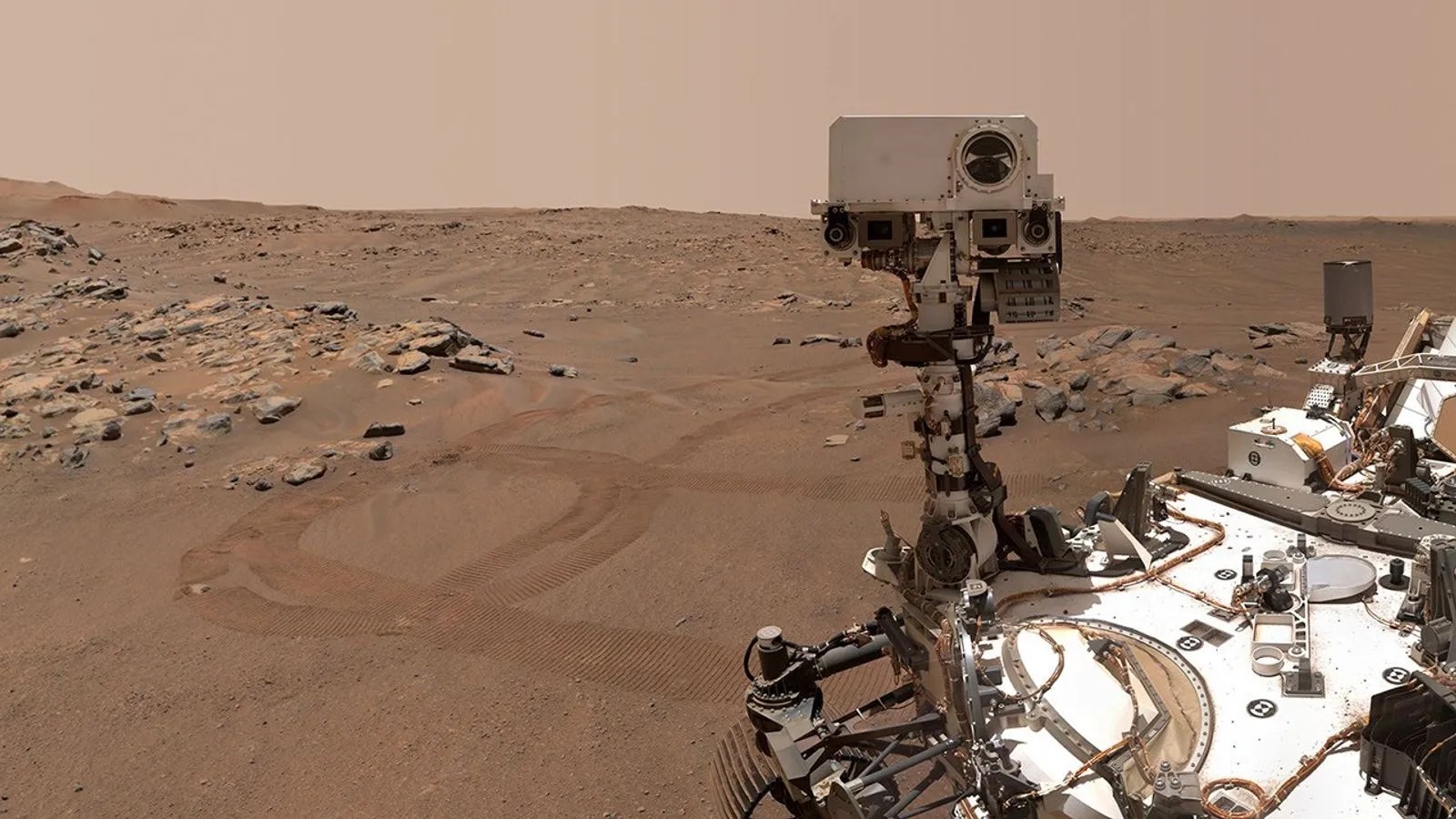
Image (Credit): Selfie by NASA’s Perseverance Mars rover taken on September 10, 2021. (NASA/JPL-Caltech)
First the White House dropped the idea of retrieving soil samples from Mars. Now it is going after the rover collecting those samples.
This week NASA’s Jet Propulsion Laboratory (JPL), which manages the rovers on Mars, announced the layoff of 550 workers, stating:
In order to best position JPL going forward, we are taking steps to restructure and establish an appropriate size to ensure future success. As part of this effort, JPL is undergoing a realignment of its workforce, including a reduction in staff. This reduction — part of a reorganization that began in July and not related to the current government shutdown — will affect approximately 550 of our colleagues across technical, business, and support areas.
One of the employees at JPL who formerly operated rovers noted that the White House cuts is reducing the funding for the Perseverance Mars rover, which collected the soil samples, by two-thirds. He was quoted as saying that they cuts are “…just enough to technically keep it going and not get the full PR backlash of canceling a working rover.”
We only have two rovers left on Mars, the Perseverance rover and the Curiosity rover. Are we going to see these rovers go dark in the near future as they continue to look for life on the planet? And what does it say that we are hoping to put humans on Mars when we cannot even find a way to properly fund the robots that are already there? Would you be your life on this government?
None of this give the US public any confidence, nor does it give bright students much hope for a NASA career when the roles they want to fill are being eliminated.
We are treading water nowadays rather than reaching for the stars. It will have repercussions that may be long-lasting.
Every major objective of the flight test was achieved, providing valuable data as we prepare the next generation of Starship and Super Heavy...Focus now turns to the next generation of Starship and Super Heavy, with multiple vehicles currently in active build and preparing for tests. This next iteration will be used for the first Starship orbital flights, operational payload missions, propellant transfer, and more as we iterate to a fully and rapidly reusable vehicle with service to Earth orbit, the Moon, Mars, and beyond.
I like that ending, which sounds like something you would hear on the airport bus as you approach the rental lot, “…with service to Earth orbit, the Moon, Mars, and beyond.”
Let’s just hope this bus can get NASA to its next destination on time.




 Our Awesome Universe