If you are eager to understand what comes after the International Space Station (ISS), you might enjoy Vast’s video showing plans for the Haven-1 and Haven-2 missions as well as other future projects.
Vast’s Haven-1 is a single-module station expected to be launched in May 2026. Once Haven-1 is in orbit, four crew members will be launched to the Haven-1 station via a SpaceX Dragon for a two-week mission. This will be the first real test of the new commercial space station module, which is expected to stay in orbit for three years so three additional crews can visit and conduct research and even manufacture in space.
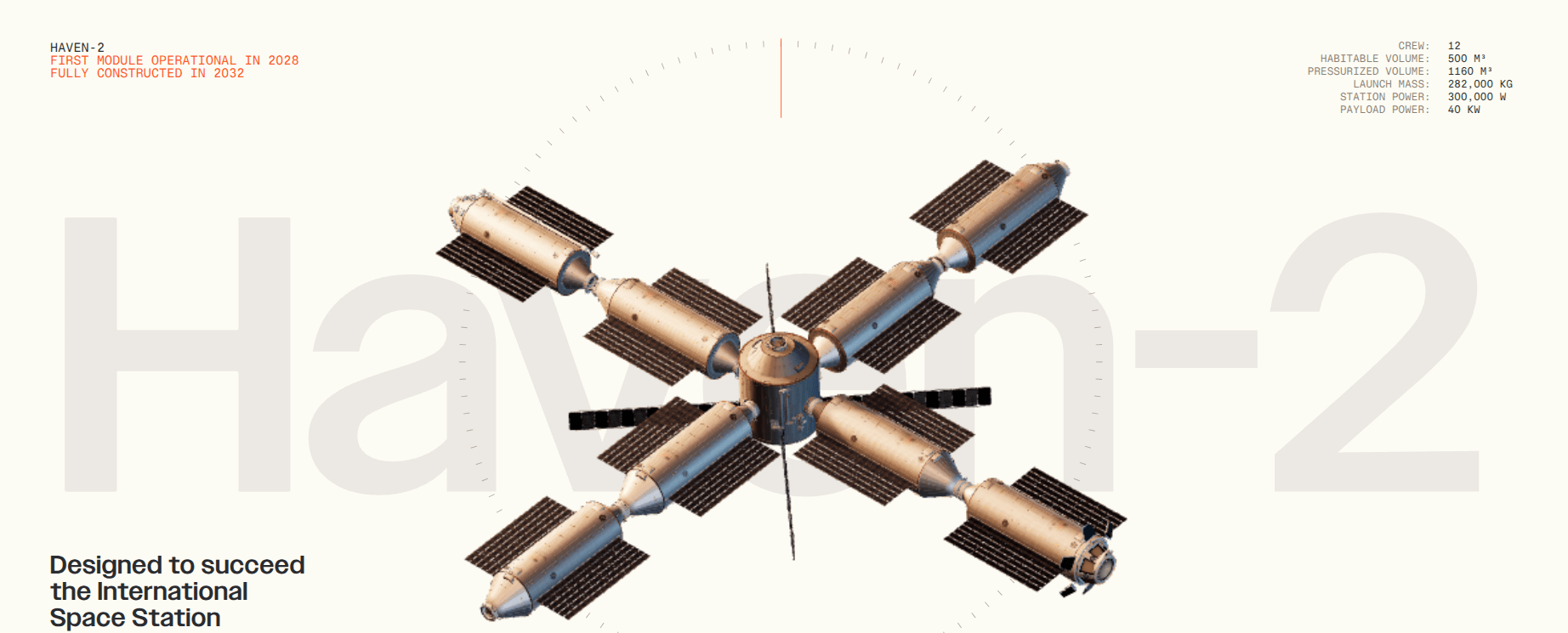
Haven-2 will follow with a larger module. The plan is to link a series of modules to create an expanded station (see image below). The construction of Haven-2 is expected to be underway while the ISS goes out of service in 2030.
Vast is one of numerous companies hoping to fill the gap left by the departing ISS. Whether it is selling seats to NASA scientists, commercial entities, or space tourists, this American company based in California sees a future in space stations.
Within the next 18 months, the space shuttle Discovery may be disassembled in Washington D.C., transported more than 1,000 miles to Houston and reassembled. But not if grassroots group Keep The Shuttle has anything to say about it. The plan to move a shuttle, notably an unnamed shuttle, was part of President Donald Trump’s “Big Beautiful Bill” passed this summer. The Smithsonian and others have dug in against the move, saying the research institute actually owns the Discovery in a trust for the American people, nothing that it’s unclear if Congress even has the authority to order the Smithsonian transfer an artifact.
Thanks to the huge spate of exoplanet discoveries, multiple rocky planets have been found orbiting within the habitable zones (HZs) of red dwarf stars. For decades, there has been an ongoing debate as to whether these systems could be our best bet for finding evidence of life beyond Earth. In a recent study, Professor David Kipping addresses two key facts that could mean humanity is an outlier. Based on the age of the Universe and the relatively rare nature of our Sun, he concludes that astrobiologists examining red dwarf planets may be looking in the wrong place.
A rare interstellar comet — only the third ever confirmed to enter our solar system — was photographed last week, closely approaching Mars, the European Space Agency said Tuesday. The images taken on Friday by two Mars orbiters show a bright, fuzzy white dot of the comet, also known as 3I/ATLAS, appearing to move against a backdrop of distant stars as it was about 18,641,135 miles away from Mars. The comet poses no threat to Earth, NASA has previously said.
Image (Credit): An earlier image of Bill Nye showing his support for NASA employees. (The Planetary Society)
You may have heard that the federal government has shut down, but that did not stop the Planetary Society’s CEO Bill Nye from traveling to Washington, DC to protest NASA cuts. He was there with almost two dozen other organizations to protest the White House’s plans to cut 24 percent of NASA’s budget.
Highlighting the potential impact of cuts to NASA’s programs, Bill Nye stated:
The China National Space Administration is going fast, doing a lot of extraordinary missions very similar, almost mission for mission, to what the United States is doing and I’m telling you there’s going to be a Sputnik moment when Taikonauts, China National Space Administration space travelers, are on the moon in the next five years.
A recent report by the Ranking Member of the Senate’s Committee on Commerce, Science, and Transportation, titled The Destruction of NASA’s Mission, states the Trump Administration is already implementing the 2026 cuts at NASA even thought Congress has yet to approve a budget. The report summary notes:
As part of Ranking Member Cantwell’s oversight of the potential impacts of President Trump’s budget request (PBR) for Fiscal Year 2026 (FY26), Democratic staff of the Senate Commerce, Science, and Transportation have uncovered evidence of an illegal plot already in motion. Based on whistleblower documents and interviews, this staff report finds that the White House Office of Management and Budget (OMB) has been directing NASA —since early summer— to begin implementing the devastating cuts demanded in President Trump’s proposed budget for FY26, in clear violation of the Constitution and without regard for the impacts on NASA’s science missions and workforce.
Not surprisingly, the law seems to be no barrier to bad behavior for this administration, yet Mr. Nye and others are not giving in or giving up. Nor should anyone who believes NASA represents the best of what our astronomers and scientists can accomplish. The size of the proposed NASA cuts for FY 2026 are shown below. It is brutal.
You can show your support for NASA by visiting the Planetary Society’s Save NASA Science page.
Image (Credit): Proposed cuts to NASA’s FY 2026 budget. (Senate Committee on Commerce, Science, and Transportation)
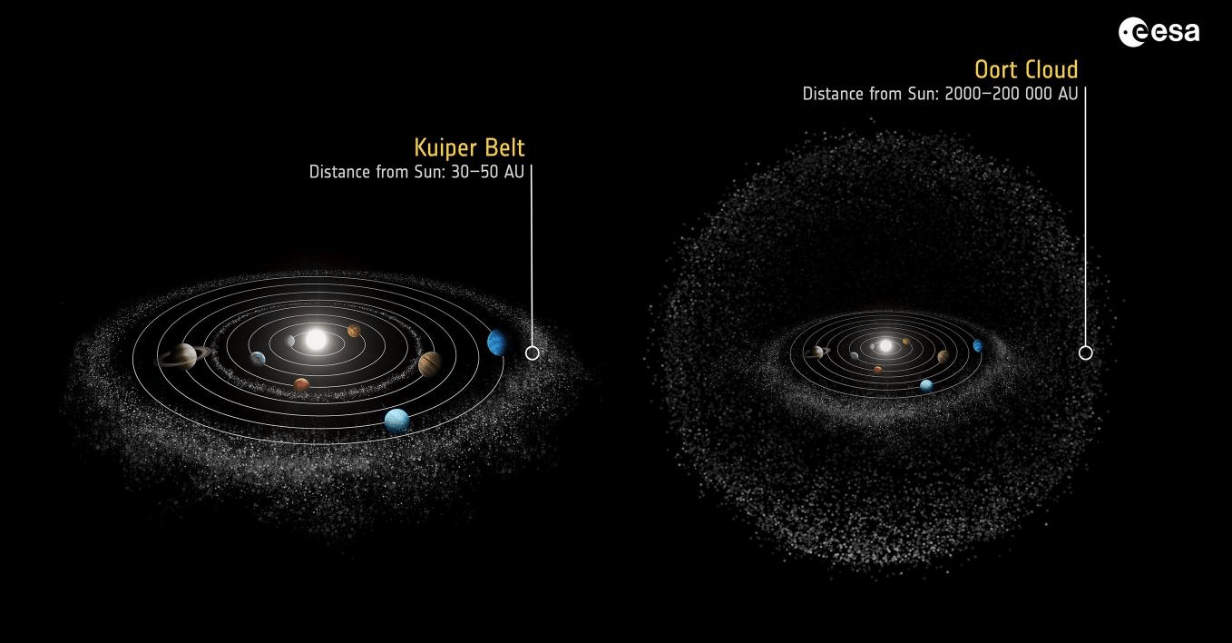
Image (Credit): Illustrations of the Kuiper Belt and the Oort Cloud. (European Space Agency)
“One explanation is the presence of an unseen planet, probably smaller than the Earth and probably bigger than Mercury, orbiting in the deep outer solar system…This paper is not a discovery of a planet, but it’s certainly the discovery of a puzzle for which a planet is a likely solution.”
-Statement by lead author Amir Siraj, an astrophysicist and a doctoral candidate in the department of astrophysical sciences at Princeton University, as quoted by CNN News. The presence of a new, distant planet attempts to address the tilted orbits of some distant objects in the Kuiper Belt. The issue is discussed in a recent paper by Siraj and his fellow authors titled Measuring the Mean Plane of the Distant Kuiper Belt and found in the journal Monthly Notices of the Royal Astronomical Society: Letters.
Image (Credit): Figure from the NASA OIG audit report, NASA’s Management of ISS Extravehicular Activity Spacesuits. (NASA OIG)
NASA has spent a significant amount of money on the Extravehicular Mobility Unit (EMU) spacesuits used during spacewalks on the International Space Station (ISS). Even so, these suits have ongoing problems that need to be resolved given that they will be critical to the ISS mission until the decommissioning of the station in 2030.
The NASA Office of Inspector General (OIG) has reported on issues with these spacesuits in the past and recently issued a new report on the status of the spacesuits. In its September 30th report, NASA’s Management of ISS Extravehicular Activity Spacesuit, the auditors noted that the contractor maintaining the spacesuits, Collins Aerospace, is having problems, including:
…considerable schedule delays, cost overruns, and quality issues that significantly increase the risk to maintaining NASA’s spacewalking capability.
The auditors stated that lack of competition for these spacesuit services as well as ineffective contract incentives are making the problems a permanent part of the program. While NASA has promoted competition for many years, these spacesuits designed 50 years ago have not benefited from this new approach, in part because the companies that feed into the supply line are slowly disappearing.
It seems dual-use rockets are much more in demand than antique spacesuits, potentially making spacesuits one of the weaker links in the space industry.
Note: Collins Aerospace ended a separate contract with NASA last year to develop a new ISS EMU. Collins continues with its contract to maintain the current EMU.





 Our Awesome Universe