Budget Cuts: A Graphic Portrayal of the NASA Betrayal

Image (Credit): Graphic showing NASA missions either eliminated (red x) or severely cut (red !) in the most recent White House budget request. (Astronomy Magazine)

Astronomy magazine did us all a great service by clearly demonstrating the impact of the White House’s FY 2026 budget request on NASA space missions.

In a graphic covering the solar system and everything else, you can visualize for yourself the enormous impact of the proposed cuts. Very few programs are safe, including those we share with the European Space Agency (ESA) and others. In fact, only the “Biological and Physical” missions (shown in orange) seem to be mostly untouched.

For example, under “Planetary” missions (shown in purple), we see the end of:

Some of this may have made sense if there was a good discussion of existing missions and a thoughtful process to wind some of them down. But that is not how this White House works, and we are all the poorer for it.

In addition to many in NASA and the public at large, some in Congress are pushing back on these excessive losses. This is still somewhat early in the budget process for FY 2026, but did anyone really expect this to be the starting point in NASA’s budget discussions?

The greatest space agency in the world is being hacked to pieces, along with many other US scientific programs. The costs will be felt for generations to come. Just as Apollo helped to lift a nation, these cuts are designed to harm that legacy and ultimately the nation.

Note: If you cannot see the image clearly here, you can go to this link.

A Day in Astronomy: Beginnings and Ends

Image (Credit): ValentinaTereshkova just before boarding her Vostok 6 capsule. (NASA)

On this day in 1963, Valentina Vladimirovna Tereshkova from the USSR became the first woman in space. She flew solo on the Vostok 6 for three days. It was her first and last time in space. Her importance as a symbol for women and the USSR meant she would never fly again lest something happen to her.

She was quoted as saying:

They forbade me from flying, despite all my protests and arguments. After being once in space, I was desperately keen to go back there. But it didn’t happen.

On this same day in 1977, German-American Wernher von Braun passed away. As the chief designer of the Saturn rockets that took men to the Moon, he was to see all of the Apollo missions before his death.

He is also quoted as saying:

I’m convinced that before the year 2000 is over, the first child will have been born on the moon.

It is unlikely he would have believed that it would be another 50 years before we found our way back to the Moon.

Image (Credit): Braun standing next to the first stage of the Saturn V booster he helped design. (NASA)

Video: Cosmic Dawn: The Untold Story of the James Webb Space Telescope

Image (Credit): Ongoing work to make the JWST a reality. (NASA)

If you are looking for some inspiration about the US space program, you might want to watch this NASA video, “Cosmic Dawn: The Untold Story of the James Webb Space Telescope.”

As the NASA site explains:

Go behind the scenes with the dedicated NASA team and its partners to uncover the untold story of the James Webb Space Telescope. “Cosmic Dawn” unveils the immense challenges, groundbreaking innovations, and extraordinary efforts behind humanity’s most powerful eye on our universe, from its complex development to its nail-biting deployment a million miles away.

This is what it takes to explore our universe, and I only hope we can continue to maintain the stamina, skills, and public support to maintain the JWST and initiate similar programs.

It may be time to write to Congress and let them know that America needs more of this grit and determination, not less.

Space Quote: ISS is Closed to Visitors at the Moment

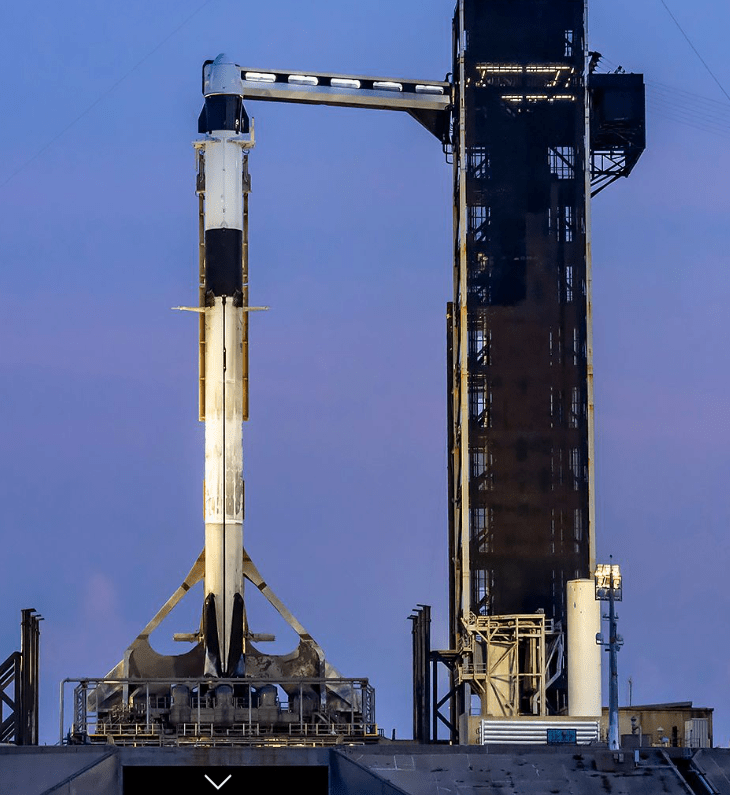
Image (Credit): Falcon 9 rocket on the lauch pad with Axiom Space’s Axiom Mission 4. (SpaceX)

“NASA and Axiom Space are postponing the launch of Axiom Mission 4 to the International Space Station. As part of an ongoing investigation, NASA is working with Roscosmos to understand a new pressure signature, after the recent post-repair effort in the aft most segment of the International Space Station’s Zvezda service module.”

Statement by NASA regarding an leak in the Russian section of the International Space Station (ISS) that has yet to be resolved. This may slow down some of the space tourism to the site, such as the already delayed Axiom Mission, but it is more important to get this right rather than risk additional lives on the station. Axiom Space stated that the launch of the mission will be no earlier than June 19.

The European Space Agency is Staying Busy with Sunshine

Image (Credit): A radiance map of the sun’s south pole as recorded by the Solar Orbiter spacecraft. (ESA & NASA/Solar Orbiter/PHI Team, J. Hirzberger (MPS))

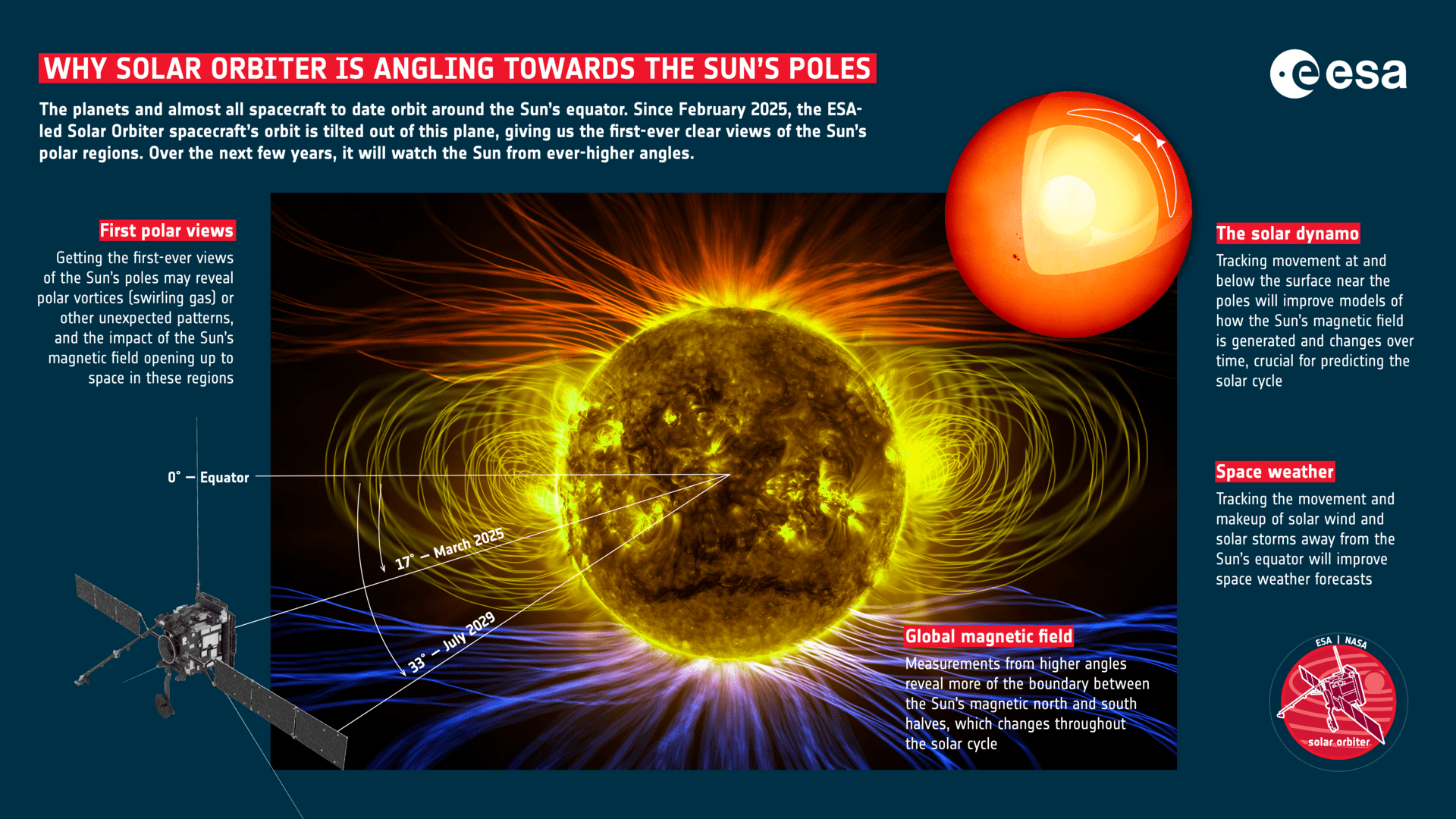
While NASA is going crazy over budget cuts, the European Space Agency (ESA) is focused on new images from the Solar Orbiter spacecraft showing the sun’s south pole from a distance of about 40 million miles (shown above).

Launched in February 2020, Solar Orbiter is an ESA-led cooperative mission with NASA designed to answer a number of questions:

  • What drives the Sun’s 11-year cycle of rising and subsiding magnetic activity?
  • What heats up the upper layer of its atmosphere, the corona, to millions of degrees Celsius?
  • How does solar wind form, and what accelerates it to speeds of hundreds of kilometres per second?
  • How does it all affect our planet?

Professor Carole Mundell, ESA’s Director of Science, stated:

Today we reveal humankind’s first-ever views of the Sun’s pole…The Sun is our nearest star, giver of life and potential disruptor of modern space and ground power systems, so it is imperative that we understand how it works and learn to predict its behaviour. These new unique views from our Solar Orbiter mission are the beginning of a new era of solar science.

We all need a diversion from the ongoing budget news, so it is good to read about ongoing science and a successful mission.