A Day in Astronomy: Launch of Ranger 4 Lunar Probe

Image (Credit): The Ranger 4 problem. (NASA/JPL)

On this day in 1962, the United States launched the Ranger 4 lunar probe from Cape Canaveral. Its mission was to photograph the lunar surface, place scientific equipment on the Moon, and perform other tests before crashing into the surface of the Moon. A computer glitch caused the probe to crash on the far side of the Moon before it could send back any useful data. Nonetheless, it was the first US spacecraft to reach another moon or planet (the Soviets had reached the Moon in 1959) as well as the first spacecraft to reach the far side of the Moon.

NASA launched a total of nine probes to the Moon under the Ranger program, with the last missions – Rangers 7,8, and 9 – being successful. Rangers 1 and 2 never left Earth orbit, while Rangers 3 and 5 missed the moon altogether. As noted above, Ranger 4 made it to the Moon, but not where is was supposed to land. And Ranger 6 made it to the Moon, but experienced a camera failure.

The Ranger missions set the stage for the later Apollo missions, which allowed the US to put the first man on the Moon.

Note: This NASA paper, Lunar Impact: A History of Project Ranger, provides greater detail on the earlier missions.
Space Stories: Safe Return of Astronaut & Cosmonauts from ISS, Resupply of ISS Successful, and Continuing Concerns About ISS Risks

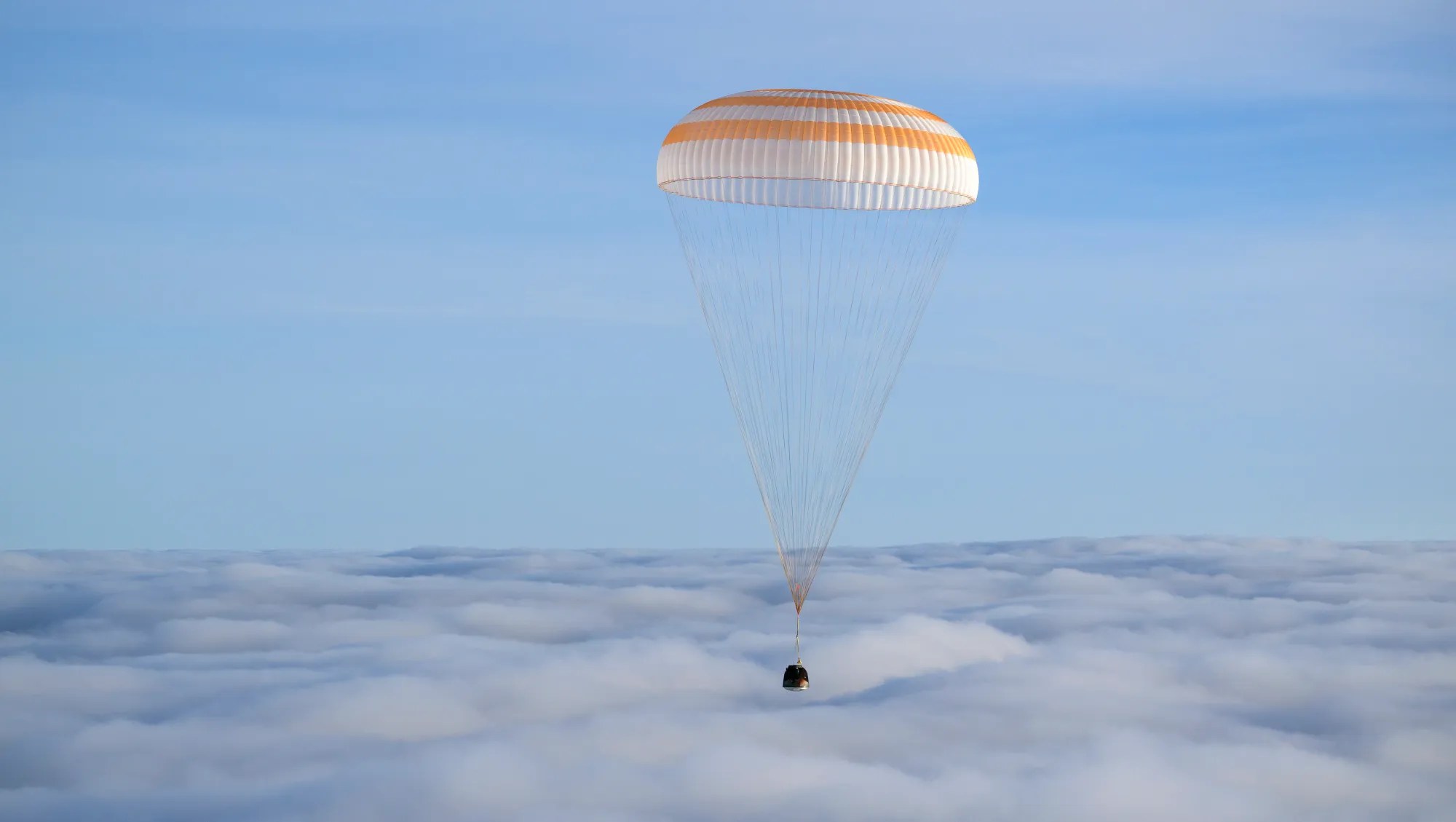
Image (Credit): The Soyuz MS-26 spacecraft carrying Expedition 72 NASA astronaut Don Pettit, and Roscosmos cosmonauts Alexey Ovchinin and Ivan Vagner back to Earth from the ISS on April 19, 2025 (April 20, 2025, Kazakhstan time). (NASA/Bill Ingalls)

Here are some recent stories of interest related to the International Space Station (ISS).

ABC News: Capsule with 1 American, 2 Russians returns to Earth from International Space Station

A Soyuz capsule carrying two Russians and one American from the International Space Station landed Sunday in Kazakhstan, ending their seven-month research assignment. According to Russian space agency Roscosmos, the capsule carrying Roscosmos cosmonauts Alexey Ovchinin and Ivan Vagner and astronaut Don Pettit of U.S. space agency NASA landed on the Kazakh steppe near the city of Zhezkazgan at 6:20 a.m. (0120 GMT). Roscosmos said the parachute-assisted landing was a trouble-free descent.

Space.com: SpaceX CRS-32 Dragon Cargo Capsule Arrives at the ISS with 6,700 Pounds of Supplies

A SpaceX Dragon cargo capsule has arrived at the International Space Station (ISS) this morning (April 22), wrapping up about 28 hours traveling on orbit to close the gap between them. Elon Musk’s company launched its 32nd robotic resupply mission to the ISS for NASA early Monday morning (April 21), sending a Dragon freighter aloft from Florida’s Space Coast.

Gizmodo: The ISS Is in the ‘Riskiest Period of Its Existence,’ NASA Safety Panel Warns

During a meeting of the Aerospace Safety Advisory Panel (ASAP) held on Thursday, members of a NASA safety panel stated that there are growing risks threatening the space station as it nears the end of its use, SpaceNews reported. “The ISS has entered the riskiest period of its existence,” Rich Williams, a member of the panel, said during the meeting. At the top of the list of growing risks is a leak where air has been escaping at an increasing rate from a tunnel that connects a docking port to a Russian module.

Study Findings: Four Sub-Earth Planets Orbiting Barnard’s Star from MAROON-X and ESPRESSO

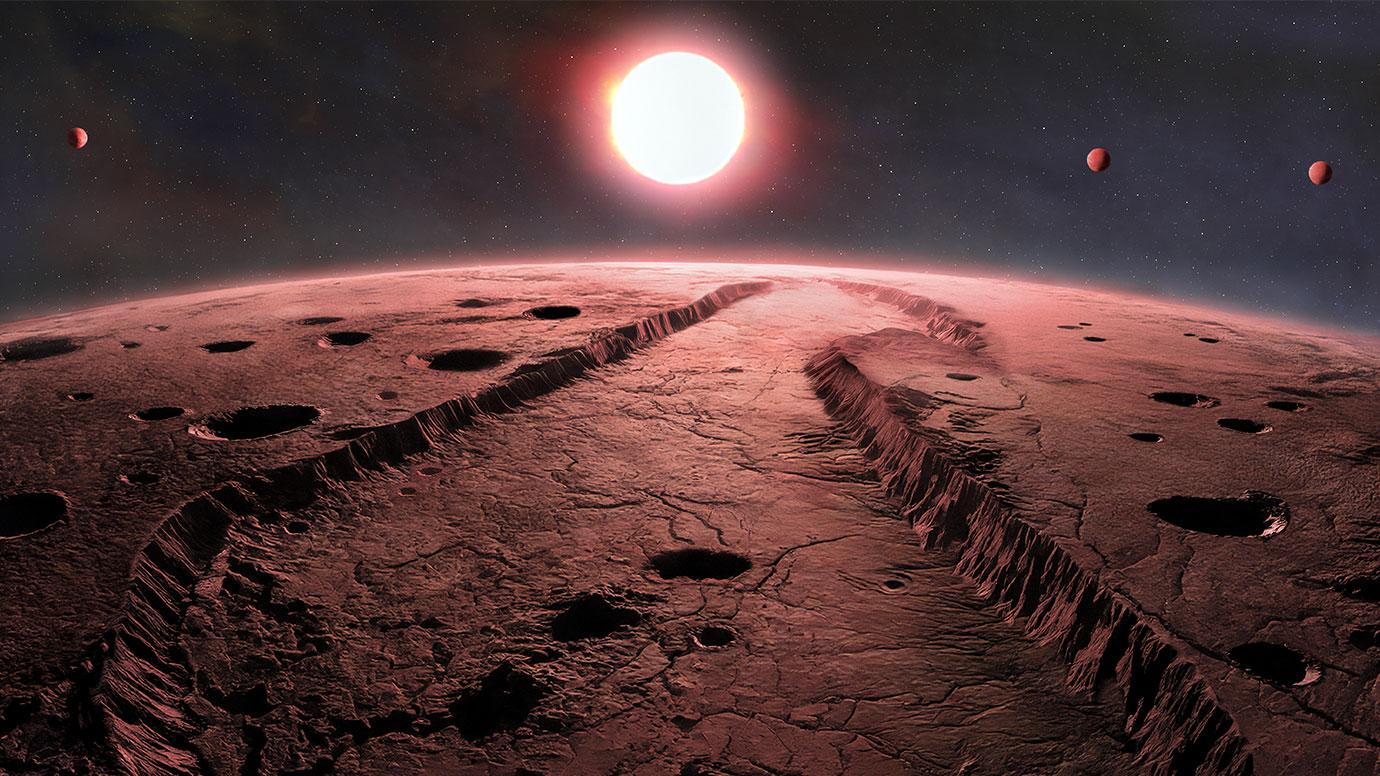
Image (Credit): Conceptual art showing Barnard’s Star from the surface of one of its four orbiting planets. (Illustration by International Gemini Observatory/NOIRLab/NSF/AURA/R. Proctor/J. Pollard)

The Astrophysical Journal Letters abstract of the study findings:

Barnard’s Star is an old, single M dwarf star that comprises the second-closest extrasolar system. It has a long history of claimed planet detections from both radial velocities and astrometry. However, none of these claimed detections have so far withstood further scrutiny. Continuing this story, extreme precision radial velocity measurements from the ESPRESSO instrument have recently been used to identify four new sub-Earth-mass planet candidates around Barnard’s Star. We present here 112 radial velocities of Barnard’s Star from the MAROON-X instrument that were obtained independently to search for planets around this compelling object.

Citation: Ritvik Basant et al. Four sub-Earth planets orbiting Barnard’s Star from MAROON-X and ESPRESSO. ApJL 982 L1 (2025).
https://doi.org/10.3847/2041-8213/adb8d5

Study-related stories:

The University of Chicago

SciTechDaily

Astronomy Magazine

Television: Season Two of Andor

Credit: Disney+

Finally, after two and a half years, Star Wars: Andor is returning to Disney+. The second season, premiering on April 22, will also be the final season, but that’s okay. I am just glad it’s back.

The season two trailer is all you need to become invested in what is the best of the Star Wars spin-off television series. And if you need to catch up, you will want to watch this recap of season one.

Andor is by far the most adult of the Star Wars series, consistent with Rogue One, which became one of the best Star Wars movies after the original three films.

Critics are already raving about season two, such as this statement by Erik Davis from Fandango:

I have watched the entire second season of ‘Andor’ and it is as good, if not better than the first. From an epic opening Tie Fighter heist to a finale that left me in tears, this show has it all. Hang on cause the last six eps are all bangers. Absolutely loved it.

Be prepared to want to watch ‘Rogue One’ immediately after finishing ‘Andor’ – it truly sets up that film and expands upon the characters and stakes in some emotional ways. Just getting to watch Andor and K2 on a mission again meant everything to me. The cast crushes it. The sets are incredible. Star Wars fans will adore this and all the classic lore explored. Big recommend for me!

All of this is proof that the owners of the Star Wars franchise have the ability to produce quality TV. We just need to hold them to this standard going forward.

Podcast: The Curious Universe

If you are looking for new podcast material, you may want to check out NASA’s Curious Universe podcast. It has been around for a while, but it is starting a new series celebrating Earth from April 15 to May 13.

The first episode in the new Earth series is titled “How NASA Sees Our Blue Marble.” In the episode, we hear from Karen St. Germain, the director of NASA’s Earth Science Division. It is a chance to learn about the planet that NASA spends the most time studying.

If you like this series, you can go back and listen to other episodes, such as:

-“Inside the Team That Keeps Hubble Flying” (March 14, 2025)
-“The Sun Series” (March 19 to May 3, 2024)
-“Defending the Planet from Asteroids” (February 21, 2023)
-“The Search For Life: Are We Alone?” (June 21, 2022)