Have We Detected Life on an Exoplanet?

Credit: Image by Adis Resic from Pixabay.

The news is filled this week with a story about possible life on a distant exoplanet? What did scientists find?

The exoplanet is named K2-18b, and it orbits a red star that is about 124 light-years away. It is also about 2.6 times larger than the Earth and 8.6 times as massive.

Scientists using data from the James Webb Space Telescope have detected a biosignature similar to molecules – dimethyl sulfide (DMS) and dimethyl disulfide (DMDS) – associated with marine phytoplankton on our planet.

Nikku Madhusudhan, professor of astrophysics and exoplanetary science at the University of Cambridge’s Institute of Astronomy, stated:

Earlier theoretical work had predicted that high levels of sulfur-based gases like DMS and DMDS are possible on Hycean worlds…And now we’ve observed it, in line with what was predicted. Given everything we know about this planet, a Hycean world with an ocean that is teeming with life is the scenario that best fits the data we have.

A Hycean planet is basically a world with liquid oceans and a hydrogen-rich atmosphere. Such planets are also more common around red dwarf stars.

Of course, more work is necessary to determine whether this finding could relate to something other than biological life, but its does offer exciting possibilities and a clear target for more study.
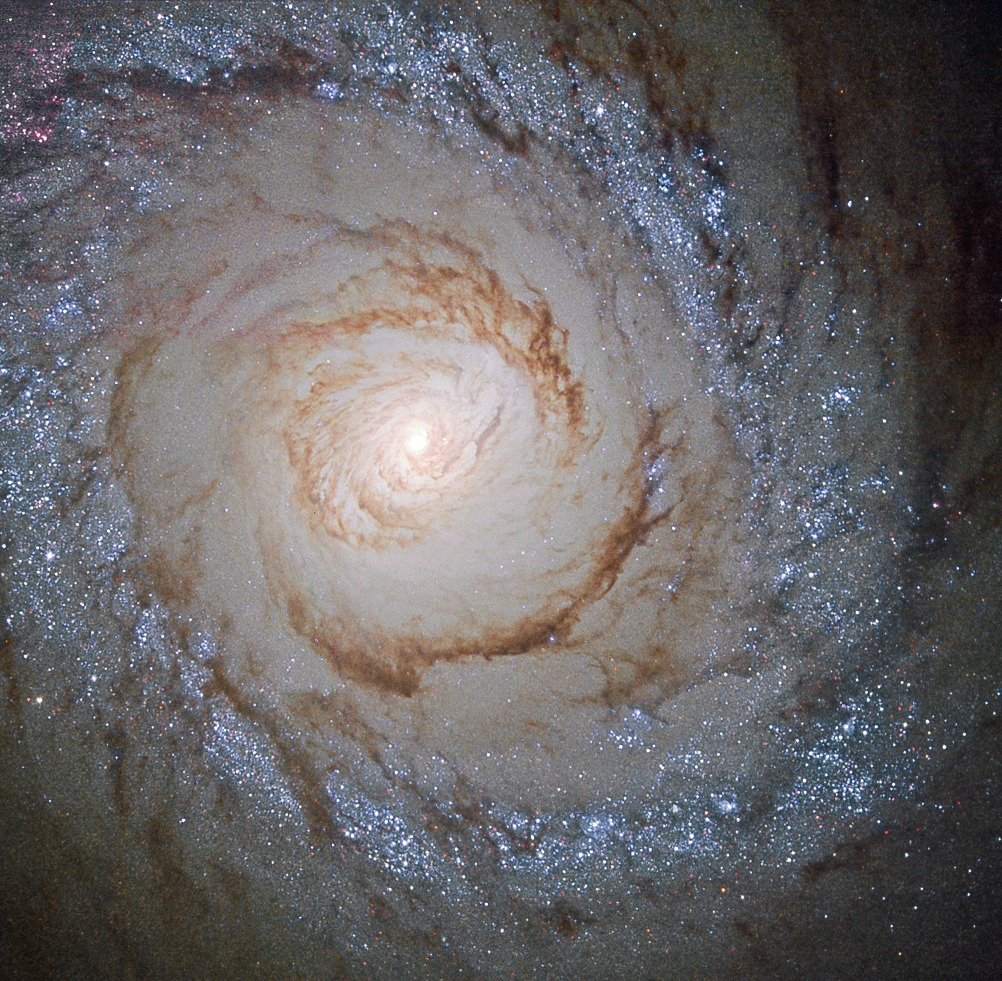
Pic of the Week: The Starburst Galaxy

Image (Credit): Starburst Galaxy Messier 94. (ESA/Hubble and NASA)

This week’s image is from the Hubble Space Telescope. It was shared on NASA’s Astronomy Picture of the Week website last month. The sparkling galaxy, Messier 94, is about 15 million light-years away.

Here is NASA’s description of what you are seeing above:

Beautiful island universe Messier 94 lies a mere 15 million light-years distant in the northern constellation of the hunting dogs, Canes Venatici. A popular target for earth-based astronomers, the face-on spiral galaxy is about 30,000 light-years across, with spiral arms sweeping through the outskirts of its broad disk. But this Hubble Space Telescope field of view spans about 7,000 light-years or so across M94’s central region. The sharp close-up examines the galaxy’s compact, bright nucleus and prominent inner dust lanes, surrounded by a remarkable bluish ring of young, massive stars. The massive stars in the ring appear to be less than about 10 million years old, indicating the galaxy experienced a corresponding well-defined era of rapid star formation. As a result, while the small, bright nucleus is typical of the Seyfert class of active galaxies, M94 is also known as a starburst galaxy. Because M94 is relatively nearby, astronomers can explore in detail reasons for the galaxy’s burst of star formation.

Note: I swapped out the earlier protostar image for this one when I realized I was duplicating an earlier entry.

Television: The USS Callister is Back

Image (Credit): Crew from the Netflix series “USS Callister: Into Infinity”. (Netflix)

It’s hard to believe that we first met the crew of the USS Callister back in late 2017. The Black Mirror episode was a dark parody of the Star Trek universe where one twisted employee trapped the DNA clones of other employees in his make believe world. It was a typical twisted warning about technology in a way that one Black Mirror can deliver.

Well, the USS Callister crew is back in season 7 of the series in a new episode called “USS Callister: Into Infinity.” It do not want to give too much away, but most of your favorite characters have returned – both copies.

Some critics are skeptical about the returning episode, claiming the creators of Black Mirror have run out of ideas, yet I bet many will agree that it was a great idea back in 2017, and catching up with our old friends is fun.

A lot has changed in the real world with the rise of AI, so the central plot may be a bit out of date, but that make it more of a retro future, if that makes sense.

If you forget some of the first episode, check out this recap from Netflix.

And if you still want more, don’t worry, there is a chance that a third episode will be produced to complete the trilogy at some point, according to The Hollywood Reporter.

So sit back and enjoy the second episode. We can only hope we don’t need to wait another 7-8 years for the final episode to drop.

Note: Check out this video from Netflix as well showing the actors returning to the set for the second episode so many years later.

Space Stories: Even More Space Tourists, Upcoming Asteroid Encounter, and Copernicus Had Help

Image (Credit): New Shepard’s NS-31 Mission crew. (Blue Origin)

Here are some recent stories of interest.

ABC News: Blue Origin Mission with All-female Crew, Including Katy Perry, Completes Space Trip

Blue Origin’s all-female crew, which included pop star Katy Perry, completed their trip into space Monday morning. The flight lasted around 11 minutes and traveled more than 60 miles above Earth, according to Blue Origin, passing the Kármán line, which at 62 miles above sea level is considered to be the boundary between Earth’s atmosphere and outer space. Along with Perry, the crew included Blue Origin owner Jeff Bezos’ journalist fiancée, Lauren Sanchez, who is also a helicopter pilot.

NASA: NASA’s Lucy Spacecraft Prepares Second Asteroid Encounter

NASA’s Lucy spacecraft is 6 days and less than 50 million miles (80 million km) away from its second close encounter with an asteroid; this time, the small main belt asteroid Donaldjohanson. This upcoming event represents a comprehensive “dress rehearsal” for Lucy’s main mission over the next decade: the exploration of multiple Trojan asteroids that share Jupiter’s orbit around the Sun.

University of Sharjah: Copernicus May Have Leaned on Ancient Muslim Astronomer in Developing his Cosmological System

New research has revealed that the cosmological model developed by Nicolaus Copernicus, the renowned European Renaissance polymath, bears striking resemblance to the one designed by an Arab Muslim astronomer nearly two centuries earlier. The research conducted at the University of Sharjah is a comparative and analytical study which examines in parallel the writings of Copernicus in correlation with the works of the 14th century Muslim astronomer Ibn al-Shatir.

Space Quote: Senator’s Warning About NASA Cuts

Image (Credit): NASA’s Goddard Space Flight Center in Greenbelt, Maryland. (NASA)

“When you pull the plug on major space science, it’s like eating your seed corn; it’s so damaging to our entire ecosystem when it comes to American leadership and innovation in this area…We will lose engineers, we will lose others to China. In fact, they are launching a major space exploration initiative.”

Statement by Maryland Senator Chris Van Hollen commenting on potential DOGE cuts after visiting NASA’s Goddard Space Flight Center just outside the Washington, DC Beltway. The Center is home to the nation’s largest organization of scientists, engineers and technologists who build spacecraft, instruments and new technology to study Earth, the sun, our solar system, and the universe.