2025 International Mars Society Convention

It is time to mark your calendar for the Mars Society’s 2025 International Mars Society Convention scheduled for October 9–11 at the University of Southern California in Los Angeles. The theme this year is “Mars: The Time Has Come!”

If you want to learn more about past conventions to see if this is something for you, check out this link.

Some of the guests at last year’s convention included:

  • Tiffany M. Morgan, Deputy Director of the Mars Exploration Program in NASA’s Science Directorate, who will give an address about “Exploring Mars Together, DRAFT Plan for a Sustainable Future for Science at Mars.”
  • Howard Hu, the Orion Program Director at NASA, who will give an address about “NASA’s Artemis plans for returning to the Moon and beyond,”
  • Brig. General (Ret.) Dr. S. Pete Worden, Chairman of the Breakthrough Prize Foundation, who will give an address about “Life in the Universe and Private Sector Space Science Initiatives.”
  • Dr. Alan Stern, a renowned planetary scientist and commercial astronaut, who will give an address about “The Other Red Planet” focusing on Pluto.

If you are interested, you can register for this year’s convention here.

Also, if you have any ideas for the design of this promotional poster for the 2025 convention visit this site for more information.

Space Quote: More on the DEI Issue and Artemis

Image (Credit): Artemis II crew members greeting a crowd in April 2023. From left to right is Canadian Space Agency astronaut Jeremy Hansen and NASA astronauts Victor Glover, Reid Wiseman, and Christina. (NASA)

“[I]t is important to note that the change in language does not indicate a change in crew assignments.”

-Statement by a NASA spokesperson to Space.com regarding the recent removal of “DEI” language from the Artemis mission page. The scheduled crew for the upcoming Artemis II mission includes one woman, one person of color, and one international astronaut, as stated earlier on NASA’s website.

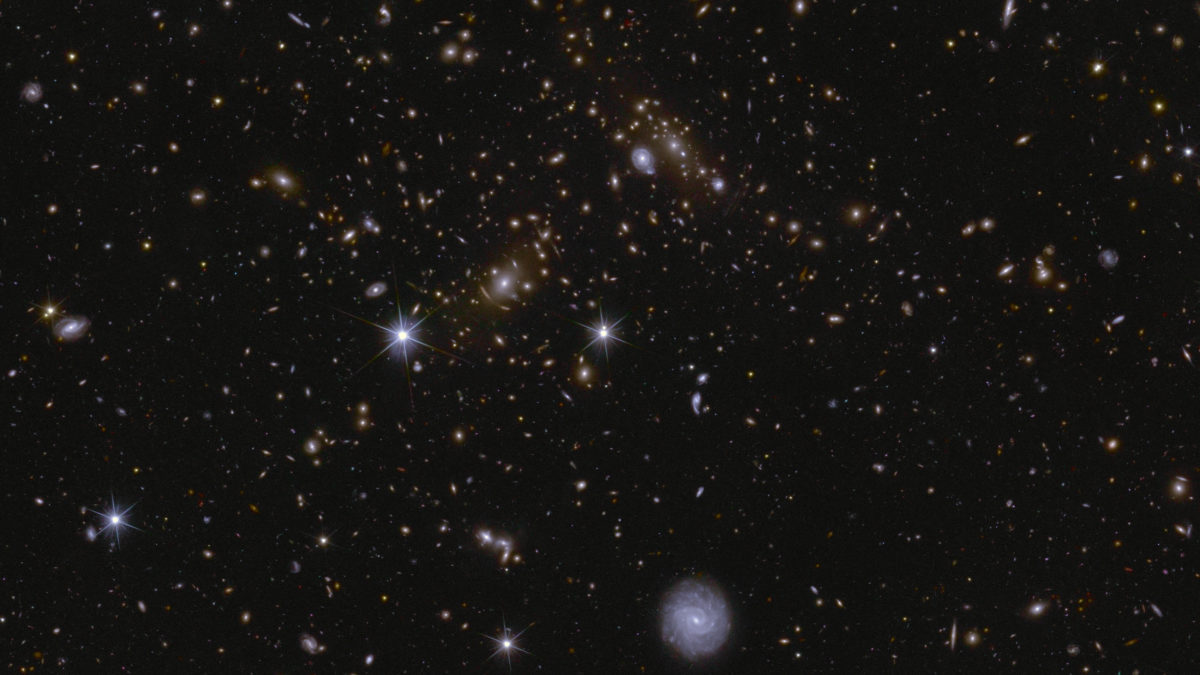
Pic of the Week: Deep Field South

Image (Credit): The Deep Field South captured by the ESA’s Euclid space telescope. (ESA/Euclid/Euclid Consortium/NASA, image processing by J.-C. Cuillandre, E. Bertin, G. Anselmi/Handout via REUTERS)

Last week, the European Space Agency released images from the Euclid space telescope, which was launched on July 1, 2023. The goal of the space telescope’s mission is to catalog more than 1.5 billion galaxies over a six year period.

The image above shows a part of the sky called the Deep Field South. One of the galaxy clusters near the center of the image is located almost 6 billion light-years away. At the center bottom of the image you can also clearly see a beautiful spiral galaxy.

Space Stories: Cygnus Spacecraft Damaged, AI & Astronomy, and Toxic Martian Dust

Image (Credit): The Cygnus cargo shit at the International Space Station. (Northrup Grumman)

Here are some recent stories of interest.

Ars Technica: After a Spacecraft was Damaged en route to Launch, NASA Says it Won’t Launch

Three weeks ago, NASA revealed that a shipping container protecting a Cygnus spacecraft sustained “damage” while traveling to the launch site in Florida. Built by Northrop Grumman, Cygnus is one of two Western spacecraft currently capable of delivering food, water, experiments, and other supplies to the International Space Station. This particular Cygnus mission, NG-22, had been scheduled for June. As part of its statement in early March, the space agency said it was evaluating the NG-22 Cygnus cargo supply mission along with Northrop.

Intelligent Computing: AI Reshapes How We Observe the Stars

AI tools are transforming how we observe the world around us—and even the stars beyond. Recently, an international team proved that deep learning techniques and large language models can help astronomers classify stars with high accuracy and efficiency. Their study, “Deep Learning and Methods Based on Large Language Models Applied to Stellar Light Curve Classification,” was published Feb. 26 in Intelligent Computing.

CNN: Toxic Dust on Mars Would Present Serious Hazard for Astronauts

Toxic dust on Mars would make a future mission to the red planet extremely hazardous for astronauts and require significant countermeasures, new research suggests. Substances such as silica, gypsum, perchlorates and nanophase iron oxides contained in Martian dust could have life-threatening effects on members of a potential Mars mission, according to a study published in the journal GeoHealth last month.

Space Quote: The Cutting Continues at NASA

Credit: Image by David Yonatan González from Pixabay

“Good work by @NASA this week:
-Eliminated their unused Purchasing Cards (~80%)
-Terminated ~$420M in unneeded contracts, including $45M ($15M each) to three separate consultants, all for “Change Management Support Services””

-Statement on Twitter/X by the Department of Government Efficiency (DOGE). The specific “unneeded” contacts being cut beyond the three provided contracts is unclear. What is the chance that any of the cuts will impact SpaceX or other Musk interests? Probably zero at this point. We will need to wait for more transparency once the dust settles.