Looking Back at What Did Not Work in 2024

Image (Credit): NASA’s new Advanced Composite Solar Sail System. (NASA)

It is worthwhile reflecting on all of the space successes in 2024, though if we believe we learn from our mistakes then it would seem the mission shortcomings are worth highlighting as well.

Fortunately, Live Science has prepared a list for our review. Its article “10 Times Space Missions Went Very Wrong in 2024” includes well known stories, such as the stranded Starliner and SpaceX rocket woes, as well as less covered items, such as:

  • Tumbling Solar Sail – the failure of NASA’s new Advanced Composite Solar Sail System (ACS3);
  • Shattering Spacecraft – multiple cases of new space debris and close calls that could have impacted other space missions; and
  • Multiple Voyager Issues – the continued decline of the two Voyager probes as they reach further into space.

Check out the story for a full list of issues.

Note: This website has also covered a number of flubs, including:

Pic of the Week: Spiral Galaxy NGC 2566

Image (Credit): Spiral galaxy NGC. (ESA/NASA)

This week’s image is from the Hubble Space Telescope. It shows the bright and colorful spiral galaxy NGC 2566, which is about 76 million light-years away.

Here is a little more about the image from NASA:

A prominent bar of stars stretches across the center of this galaxy, and spiral arms emerge from each end of the bar. Because NGC 2566 appears tilted from our perspective, its disk takes on an almond shape, giving the galaxy the appearance of a cosmic eye.

As NGC 2566 appears to gaze at us, astronomers gaze right back, using Hubble to survey the galaxy’s star clusters and star-forming regions. The Hubble data are especially valuable for studying stars that are just a few million years old; these stars are bright at the ultraviolet and visible wavelengths to which Hubble is sensitive. Using these data, researchers can measure the ages of NGC 2566’s stars, which helps piece together the timeline of the galaxy’s star formation and the exchange of gas between star-forming clouds and the stars themselves.

Space Stories: Support for the Near Space Network, Another Interesting Exoplanet, and Firefly Gets Fourth Lunar Contract

Image (Credit): Part of NASA’s Near Space Network. (NASA)

Here are some recent stories of interest.

SatnewsNASA Selects Four Commercial Companies to Support Near Space Network

NASA has selected multiple companies to expand the agency’s Near Space Network’s commercial, direct-to-Earth capabilities services, which is a mission-critical communication capability that allows spacecraft to transmit data directly to ground stations on Earth. The work will be awarded under new Near Space Network services contracts that are firm-fixed-price, indefinite-delivery/indefinite-quantity (IDIQ) contracts. Project timelines span from February 2025 to September 2029, with an additional five-year option period that could extend a contract through Sept. 30, 2034. The cumulative maximum value of all Near Space Network Services contracts is $4.82 billion.

Daily GalaxyNASA Discovers Massive Planet Bigger Than Earth with Gas Tied Exclusively to Living Organisms

Scientists have made a groundbreaking discovery on a planet over eight times the mass of Earth, located 120 light-years away. Using advanced technology, researchers detected a gas in its atmosphere that, on Earth, is only produced by living organisms. Could this be the first real hint of life beyond our planet? While the findings are intriguing, they come with questions that still need answering.

Express NewsTexas-based Firefly Aerospace Gets Another NASA Moon Mission, a $179.6M Deal That’s Part of Artemis

NASA gave Texas-based Firefly Aerospace a Christmas present of sorts — a $179.6 million deal to deliver six scientific instruments to the lunar surface as part of the Artemis program, which is intended to put astronauts back on the moon. Awarded a week before the holiday, the contract is the fourth for the Cedar Park company under the space agency’s Commercial Lunar Payload Services initiative. The $2.6 billion program aims to create a lunar economy while learning more about the moon in preparation for the first crewed flights to the lunar surface in more than 50 years.

2024 Space Hightlights – Missions

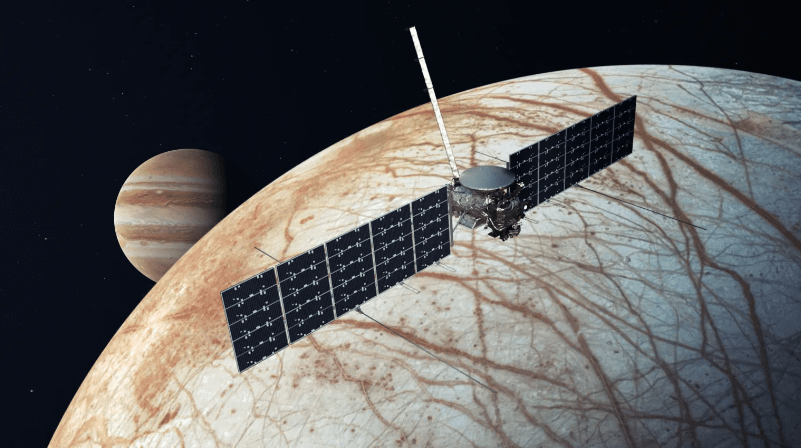
Image (Credit): An artist’s rendering of NASA’s Europa Clipper spacecraft over Europa. (NASA/JPL-Caltech)

Another list worth highlighting at year-end covers all of the space missions from 2024. For example, this list from Freethink, “the top 10 space stories of 2024,” includes the launch of the Europa Clipper, China’s Chang’e 6 round-trip to the Moon, and a successful commercial launch to the Moon (Odysseus lunar lander).

Here are some other lists of missions from 2024:

Note: The Awesome-Universe list of top missions looking back in 2024 include: