According to a story in Chron, a few years back the current nominee for NASA administrator, Jared Isaacman, made the following statement:
I truly want us to live in a world 50 or 100 years from now where people are jumping in their rockets like the Jetsons and there are families bouncing around on the moon with their kid in a spacesuit.
Given the difficulty was are having getting back to the moon 50 years after we dropped such travel, his time frame and expectations may be a little ambitious. I would be happy to have a few astronauts on the surface and the beginning of some type of rudimentary lunar station within 10 years, but something like The Jetsons in the near future or even 50 years out does not seem to be likely.
We heard stories about The Jetsons and flying cars long ago. Though some of the ideas in the television series were workable, if we cannot get to everyday flying cars just yet, I think everyday rockets to the Moon with the whole family are even further away.
Somehow he watched The Jetsons in his youth but seemed to miss Space: 1999 and even the original Lost in Space.
I expect his discussions with NASA will be pretty eye-opening and may temper his expectations.
We need to nail down the basics again before we issue travel posters to the Moon.
What’s going on in New Jersey and other parts of the East Coast? We are hearing of mysterious drone flights over communities and military installations, which the government cannot confirm.
Earlier this week, New Jersey State Senator Jon Bramnick stated:
The State of New Jersey should issue a limited state of emergency banning all drones until the public receives an explanation regarding these multiple sightings.”
New Jersey Governor Phil Murphy voiced his own concerns as well to President Biden, stating:
While I am sincerely grateful for your administration’s leadership in addressing this concerning issue, it has become apparent that more resources are needed to fully understand what is behind this activity.
The Federal Bureau of Investigation says it knows nothing at this point, stating:
The public can continue to call our 800 line, or submit a tip online, we are acting on every substantive lead that we get.
And, always helpful, Donald Trump has joined the chorus, stating:
Mystery Drone sightings all over the Country,…Can this really be happening without our government’s knowledge. I (don’t) think so! Let the public know, and now. Otherwise, (shoot) them down!
As noted, this mystery covers other parts of the East Coast, including Maryland and Virginia. So is this another Chinese balloon-like incident, teenage pranksters, or something more targeted against U.S. interests?
With drones doing heavy damage in Ukraine, Russia, and the Middle East, we are no longer talking about toys. It just represents another wave of space technology causing us to look up with fear, not unlike the Cold War, which gave us plenty of other UFO scares.
We should know soon enough what is happening, but it demonstrates again the risks related to the militarization of our airspace. It starts low to the ground and goes as high as our most sensitive satellites, representing a renewed threat to all the satellites and aircraft assisting with astronomy.
Keep looking up, but hold off on shooting them down until we know more.
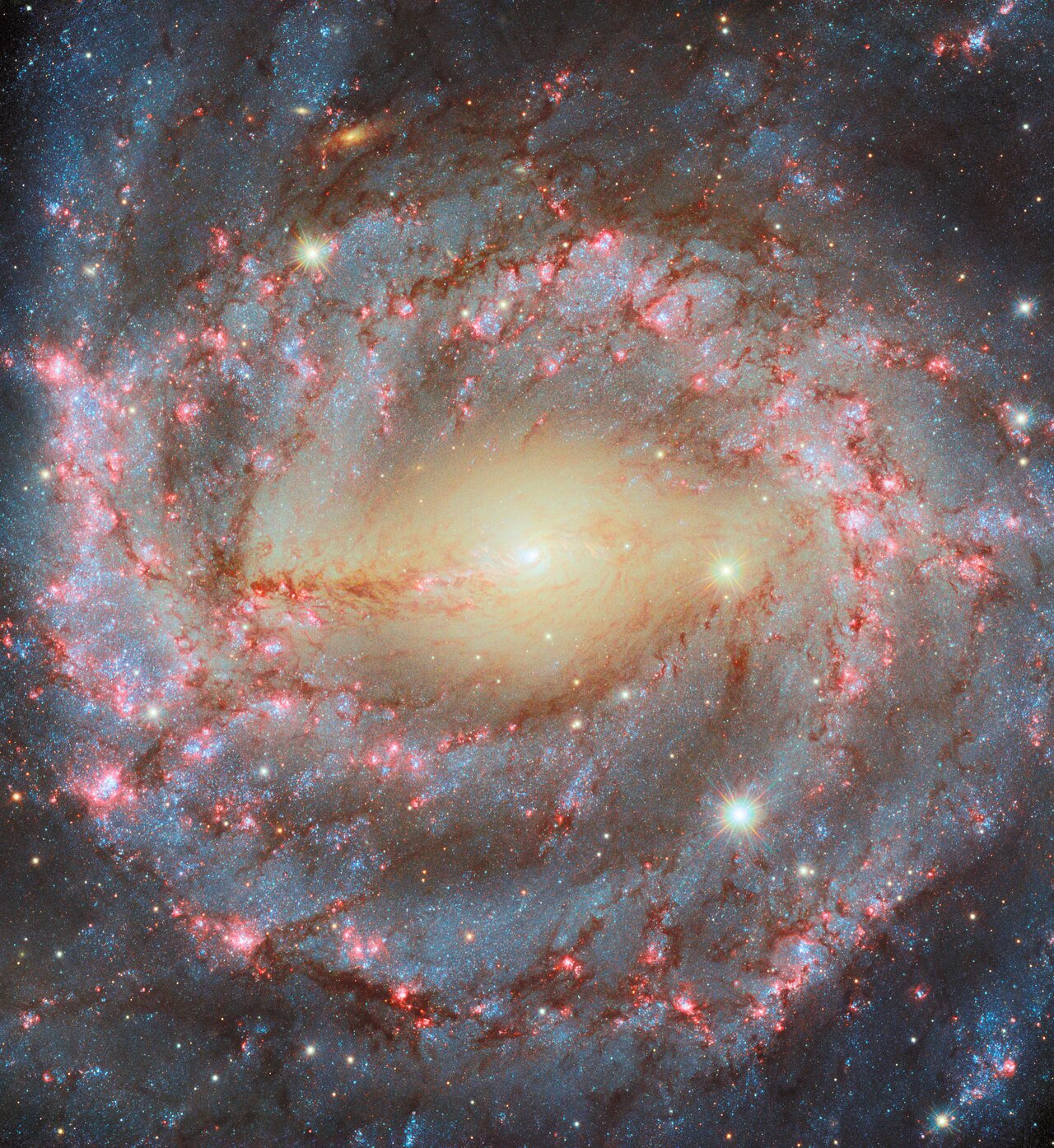
Image (Credit): Spiral galaxy NGC 5643, which is located roughly 40 million light-years away in the constellation Lupus. (ESA/Hubble & NASA, A. Riess, D. Thilker, D. De Martin (ESA/Hubble), M. Zamani (ESA/Hubble))
This week’s image comes from the NASA/European Space Agency’s (ESA) Hubble Space Telescope. It shows colorful spiral galaxy NGC 5643, which is located roughly 40 million light-years away in the constellation Lupus.
NGC 5643 is what’s known as a grand design spiral, referring to how the galaxy’s two large, winding spiral arms are clear to see. The spiral arms are defined by bright blue stars, lacy reddish-brown dust clouds and pink star-forming regions. As fascinating as the galaxy appears at visible wavelengths, some of NGC 5643’s most interesting features are invisible to the human eye. Ultraviolet and X-ray images and spectra of NGC 5643 show that the galaxy hosts an active galactic nucleus: an especially bright galactic core powered by a feasting supermassive black hole. When a supermassive black hole ensnares gas from its surroundings, the gas collects in a disc that heats up to hundreds of thousands of degrees. The superheated gas shines brightly across the electromagnetic spectrum, but especially at X-ray wavelengths.
NGC 5643’s active galactic nucleus isn’t the brightest source of X-rays in the galaxy, though. Researchers using ESA’s XMM-Newton discovered an even brighter X-ray-emitting object, called NGC 5643 X-1, on the galaxy’s outskirts. What could be a more powerful source of X-rays than a supermassive black hole? Surprisingly, the answer appears to be a much smaller black hole!
While the exact identity of NGC 5643 X-1 is not yet known, evidence points to a black hole that is about 30 times more massive than the Sun. Locked in an orbital dance with a companion star, the black hole ensnares gas from its stellar companion, creating a superheated disc that outshines the galactic centre.
Image (Credit): JPL’s most likely scenario for the unsuccessful landing of NASAs Ingenuity Mars Helicopter on Jan. 18, 2024. (NASA/JPL-Caltech)
“When running an accident investigation from 100 million miles away, you don’t have any black boxes or eyewitnesses…While multiple scenarios are viable with the available data, we have one we believe is most likely: Lack of surface texture gave the navigation system too little information to work with.”
-Statement by Ingenuity’s first pilot, Håvard Grip of JPL, in a Jet Propulsion Laboratory (JPL) publication explaining the final flight of the Ingenuity Mars Helicopter on Jan. 18, 2024. The helicopter flew 72 times over the Martian surface, far surpassing NASA’s expectations.
Image (Credit): The Roman god Mars. (worldhistory.org)
While Elon Musk has talked endlessly about going to Mars with his Starship, it seems the U.S. Department of Defense (DOD) in the service of Mars, God of War, has other ideas for his rocket.
A recent Washington Post article, “Elon Musk’s Martian Dreams are a Boon to the U.S. military,” stated that DOD is looking to use the Starship for Earthbound battles, such as the quick deployment of soldiers and materiel into the Chinese theater. Sending rockets directly into the war zone with troops and supplies can turn a multi-week trip into a 90 minute trip. Another option is to keep key military supplies in Low-Earth Orbit so that they can be timely delivered when needed (in the way the DOD already pre-positions military equipment at sea and elsewhere).
The article states that the U.S. Air Force already has a five-year contract with SpaceX to make this rocket-based delivery possible. Space News reported on the $102 million contract award to SpaceX back in January 2022, which was to help “determine exactly what a rocket can achieve when used for cargo transport, what is the true capacity, speed, and cost of the integrated system.” A similar contract was awarded to Blue Origin in December 2021.
The space domain remains completely underdeveloped regarding providing terrestrial materiel support and offers an ideal platform to sustain smaller units of action within the joint force, which would otherwise divert aircraft or naval vessels that could be used to support larger formations…Space-based logistics can facilitate the delivery of blood, weapons, 3D-printed parts, power, and food to the joint force and has the potential for delivery time to be measured in minutes, not hours or days. The impetus for this idea can be traced to the Cold War.
The Army story makes reference to a separate 2022 The Journal of theJoint Forces Staff College article, “The World in 90 Minutes or Less: Rocket Logistics and Future Military Operations,” that discusses the pros and cons of this rocket-based approach. The article also cites numerous companies in addition to SpaceX that should be considered for this new approach, including United Launch Alliance (ULA), Rocket Lab, Northrop Grumman, and Blue Origin.
In terms of advantages, the journal article notes:
The most significant difference between Rocket Logistics and conventional methods is the speed of delivery; rockets are expected to transport tons of material across the planet in under ninety minutes by using an orbital trajectory to reduce transit time. This presents a variety of logistical options to deliver valuable cargo within tactically relevant timelines, as opposed to hours or days (e.g. fourteen hours of flight time for a plane traveling from New York City to Nairobi, Kenya). The second advantage of Rocket Logistics is that movement above 100 kilometers in altitude is not governed by national airspace regulations. This means that the rocket would only need permission to access the nation’s airspace from which it departed and the nation in which it will land.
Of course, there are some limitations, including limited launch facilities, specific fuel needs, long turnaround time, and G-forces that may limit the types of cargo carried. For instance, the journal article notes:
While cargo aircraft are relatively sedentary in their acceleration profiles, a rocket can produce more G-forces than fighter aircraft. NASA and civilian space companies recognize this and limit flight parameters for the protection of cargo. Despite acceleration limitations, G-forces must be considered when planning the operational usage of rocket cargo.
There is a lot of money to be made in wars, and potentially more ongoing demand than a risky mission to Mars. Is this the future of SpaceX? Will it become further wrapped into the military-industrial complex (with its Starlink and other assets) at the expense of missions off planet?
The planned review of NASA and other federal agencies by the Trump administration may have an answer. But one thing you can be sure of, particularly with Musk in the middle of the review, is that SpaceX will be making plenty of money whether its goal is landing on the Red Planet or defeating Red China.





 Our Awesome Universe