Space Stories: Classifying Supernovae, Non-Water Liquid on Mars, and Understanding Exoplanet Atmospheres

Image (Credit): Wolf-Rayet 124 (WR 124), a hot star just about to go supernova, as captured by the James Webb Space Telescope. (NASA, ESA, CSA, STScI, Webb ERO Production Team)

Here are some recent stories of interest.

CaltechZwicky Transient Facility Leads to Classification of 10,000 Supernovae

Fast forward to now, and Zwicky’s namesake, the Zwicky Transient Facility (ZTF)—a National Science Foundation-funded sky survey that began operations in 2017 using the 48-inch telescope—has detected about a hundred thousand supernovae. These detections, in turn, have led to the spectroscopic classification and confirmation of more than 10,000 supernovae, making ZTF the largest supernova survey to date. “There are trillions of stars in the universe, and about every second, one of them explodes. Reaching 10,000 classifications is amazing, but what we truly should celebrate is the incredible progress we have made in our ability to browse the universe for transients, or objects that change in the sky, and the science our rich data will enable,” says Christoffer Fremling, a staff astronomer at Caltech. Fremling leads the Bright Transient Survey (BTS), ZTF project that discovers and classifies new supernovae.

MIT NewsLiquid on Mars was Not Necessarily All Water

Dry river channels and lake beds on Mars point to the long-ago presence of a liquid on the planet’s surface, and the minerals observed from orbit and from landers seem to many to prove that the liquid was ordinary water. Not so fast, the authors of a new Perspectives article in Nature Geoscience suggest. Water is only one of two possible liquids under what are thought to be the conditions present on ancient Mars. The other is liquid carbon dioxide (CO2), and it may actually have been easier for CO2 in the atmosphere to condense into a liquid under those conditions than for water ice to melt. 

Institute of Astrophysics and Space SciencesA Rare Venus Solar Transit Helps Unravel Exoplanet Atmospheres

In the next decade, researchers will start probing the atmosphere of planets as small as Earth and Venus orbiting nearby stars. But although these two solar system planets are similar in size and bulk density—so that some call them “twins”—their atmospheres are nothing alike. Would scientists be able to set them apart if seen from light-years away? A team led by the Institute of Astrophysics and Space Sciences (IA) pretended Venus was faraway in another planetary system—an exoplanet—and asked what kind of information they could extract. The results were published in an article in the journal Atmosphere and prove that techniques being used to study large hot exoplanets can be effectively applied to those with a diameter 10 times smaller.

Space Quote: SLS or Bust

Image (Credit): NASA Administrator Bill Nelson discussing the Artemis program at a press conference last week. (NASA)

“Are they going to axe Artemis and insert the Starship? First of all, there is one human-rated spacecraft that is flying and has already flown beyond the moon, farther than any other human-rated spacecraft, and that’s the SLS combined with Orion.”

-Statement by NASA Administrator Bill Nelson at the agency’s press conference last week at the NASA Artemis Campaign Leadership News Conference. He was making reference to the SpaceX Starship replacing the Space Launch System (SLS) in the Artemis program. It was a solid answer to a question that many may have these days.

More Artemis Delays Announced

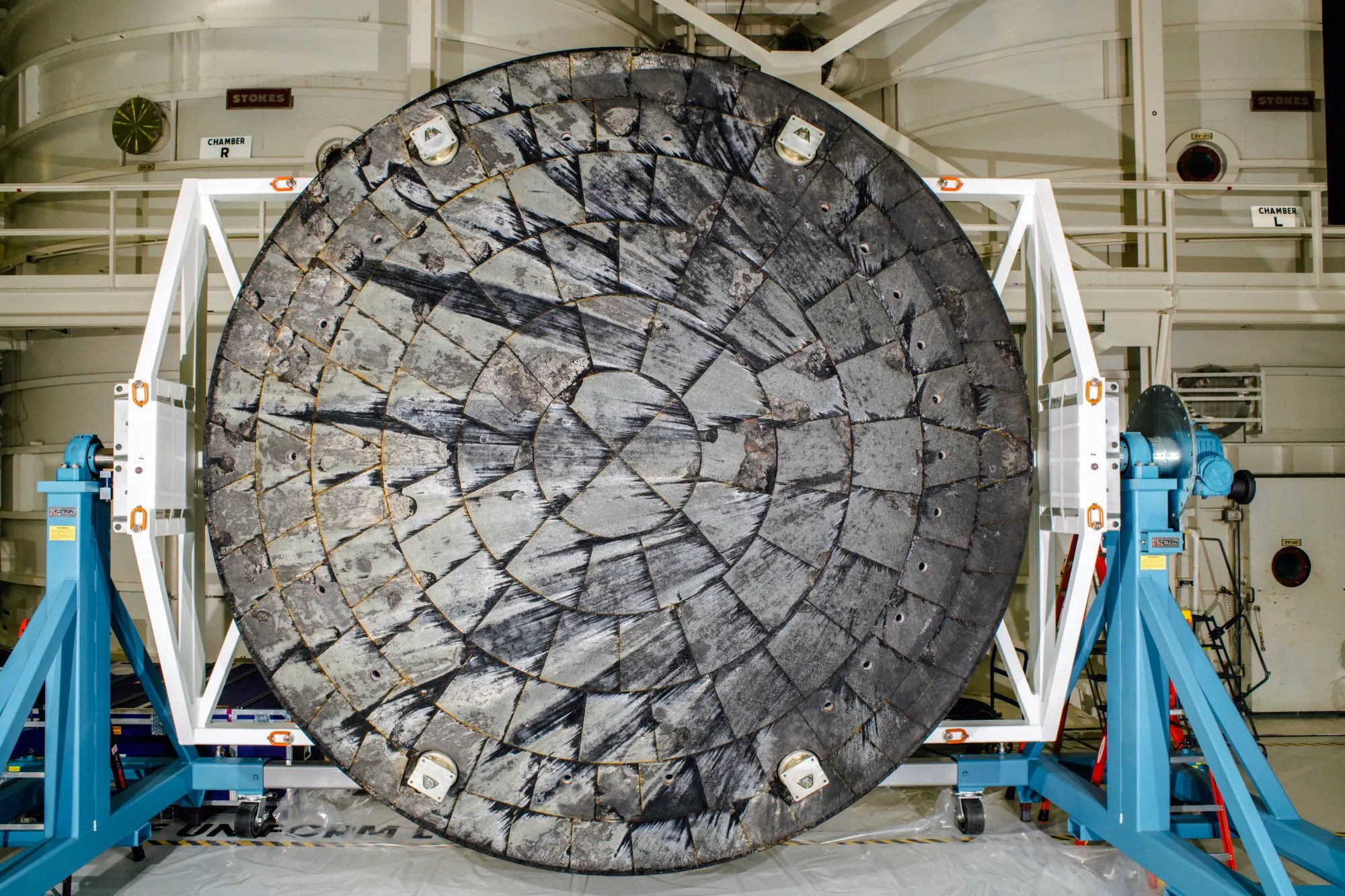
Image (Credit): The recovered Orion heat shield at NASA’s Kennedy Space Center in Florida. (NASA)

Orion heat shield issues have contributed to more delays with the Artemis II (crewed capsule around the Moon) and Artemis III (crewed capsule lands on the Moon) missions. The Artemis II launch has moved from September 2025 to April 2026, while the Artemis III launch has moved from 2026 to mid-2027.

NASA still has plenty of time to beat the China back to the Moon given that China is still aiming for a 2030 human landing on the lunar surface. Even so, this is not a good time to be highlighting the engineering weaknesses in the Artemis program. We know that the incoming administration is likely to ask a lot of questions.

You can watch the entire NASA news conference discussing the delays here.

Nominee Jared Isaacman’s Statement

Credit: Image by OpenClipart-Vectors from Pixabay

This is what Mr. Isaacman posted on Twitter/X after being nominated to be the next administrator of NASA:

I am honored to receive President Trump’s…nomination to serve as the next Administrator of NASA. Having been fortunate to see our amazing planet from space, I am passionate about America leading the most incredible adventure in human history.

On my last mission to space, my crew and I traveled farther from Earth than anyone in over half a century. I can confidently say this second space age has only just begun. Space holds unparalleled potential for breakthroughs in manufacturing, biotechnology, mining, and perhaps even pathways to new sources of energy. There will inevitably be a thriving space economy—one that will create opportunities for countless people to live and work in space. At NASA, we will passionately pursue these possibilities and usher in an era where humanity becomes a true spacefaring civilization.

I was born after the Moon landings; my children were born after the final space shuttle launch. With the support of President Trump, I can promise you this: We will never again lose our ability to journey to the stars and never settle for second place. We will inspire children, yours and mine, to look up and dream of what is possible. Americans will walk on the Moon and Mars and in doing so, we will make life better here on Earth.

It is the honor of a lifetime to serve in this role and to work alongside NASA’s extraordinary team to realize our shared dreams of exploration and discovery.

Grateful to serve,

Jared

I find it interesting that his first mention of space accomplishments was his own private flight into orbit rather than the amazing things NASA has already accomplished and plans to do. He also seems to think his space venture brought on the second space age, maybe unaware that the movement towards commercial partnerships started with the Obama administration.

And the statement “Americans will walk on the Moon and Mars” should probably be “Americans will walk on the Moon again and Mars as well.” He admitted that he missed the Moon landing and his kids missed the space shuttle, but let’s treat them like milestones rather than missed opportunities.

I am skeptical that this will be good for NASA, but maybe having a buddy running the agency will give Mr. Musk second thoughts about stripping it down for parts like a Jawa sandcrawler.

Maybe.

Pic of the Week: The Best of 2024

Image (Credit): Odysseus Leaves Earth. (Intuitive Machines)

This week’s image is the best space exploration image winner in The Planetary Society’s Best of 2024 contest. It shows the Odysseus lunar lander, launched on February 15, leaving the Earth behind as it travels to the Moon. You can read more about the lunar mission to the lunar South Pole by visiting this NASA mission page.

Visit The Planetary Society for more on the Best of 2024 winners, including the most exciting upcoming planetary science mission. I won’t spoil the news. You can read about it yourself.