Time to Think About Christmas Shopping

Image (Credit): NASA astronaut water blaster. (NASA Gear)

With Thanksgiving behind us and Black Friday here, it is time to start thinking about that star-gazing person in your life. Fortunately, The Planetary Society is already sharing some gift ideas, including the Astronaut Space Pack Water Blaster (shown above) for the smaller Earth-bound people in your life. Or maybe the Constellations Rocks Glass (shown below) is a better option for the person on your gift list.

I will share some other ideas as Christmas approaches, but I wanted to get the process started.

Only 26 shopping days left!

Image (Credit): Constellations rocks glass (Interstellar Seller)

Pic of the Week: Thanksgiving on the ISS

Image (Credit): Expedition 72 astronauts on the ISS celebrating Thanksgiving. (NASA)

This week’s image shows the four US astronauts aboard the International Space Station (ISS) showing their Thanksgiving meal to all of us (contained in the white plastic bags). The astronauts pictured (clockwise from bottom left) are Nick Hague, Suni Williams, Butch Wilmore, and Don Pettit. You also watch a video where they share their holiday messages.

Podcast: Neil deGrasse Tyson in the Hot Seat

Last week’s Real Time with Bill Maher included an interview with astrophysicist Neil deGrasse Tyson, which did not go very well given the line of questioning. Mr. Maher was trying to entrap Dr. Tyson into some anti-woke politics, but he did not play along.

With all the topics Dr. Tyson could address on the show, it was a waste of time for viewers to witness this ambush. Mr. Maher continues to forget that he is a comedian and his guests come onto the show to have some fun. You can listen to the mess here.

Fortunately, the Overtime show after the main show, which focuses on questions from the audience, finally addressed some space-related questions, including one about Mr. Musk’s plans to go to Mars. Dr. Tyson said the costs, risks, and return on investment do not currently justify such a mission. However, he pointed out that once it becomes a space race with China then it may be something worth pursuing.

It was an interesting answer, and yet it seemed to ignore that we already have decided as a nation to go to Mars under the Artemis program even with the cost, risks, and lack of return on investment. It has a different time-table than Mr. Musk’s vision, but it is a plan that seems to be in place at the moment.

Maybe Dr. Tyson believes that too will be a space race similar to what it going on now with China regarding a Moon landing. It seems more likely than not at the moment.

Anyway, ignore the main show and tap into the Overtime show for some fun space-related discussions.

Space Quote: A Rolls Royce on the Moon?

Image (Credit): Artist’s rendering of a lunar base. (NASA)

“We believe once governments and the Artemis missions have re-established human presence on the moon, commercial services will follow that…every operation on the moon will require power”.

-Statement by Jake Thompson, director of novel nuclear and special projects at Rolls-Royce, in a Financial Times article. Rolls Royce is working on a micro nuclear reactor for use on space missions.

Martian Space Stories: Ocean Shoreline Located, Rings Turned to Moons, and Ancient Liquid Water

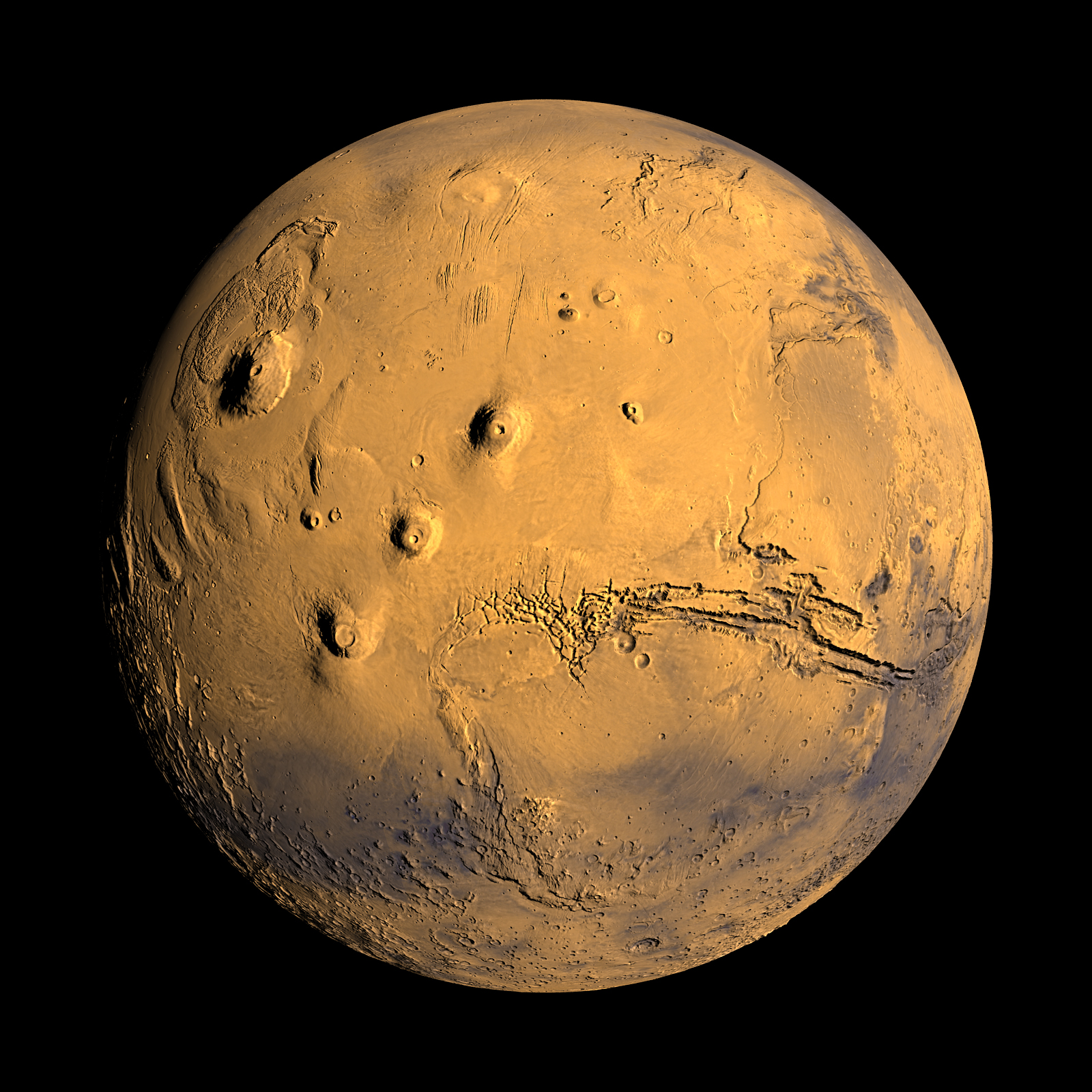
Image (Credit): The Red Planet. (NASA/JPL)

Here are some recent stories on Mars.

Earth.comChina’s Mars Zhurong Rover Finds an Ocean Shoreline on the Red Planet

The Chinese Mars rover Zhurong is adding an exciting twist to the story and history of water on Mars. After landing in southern Utopia Planitia on Mars in May 2021, the now-defunct Zhurong rover went to work exploring the Martian surface, and its latest findings might just change the way we think about the Red Planet. Bo Wu and a team of researchers from Hong Kong Polytechnic University believe they’ve found compelling evidence of an ocean shoreline for a massive body of water that once covered Mars’ northern lowlands.

New York TimesAn Asteroid’s Destruction May Have Given Mars Rings, Then Moons

Something’s not quite right about the moons of Mars. They are too small — Phobos is 17 miles across, and Deimos is a mere nine miles in length. And they aren’t round, but lumpy, misshaped objects. Frankly, they don’t resemble moons at all…A study published Wednesday in the journal Icarus makes a case that the moons did indeed start out in asteroid form. But it’s not the genesis everyone was expecting. Using supercomputer-powered simulations, scientists describe a situation in which a large-enough asteroid was captured by Mars long ago and torn to shreds by the planet’s gravity, briefly forming a debris cloud — and possibly a ring system — around Mars that ultimately clumped together to form two moons.

Astrobiology NewsMeteorite Contains Evidence Of Liquid Water On Mars 742 Million Years Ago

An asteroid struck Mars 11 million years ago and sent pieces of the red planet hurtling through space. One of these chunks of Mars eventually crashed into the Earth somewhere near Purdue and is one of the few meteorites that can be traced directly to Mars. This meteorite was rediscovered in a drawer at Purdue University in 1931 and therefore named the Lafayette Meteorite. During early investigations of the Lafayette Meteorite, scientists discovered that it had interacted with liquid water while on Mars. Scientists have long wondered when that interaction with liquid water took place. An international collaboration of scientists including two from Purdue University’s College of Science have recently determined the age of the minerals in the Lafayette Meteorite that formed when there was liquid water. The team has published its findings in Geochemical Perspective Letters.