A Day in Astronomy: Death of Hermann Oberth

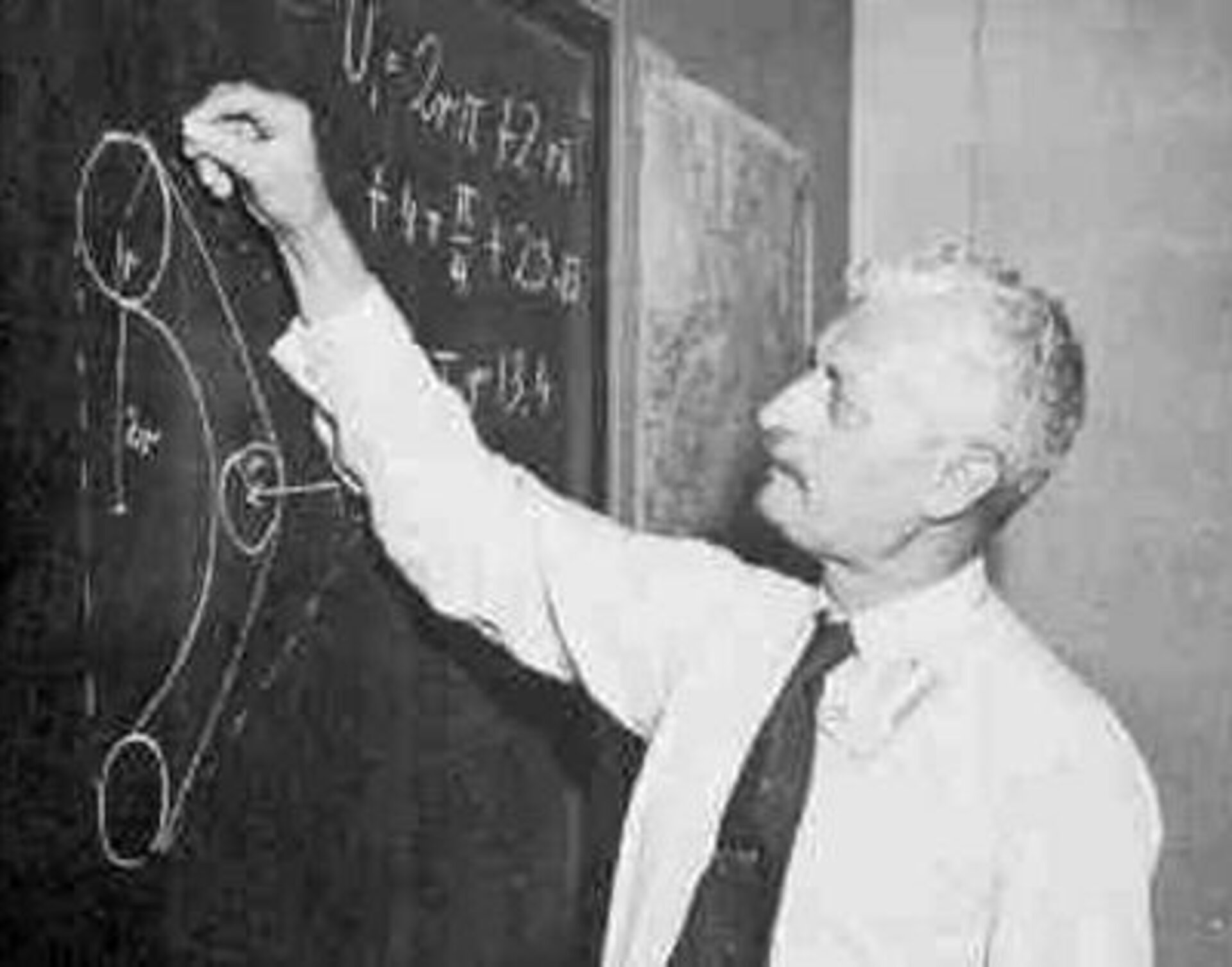
Image (Credit): Hermann Julius Oberth. (European Space Agency)

On this day in 1989, rocket pioneer Hermann Julius Oberth died. He was born in Austria-Hungary in 1894 and at a young age was inspired by the rockets in the fictional stories by Jules Verne, such as From the Earth to the Moon.

Oberth’s interest in the stories of Verne led him to build his first rocket at the age of 14. His doctoral dissertation was on rocketry, he wrote books on rocketry, and he later joined an amateur rocketry group called the “Spaceflight Society” where he mentored other rocket enthusiasts, including Wernher von Braun.

Oberth was unable to get a security clearance to work on the Nazis V-2 rocket, thereby limiting his value to Americans following World War II, unlike Wernher von Braun and others who came to the United States under Project Paperclip and later assisted with NASA’s Apollo program.

Wernher von Braun was still able to get Oberth a position with the U.S. Army after the war and paid tribute to his mentor by stating:

I have a boundless admiration for the solitary genius which enabled him to bring into focus all of the essential elements of a gigantic concept, together with the human greatness which allowed him, in shy reserve, to bear with equanimity the “crucify him” as well as the “hosannas” of public opinion. I myself owe him a debt of gratitude not only for being the guiding light of my life but also for my first contact with the theoretical and practical aspects of rocket technology and space travel.

Oberth continues to be known today as the “Father of Space Travel.”

A Day in Astronomy: The Death of Percival Lowell

Image (Credit): Percival Lowell’s mausoleum just steps away from the Lowell Observatory in Flagstaff, AZ. (Atlas Obscura)

On this day in 1916, American astronomer Percival Lowell died at the age of 61 in Flagstaff, AZ. He will forever be remembered for his incorrect theory concerning canals on Mars as well as his better theory about a ninth planet, which contributed to the discovery of Pluto 14 years by Clyde Tombaugh, who was working at the Lowell Observatory in Flagstaff.

Some interesting facts about Mr. Lowell’s life includes:

  • After graduating from Harvard with a degree in mathematics yet spent six years running a cotton mill;
  • He traveled extensively to Asia and wrote numerous books about the region;
  • He was a dedicated pacifist; and
  • His greatest contribution to astronomy related to the preferred placement of observatories.

Mr. Lowell was far from the mark when he said this about Mars:

Speculation has been singularly fruitful as to what these markings on our next to nearest neighbor in space may mean. Each astronomer holds a different pet theory on the subject, and pooh-poohs those of all the others. Nevertheless, the most self-evident explanation from the markings themselves is probably the true one; namely, that in them we are looking upon the result of the work of some sort of intelligent beings. . . . The amazing blue network on Mars hints that one planet besides our own is actually inhabited now.

Yet it is too early to say he was also dreaming when he made this comment:

Now when we think that each of these stars is probably the centre of a solar system grander than our own, we cannot seriously take ourselves to be the only minds in it all.

A Day in Astronomy: The Arrival of the Expedition 1 Crew at the ISS

Image (Credit): The Expedition 1 crew of Yuri P. Gidzenko (left), William M. Shepherd, and Sergei K. Krikalev in the ISS’s Zvezda Service Module. (NASA)

It was 25 years ago on this day that the Expedition 1 crew arrived at the International Space Station (ISS), which marked the beginning of very successful space collaboration between five space agencies from the United States, Russia, the European Union, Japan, and Canada.

The Expedition 1 crew, arriving at the ISS aboard a Russian Soyuz capsule, consisted of NASA astronaut William M. Shepherd and Russian cosmonauts Yuri P. Gidzenko and Sergei K. Krikalev. This first mission of four months focused on the continued assembly of the station, with the Expedition 2 crew arriving in March 2001 aboard Space Shuttle Discovery.

Some of the key facts related to the ISS include:

  • In 24 hours, the space station makes 16 orbits of Earth, traveling through 16 sunrises and sunsets.
  • The living and working space in the station is larger than a six-bedroom house (and has six sleeping quarters, two bathrooms, a gym, and a 360-degree view bay window).
  • A spacecraft can arrive at the space station as soon as four hours after launching from Earth.
  • The space station travels an equivalent distance to the Moon and back in about a day.
Image (Credit): Drawing of the International Space Station with all of the elements labeled. (NASA)

A Day in Astronomy: Letter to General Secretary Brezhnev

Image: USSR 1991 Yuri A. Gagarin Stamps.

The U.S. has plenty of issues regarding the pace of its space programs in the face of Chinese achievements, as noted multiple times in posts on this site. We should not see this as anything new. U.S. politicians and citizens had plenty of similar complaints during the space race with the USSR, and we also have evidence of similar complaints within the USSR.

For instance, on this day in 1965, Yuri Gagarin, the first man in space, wrote a letter with other cosmonauts to the USSR’s General Secretary Brezhnev with a list of concerns. The letter stated, in part:

The USA have not only caught up with us, but even surpassed us in certain areas. The flights of space vehicles Ranger-7, Ranger-8, Mariner-4, Gemini-5, and others are serious achievements of American scientists. This lagging behind of our homeland in space exploration is especially objectionable to us, cosmonauts, but it also damages the prestige of the Soviet Union and has a negative effect on the defense efforts of the countries from the socialist camp…Why is the Soviet Union losing its leading position in space research? A common answer to this question answer is as follows: the USA have developed a very wide front of research in space; they allocate enormous funds for space research. In the past 5 years they spent more than 20 billion dollars, and in 1965 alone 7 billion dollars. This answer is basically correct. It is well known that the USA spend on space exploration much more than does the USSR.

The letter covers other issues, including battles between the various organizations involved in space affairs as well as a stated preference by some for robotic flights rather than manned-flights.

It is an interesting reminder that the same issues constantly crop up to potentially cripple space initiatives, and today’s leader in space can quickly fall behind.

A Day in Astronomy: The Discovery of Phobos

Image (Credit): Mar’s moon Phobos. (NASA / JPL-Caltech / University of Arizona)

On this day in 1877, American astronomer Asaph Hall discovered the Martian moon Phobos while at the US Naval Observatory in Washington, D.C. He had discovered Mar’s other moon Deimos six days earlier.

Oddly enough, the idea of two moons orbiting Mars was first proposed in 1726 by Jonathan Swift in his tale Gulliver’s Travels. In the book, astronomers on the flying island of Laputia were noted to have

… discovered two lesser stars, or satellites, which revolve around Mars, whereof the innermost is distant from the center of the primary exactly three of his diameters, and the outermost five: the former revolves in the space of ten hours, and the latter in twenty-one and a half.

All Professor Hall had to do was confirm the work of the Laputian astronomers.