Image (Credit): Shan Shan (left) and Xiao Bao. (South China Morning Post)
On this day in 1966, China launched a male puppy named Xiao Bao (meaning Little Leopard) into space. He was used to test the effects of space and was safely recovered after the flight.
Thirteen days later a female puppy named Shan Shan (meaning Coral) was also launched into space. She too was safely recovered.
This is a much better tale than that of Laika, the dog that the USSR sent into orbit in 1957. As stray dog from the streets of Moscow, she only lasted a few hours after the launch, eventually dying of hyperthermia.
Image (Credit): Laika in a training capsule before her mission to space. (Sputnik / Alamy)
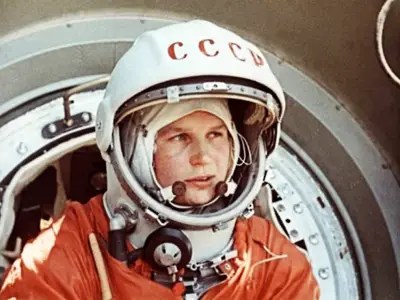
Image (Credit): ValentinaTereshkova just before boarding her Vostok 6 capsule. (NASA)
On this day in 1963, Valentina Vladimirovna Tereshkova from the USSR became the first woman in space. She flew solo on the Vostok 6 for three days. It was her first and last time in space. Her importance as a symbol for women and the USSR meant she would never fly again lest something happen to her.
They forbade me from flying, despite all my protests and arguments. After being once in space, I was desperately keen to go back there. But it didn’t happen.
On this same day in 1977, German-American Wernher von Braun passed away. As the chief designer of the Saturn rockets that took men to the Moon, he was to see all of the Apollo missions before his death.
He is also quoted as saying:
I’m convinced that before the year 2000 is over, the first child will have been born on the moon.
It is unlikely he would have believed that it would be another 50 years before we found our way back to the Moon.
Image (Credit): Braun standing next to the first stage of the Saturn V booster he helped design. (NASA)
On this day in 1961, President John F. Kennedy addressed a joint session of Congress and called for landing a man on the Moon. An excerpt from that address is provided below:
First, I believe that this nation should commit itself to achieving the goal, before this decade is out, of landing a man on the moon and returning him safely to the earth. No single space project in this period will be more impressive to mankind, or more important for the long-range exploration of space; and none will be so difficult or expensive to accomplish. We propose to accelerate the development of the appropriate lunar space craft. We propose to develop alternate liquid and solid fuel boosters, much larger than any now being developed, until certain which is superior. We propose additional funds for other engine development and for unmanned explorations–explorations which are particularly important for one purpose which this nation will never overlook: the survival of the man who first makes this daring flight. But in a very real sense, it will not be one man going to the moon–if we make this judgment affirmatively, it will be an entire nation. For all of us must work to put him there.
On this day in 1962, the United States launched the Ranger 4 lunar probe from Cape Canaveral. Its mission was to photograph the lunar surface, place scientific equipment on the Moon, and perform other tests before crashing into the surface of the Moon. A computer glitch caused the probe to crash on the far side of the Moon before it could send back any useful data. Nonetheless, it was the first US spacecraft to reach another moon or planet (the Soviets had reached the Moon in 1959) as well as the first spacecraft to reach the far side of the Moon.
NASA launched a total of nine probes to the Moon under the Ranger program, with the last missions – Rangers 7,8, and 9 – being successful. Rangers 1 and 2 never left Earth orbit, while Rangers 3 and 5 missed the moon altogether. As noted above, Ranger 4 made it to the Moon, but not where is was supposed to land. And Ranger 6 made it to the Moon, but experienced a camera failure.
The Ranger missions set the stage for the later Apollo missions, which allowed the US to put the first man on the Moon.
Image (Credit): Wernher von Braun (center) with President John F. Kennedy discussing the Saturn Launch System. (NASA)
On this day in 1912, Wernher Magnus Maximilian, Freiherr von Braun was born in Wyrzysk (once German, now Polish). He became an aerospace engineer for both the Germans during World War II as well as the Americans following the war.
Wernher von Braun designed the V-2 rocket that terrorized Great Britain during the war. He used that knowledge to assist NASA with the Saturn V rocket that became the backbone of the Apollo Moon missions.
In a speech on the eve of the Apollo 11 launch, he stated:
If our intention had been merely to bring back a handful of soil and rocks from the lunar gravel pit and then forget the whole thing, we would certainly be history’s biggest fools. But that is not our intention now—it never will be. What we are seeking in tomorrow’s [Apollo 11] trip is indeed that key to our future on earth. We are expanding the mind of man. We are extending this God-given brain and these God-given hands to their outermost limits and in so doing all mankind will benefit. All mankind will reap the harvest…. What we will have attained when Neil Armstrong steps down upon the moon is a completely new step in the evolution of man.
This was only 24 years after the end of World War II. He came a long way from his days of bombing his fellow citizens in Europe.
More than 50 after the last Apollo launch we are still trying to “reap the harvest” started by those earlier missions.