A Day in Astronomy: Launch of the Phoenix Mars Lander

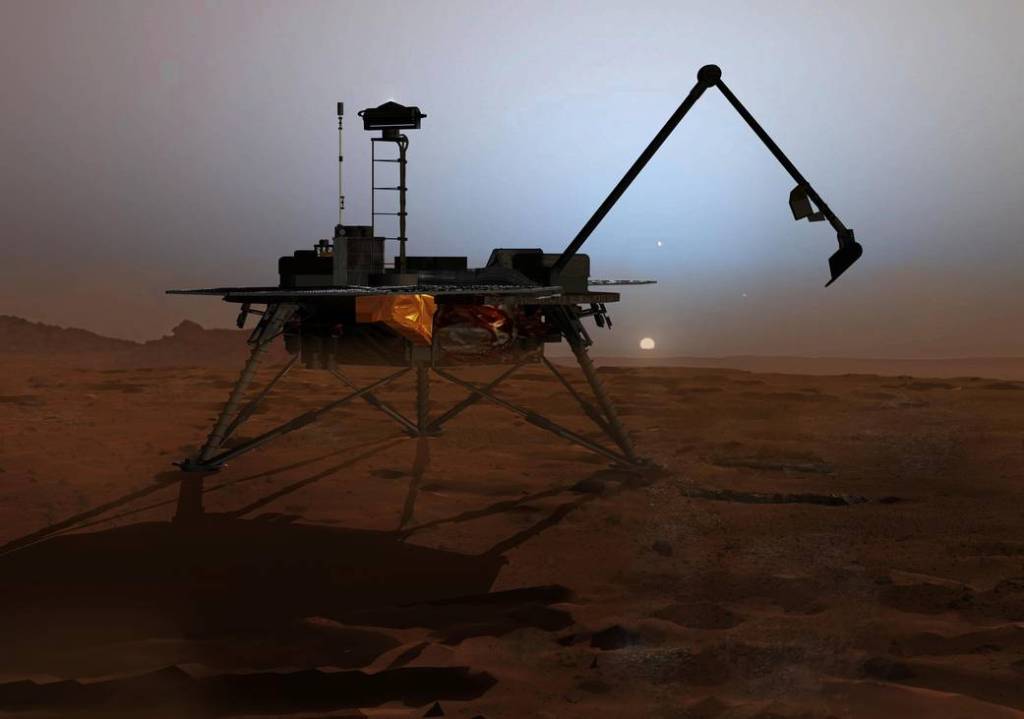
Image (Credit): Artist’s rendering of the Phoenix Mars Lander on the surface of Mars. (NASA/JPL-Calech/University of Arizona)

On this day in 2007, NASA launched the Phoenix Mars Lander from Cape Canaveral towards the Red Planet. The lander had two key objectives: (1) to study the history of water in the Martian arctic and (2) to search for evidence of a habitable zone and assess the biological potential of the ice-soil boundary.

The lander set down on Mars on May 25, 2008 and continued with its mission until November of that same year. The lander performed numerous tests on the Martian surface, confirmed the presence of water, and even discovered water ice right below where it landed. The lander also found perchlorate in the soil, which could be a source of oxygen for future missions.

The mission ended when the Martian winter diminished the sunlight needed to run the solar panels. The Phoenix Mars Lander did not survive the winter, but it successfully accomplished its mission.

Image (Credit): Phoenix Mars Lander mission patch. (NASA)

Pic of the Week/A Day in Astronomy: Moon Landing

Image (Credit): Astronaut Edwin E. (Buzz) Aldrin Jr., Lunar Module (LM) pilot, climbs down the LM ladder, preparing for his first steps on the Moon. (NASA)

On this day in 1969, the Apollo 11 crew stepped on the Moon for the first time, showing that mankind could actually travel to another world. The image above shows Astronaut Buzz Aldrin preparing the step on the Moon as the second human to ever walk on the lunar surface.

Buzz Aldrin has plenty of quotes related to his Moon mission and life in general, but I like his quotes about our next trip to Mars, like this one:

When we set out to land people on the surface of Mars, I think we should as a nation, as a world, commit ourselves to supporting a growing settlement and colonization there. To visit a few times and then withdraw would be an unforgivable waste of resources.

NASA’s Artemis mission is retracing Buzz Adrin’s steps, which is a good sign given that we visited only a few times and then withdrew for decades. Let’s hope Artemis gets us settlements on both the Moon and Mars.

A Day in Astronomy: The Beginning of Radio Astronomy

Image (Credit): Karl G. Jansky Very Large Array in New Mexico. (NRAO)

On this day in 1933, American physicist and radio engineer Karl Guthe Jansky created the science of radio astronomy by publishing “”Radio Waves From Outside the Solar System” discussing his discovery that radio waves were emanating from the center of the Milky Way galaxy.

Unfortunately, Mr. Jansky was not a trained astronomer, so he was not in a position to develop the field of radio astronomy. He then died at the age of 44, which denied his the chance to earn a Nobel Prize for his finding, though he was nominated for the 1948 Nobel Prize in Physics.

Fortunately, the National Radio Astronomy Observatory’s (NRAO) Very Large Array was later rededicated as the “Karl G. Jansky Very Large Array,” an appropriate gesture to remember his incredible contribution to astronomy.

You can read more about Mr Jansky on this NRAO history page.

A Day in Astronomy: Sally Ride and Valentina Tereshkova

Credit: The San Diego Union

On this day in 1983, astronaut Sally Ride became the first American woman in space, traveling aboard the shuttle Challenger. And 20 years earlier on the same date, Russian cosmonaut Valentina Tereshkova, the first Russian female in space, returned to Earth aboard Vostok 6, after orbiting the planet 48 times. She still remains the only woman to travel into space on a solo mission.

Image (Credit): Cosmonaut Valentina Tereshkova (New Mexico Museum of Space History)

A Day in Astronomy: The Founding of the European Space Agency

On this day in 1975, the European Space Agency (ESA) was founded after the combination of  the European Space Research Organisation (ESRO) and the European Launcher Development Organisation (ELDO). Ten countries were part of this new organization, which has since grown to 22 members (noted below). The Agency also has associate members and other cooperating partners.

You can find a list of the ESA’a past, present, and planned space missions here, which includes:

Note: According to the International Astronautical Federation, the ESA member include Austria, Belgium, the Czech Republic, Denmark, Estonia, Finland, France, Germany, Greece, Hungary, Ireland, Italy, Luxembourg, the Netherlands, Norway, Poland, Portugal, Romania, Spain, Sweden, Switzerland and the United Kingdom. Latvia, Lithuania and Slovenia are Associate Members. Canada takes part in certain programmes under a cooperation agreement. ESA has signed European Cooperating States Agreements with Bulgaria, Cyprus and Slovakia, and cooperation agreements with Croatia and Malta.