In Case You Missed It/Video: The Stakes Are High with Our Return to the Moon

Image (Credit): Moving the Artemis I mission into place. (NASA)

With the recent glitches related to the two commercial Moon missions, an earlier NASA video on the Artemis program became all too relevant. In the video, “Farther and Faster: NASA’s Journey to the Moon with Artemis,” we hear that the stakes are high as we attempt to return to the Moon, and how we could be the generation that loses the Moon if we don’t get it right.

In addition to the risks, the video also highlights the great successes already with the Artemis I mission, as you may recall from back in 2022:

Over the course of 25.5 days, Orion performed two lunar flybys, coming within 80 miles (129 kilometers) of the lunar surface. At its farthest distance during the mission, Orion traveled nearly 270,000 miles (435,000 kilometers) from our home planet. On Dec. 11, 2022, NASA’s Orion spacecraft successfully completed a parachute-assisted splashdown in the Pacific Ocean at 9:40 a.m. PST (12:40 p.m. EST) as the final major milestone of the Artemis I mission.

Artemis I set new performance records, exceeded efficiency expectations, and established new safety baselines for humans in deep space. This is a prelude to what comes next—following the success of Artemis I, human beings will fly around the Moon on Artemis II.

It is worth pondering what we have ahead of us. NASA may be having a few issues with its commercial partners, but the main mission has done well. We cannot be discouraged with a few delays as long as we keep the course. We have done it before and there is no reason we cannot do it again. I say slow and steady.

Mars is the goal, but we need to prove ourselves with the Moon. Check out the video and determine for yourself if we have already made a fair amount of progress.
Second US Moon Mission Expected to End Today

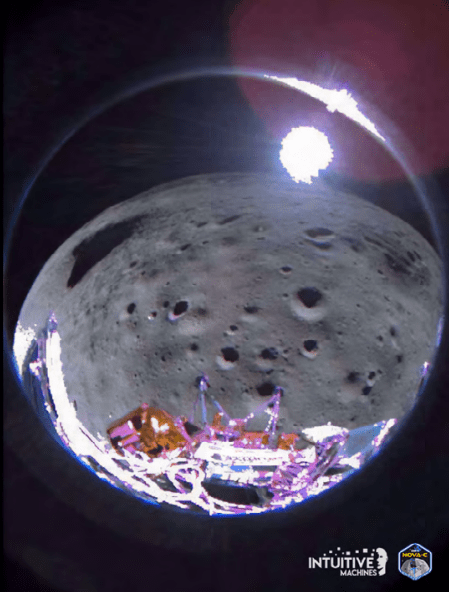
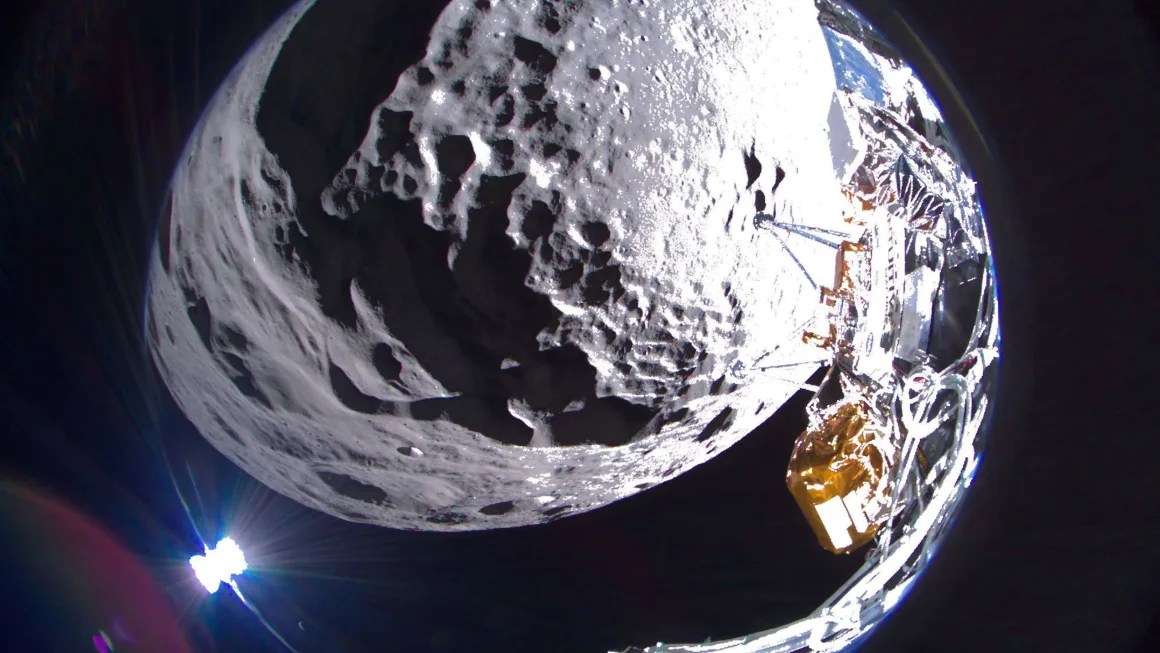
Image (Credit): Odysseus captured this image approximately 35 seconds after pitching over during its approach to the landing site. The camera is on the starboard aft-side of the lander in this phase. (Intuitive Machines)

Well, that was quick. Odysseus may run out of power today given its rough landing, prematurely ending the second US mission to the Moon this year, both of which had problems. It is really amazing that we landed humans on the Moon multiple times for days at a time when you consider the wreckage added to the Moon since then. I know the south pole is a different scenario, but this is where we want to be next. It is looking more and more difficult to do.

Intuitive Machines issued its latest update yesterday:

Odysseus continues to communicate with flight controllers in Nova Control from the lunar surface. After understanding the end-to-end communication requirements, Odysseus sent images from the lunar surface of its vertical descent to its Malapert A landing site, representing the furthest south any vehicle has been able to land on the Moon and establish communication with ground controllersFlight controllers intend to collect data until the lander’s solar panels are no longer exposed to light. Based on Earth and Moon positioning, we believe flight controllers will continue to communicate with Odysseus until Tuesday morning.

It also appears that human error was at the center of the rough landing. Reuters reported yesterday that problems with the range finders related to Intuitive Machine’s decision not to conduct a test firing of the laser system. We learned that the range finders were “…inoperable because company engineers neglected to unlock the lasers’ safety switch before launch.” This may have saved some time and money, but we now see the results.

Mike Hansen, the company’s head of navigation systems, told Reuters:

There were certainly things we could’ve done to test it and actually fire it. They would’ve been very time-consuming and very costly…So that was a risk as a company that we acknowledged and took that risk.

The company made that decision with NASA funds on the line as well. I am not sure NASA would have been so cavalier about final testing. Human error is one thing. Commercial hubris is another. The company’s shortcut is already being reflected in its stock price.

One can certainly argue that progress is being made given that the first lander, Peregrine, never even made it to the Moon’s surface. Such trials and tribulations are to be expected. Yet I wonder if that is how all of the commercial partners see it. Both Moon missions were partially funded by private sector parties who saw their cargoes either burn up in the Earth’s atmosphere and stranded in the wrong position on the Moon. Will they continue to fund such ventures given the risks? Commercial involvement is a key part of the Artemis lunar program and it could be threatened by continuing problems.

The other question is whether these Artemis-related flights will delay the upcoming crewed missions. We should know more shortly, but you can be certain all of this is being factored into timelines being prepared by NASA.

Note: NASA had a press conference the other day on the Intuitive Machines Moon mission that can be found here.

The Moon Landing: Imperfect, but Accomplished

Image (Credit): The Odysseus lunar lander’s view of the moon’s Schomberger crater on Thursday, at about 6 miles altitude and approximately 125 miles uprange from the spacecraft’s intended landing site. (Intuitive Machines)

The United States is back on the Moon, even if the trip was bumpy. Plans to have pictures of the landing via the EagleCam were affected by a last minute switch to a NASA instrument that allowed Odysseus to safely land. The seems to be a fair trade, and the EagleCam can still be used to take pictures now that the lunar lander is stationary on the surface.

Embry‑Riddle Aeronautical University, which created the EagleCam, later noted:

…both the Intuitive Machines and EagleCam teams still plan to deploy EagleCam and capture images of the lander on the lunar surface as the mission continues. The time of deployment is currently unknown.

More importantly, Odysseus stumbled during the landing and is now tipped to one side. A tilted landing disabled the Japanese lunar lander earlier this year. Fortunately, the Odysseus’s solar panels are still catching the Sun’s rays and charging. This should allow the lander to conduct its work for about nine days until the Sun’s location will no longer charge the panels.

It seems the third try this year for the Moon’s south pole was precarious yet ultimately successful. That said, we are finding that the past successes are no guarantee of future success. This is the same region where NASA will be sending the Artemis astronauts. We need to get this right before we drop a crew on the Moon.

All Eyes on the Next Moon Mission

Image (Credit): Intuitive Machines IM-1 mission on the launch pad at NASA’s Kennedy Space Center in Florida. (SpaceX)

The second NASA-related commercial Moon mission was set to launch earlier today, but SpaceX called it off at the last moment due to a methane issue with its Falcon 9 rocket. SpaceX is expected to try the launch tomorrow.

The launch of the Intuitive Machines IM-1 mission is related to NASA’s Commercial Lunar Payload Services (CLPS) initiative, and will serve as one of the first lunar-based pieces of the Artemis program.

In terms of the main mission, NASA noted:

Intuitive Machines’ Nova-C lander is expected to land on the Moon Thursday, Feb. 22. Among the items on its lander, the IM-1 mission will carry NASA science and technology instruments focusing on plume-surface interactions, space weather/lunar surface interactions, radio astronomy, precision landing technologies, and a communication and navigation node for future autonomous navigation technologies.

The Moon mission that failed last month was also part of NASA’s CLPS initiative. This program is off to a slow start, but hopefully it can be relied on to be a key component of the lunar space program going forward.

If you are looking for some good news, I can report that Russia’s Progress MS-26 International Space Station resupply mission successfully launched earlier today.

Space Quote: NASA Cannot Do Everything in this Budget Environment

“The current budget environment has significant implications for mission and safety risk. NASA has a very full mission plate. To the extent that their budget request is not fully funded, the leadership will need to acknowledge and make critical decisions with respect to program content or schedules, which will need to be adjusted to meet fiscal realities. Attempting to do all planned efforts on expected timelines will introduce unacceptable and unmanaged risk. The Agency will need to rely on its developed strategic vision, objectives, and architecture to establish well-defined priorities to ground its endeavors in reality – taking fully into account the risk-benefit tradeoffs.”

-Statement in the Aerospace Safety Advisory Panel’s 2023 Annual Report regarding NASA’s operating environment. One particular area of risk relates to Artemis III, which entails a crewed landing on the Moon. The report states:

In addition, prior to the Artemis III mission, NASA will need to address whatever issues arise from the Artemis II mission, including the possibilities of hardware (HW) and software (SW) changes to both the Space Launch System (SLS) and Orion. Orion flight time on Artemis III will exceed previous durations. Given that it is a new rocket, a new human capsule, and a new human spaceflight environment for this generation of NASA workers, it is not unreasonable to think that NASA will still have a great deal of discovery to do with every Artemis mission for the foreseeable future, and that both schedules and workloads will need to expand accordingly.