Image (Credit): Characters from SyFy’s television series Battlestar Galactica. (SyFy)
“Our findings open a new frontier in astronomy of studying what lies outside the solar system through microscopes rather than telescopes.”
-Statement by Harvard Professor Avi Loeb to USATodayregarding his recent recovery of what is believed to be fragments of an asteroid from outside our solar system that crashed into the Earth back in 2014. More tests are being conducted on the pieces recovered from the Pacific Ocean to determine whether the material is natural or artificially made. If the latter, it may be the first evidence of intelligent life beyond Earth.
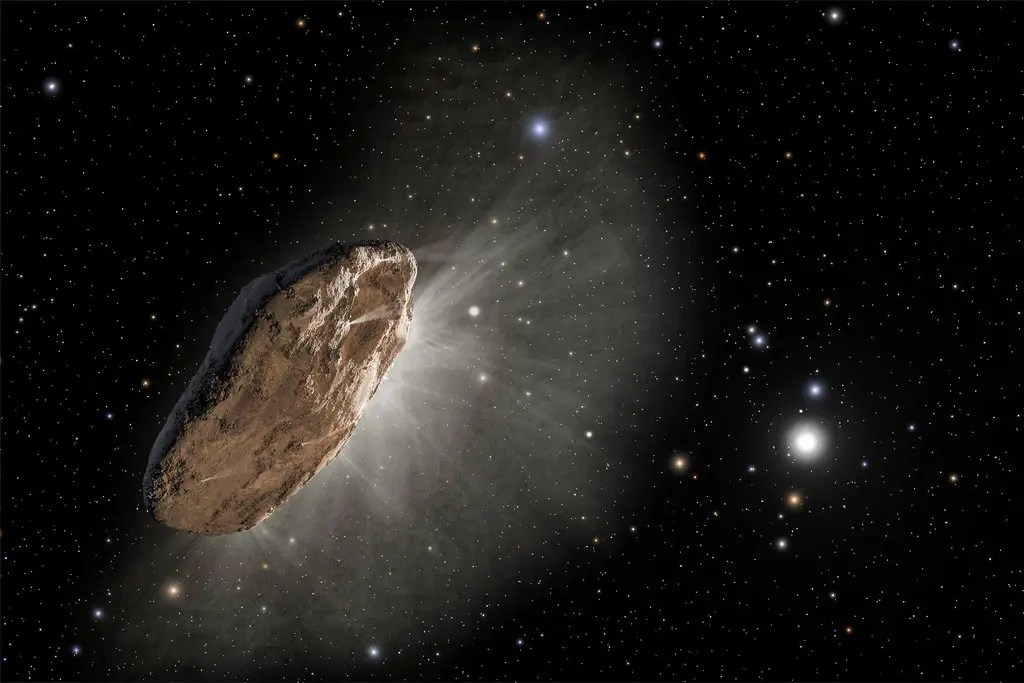
Image (Credit): Artist’s rendering of Oumuamua, an asteroid from outside out solar system. (JPL/NASA)
On International Asteroid Day, I thought it was worth revisiting an earlier video from Cool Worlds Lab on the first detected asteroid from outside our solar system. The video, “‘Oumuamua: An Interstellar Visitor,” notes that scientists have never seen an asteroid within our solar system with these cigar-shaped dimension.
Scientists now believe that more that 10,000 of such alien comments are now present in our solar system. That may offer us an opportunity for a future mission to study such an asteroid and learn about another solar system (given that the asteroids tend to stick around for about 10 years). It may also give us a better idea as whether such asteroids could have introduced life into our solar system.
This is quite a bit to ponder on this day dedicated to pondering asteroids.
This Friday, June 30th, is International Asteroid Day as adopted by the United Nations to “…observe each year at the international level the anniversary of the Tunguska impact over Siberia, Russian Federation, on 30 June 1908, and to raise public awareness about the asteroid impact hazard.”
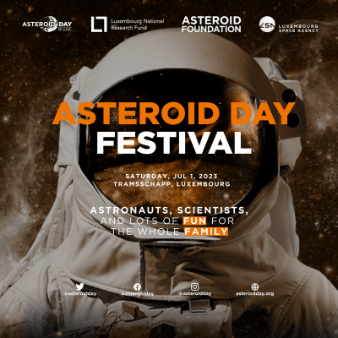
NASA has set up page to celebrate the day, as has the European Space Agency. And the Asteroid Foundation is sponsoring a few days of activities leading up to the July 1 Asteroid Day Festival in Luxembourg.
Or you can simply watch your favorite asteroid disaster film on Friday evening.
However you mark the day, enjoy yourself, and look up!
Elon Musk’s rocket company SpaceX was ready to try again at sending NASA’s next long-duration crew of the International Space Station to orbit on Thursday, about 72 hours after a first attempt was scrubbed due to a clogged filter in the launch system. Two NASA astronauts will be joined by a Russian cosmonaut and an astronaut from the United Arab Emirates for a six-month science mission made up of experiments ranging from human cell growth in space to controlling combustible materials in microgravity.
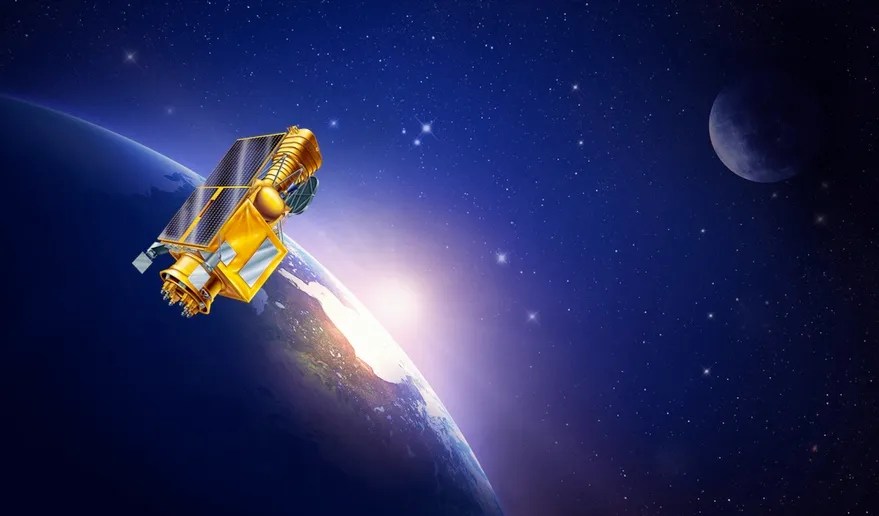
NASA will launch Israel’s first space telescope mission, the Ultraviolet Transient Astronomy Satellite (ULTRASAT). ULTRASAT, an ultraviolet observatory with a large field of view, will investigate the secrets of short-duration events in the universe, such as supernova explosions and mergers of neutron stars. Led by the Israel Space Agency and Weizmann Institute of Science, ULTRASAT is planned for launch into geostationary orbit around Earth in early 2026. In addition to providing the launch service, NASA will also participate in the mission’s science program.
Approximately 20,000 organic molecules composed of carbon, hydrogen, nitrogen, oxygen, or sulfur were found in samples returned to Earth from the asteroid Ryugu by the Japan Aerospace Exploration Agency’s Hayabusa2 mission, according to new work published in two Science papers from an international team that included Carnegie’s George Cody, Jens Barosch, and Larry Nittler. Named after a Japanese folktale, Ryugu is a near-Earth object, half a mile across, shaped kind of like a spinning top that orbits the Sun every 16 months. Hayabusa2 was the first mission to bring material back to Earth from a primitive asteroid, offering unique insight into the building blocks from which our Solar System was formed and the possible origin of organic material that contributed to Earth’s habitability.
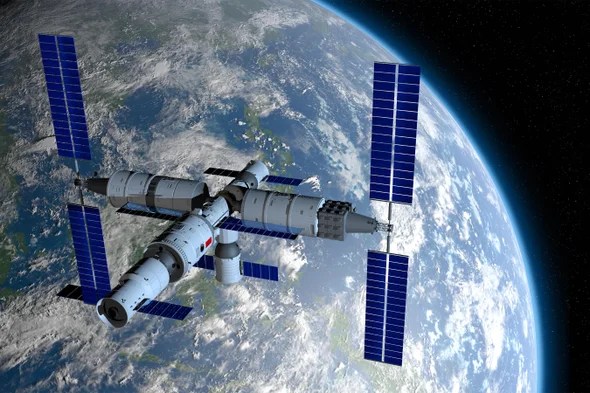
A top official with the European Space Agency said it had no plans to send European astronauts to the newly completed Chinese space station, making it clear for the first time that the agency is no longer committed to working with China in human space flight in the near future. “We are very busy supporting and ensuring our commitments and activities on the International Space Station,” ESA director general Josef Aschbacher told a press conference in Paris on Monday.
Is the Milky Way special, or, at least, is it in a special place in the Universe? An international team of astronomers has found that the answer to that question is yes, in a way not previously appreciated. A new study shows that the Milky Way is too big for its “cosmological wall”, something yet to be seen in other galaxies. The new research is published in Monthly Notices of the Royal Astronomical Society.
NASA’s Lucy spacecraft will add another asteroid encounter to its 4-billion-mile journey. On Nov. 1, 2023, the Southwest Research Institute-led Lucy mission will get a close-up view of a small main belt asteroid to conduct an engineering test of the spacecraft’s innovative asteroid-tracking navigation system. The Lucy mission was already on course to break records by its planned visit of nine asteroids during its 12-year mission to tour the Jupiter Trojan asteroids, which orbit the Sun at the same distance as Jupiter. Originally, Lucy was not expected to get a close-up view of any asteroids until 2025, when it will fly by the main belt asteroid (52246) Donaldjohanson. However, the SwRI-led Lucy team identified a small, as-yet unnamed asteroid in the inner main belt as a potential new and useful target for the Lucy spacecraft.


 Our Awesome Universe