Study Findings: The Variety and Origin of Materials Accreted by Bennu’s Parent Asteroid

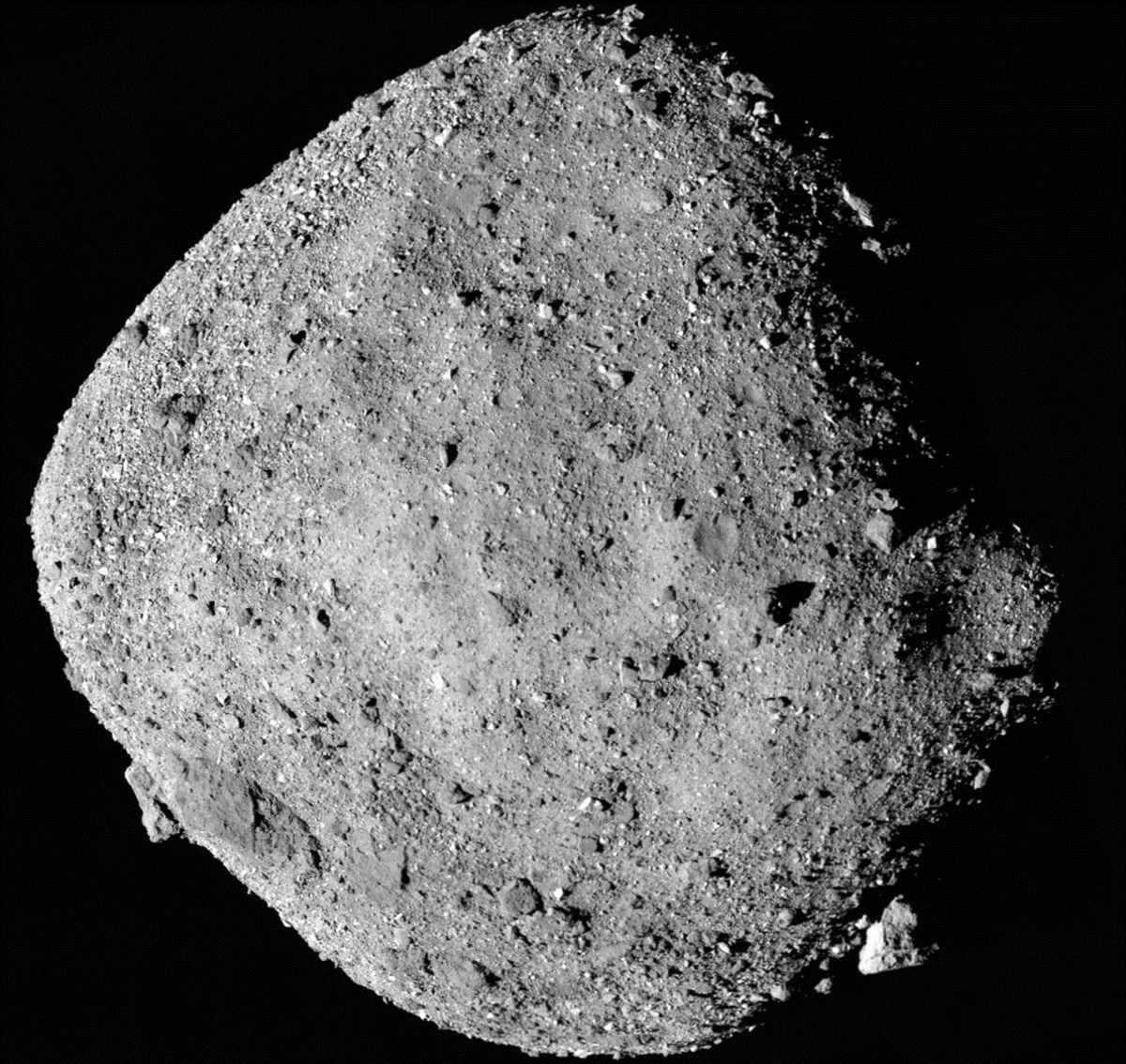
Image (Credit): The asteroid Bennu produced by the OSIRIS-REx spacecraft. (NASA, Goddard and University of Arizona)

Nature Astronomy abstract of the study findings:

The first bodies to form in the Solar System acquired their materials from stars, the presolar molecular cloud and the protoplanetary disk. Asteroids that have not undergone planetary differentiation retain evidence of these primary accreted materials. However, geologic processes such as hydrothermal alteration can dramatically change their bulk mineralogy, isotopic compositions and chemistry. Here we analyse the elemental and isotopic compositions of samples from asteroid Bennu to uncover the sources and types of material accreted by its parent body. We show that some primary accreted materials escaped the extensive aqueous alteration that occurred on the parent asteroid, including presolar grains from ancient stars, organic matter from the outer Solar System or molecular cloud, refractory solids that formed close to the Sun, and dust enriched in neutron-rich Ti isotopes. We find Bennu to be richer in isotopically anomalous organic matter, anhydrous silicates, and light isotopes of K and Zn than its closest compositional counterparts, asteroid Ryugu and Ivuna-type (CI) carbonaceous chondrite meteorites. We propose that the parent bodies of Bennu, Ryugu and CI chondrites formed from a common but spatially and/or temporally heterogeneous reservoir of materials in the outer protoplanetary disk.

Citation: Barnes, J.J., Nguyen, A.N., Abernethy, F.A.J. et al. The variety and origin of materials accreted by Bennu’s parent asteroid. Nat Astron (2025).

https://doi.org/10.1038/s41550-025-02631-6

Study-related stories:

Rowan University – “Connolly: Bennu Samples Reveal Clues to Solar System Origins, Water-rock Chemistry, Space Weathering”

Science Alert – “Asteroid Bennu Samples Contain Stardust Older Than Our Solar System”

Astrobiology – “Asteroid Bennu Is A Time Capsule Of Materials Bearing Witness To Its Origin And Transformation Over Billions Of Years”

Martian Rock Sells for Millions

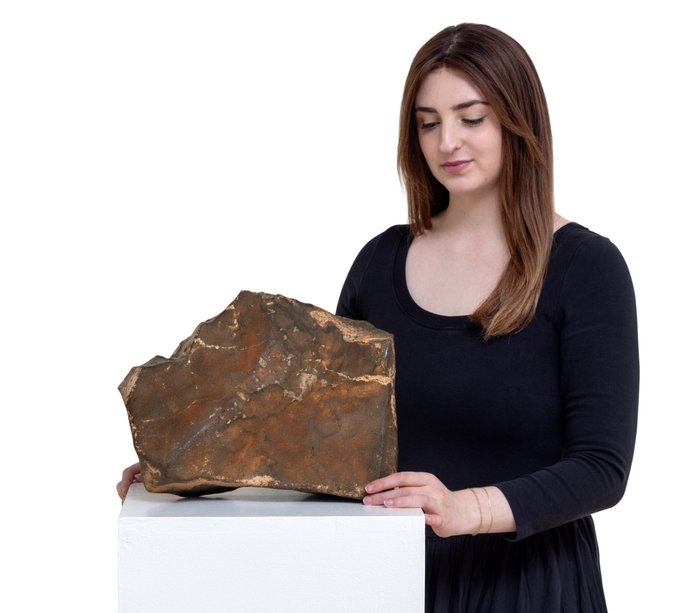
Image (Credit): Mars rock NWA 16788. (Sotheby’s)

NASA may face problems getting Martian rocks back to Earth, but the rocks that already made it this far are being sold to the highest bidder.

Earlier this week a rock from Mars sold for $5.3 million at a Sotheby’s New York auction. Officially named NWA 16788, the meteorite weighs 54 pounds. Located in the Sahara Desert in 2023, it is believed to have traveled to Earth after being blasted off the Martian surface by an incoming asteroid.

So who bought it? That information has not been shared, but if Elon Musk bought it I would consider that cheating. He needs to get to Mars on his own and fulfill his destiny (while giving the rest of us a break).

Podcast: Winter is Coming? I Hope Not

If you missed this podcast three years ago, you will want to catch it now. I listened to it again and enjoyed it just as much as last time.

The Startalk podcast episode it titled “Nuclear Winter with Ann Druyan and Brian Toon” was first broadcast on August 9, 2022, but it was shared again this past July 4th.

Here is a summary of what you will hear:

Are advanced civilizations doomed to destroy themselves? On this episode, Neil deGrasse Tyson and co-host Chuck Nice explore the Cold War, The Drake Equation, and Carl Sagan’s work on the nuclear winter hypothesis with producer of Cosmos and Carl Sagan’s widow Ann Druyan and atmospheric scientist Brian Toon.

Learn about the Future of Life award (details here) and how scientists came up with the nuclear winter hypothesis. How close to annihilation were we? Ann tells us about working with Carl Sagan on Cosmos and his research on this world and others. Find out how Carl Sagan’s research on the climate of Venus inspired work on the runaway greenhouse effect in our own atmosphere. Are scientists always supposed to be dispassionate?

What are the long-term consequences of nuclear war? How did they discover nuclear winter? Find out about volcanic eruptions and how the asteroid that killed the dinosaurs helped spark the idea of a nuclear winter. What happened after the US dropped atomic bombs on Hiroshima and Nagasaki? We learn about what smoke does to the atmosphere and what a post-nuclear world would look like. Why haven’t we seen any other advanced civilizations in the universe? Where are they? We talk about the Drake Equation, the fate of the Earth, and the current state of weapons of mass destruction. How much food would be needed to save up to survive a nuclear winter? Is there anywhere that would be safe?

What was the public’s reaction to nuclear winter? How did it impact geopolitics? Discover how Carl Sagan publicized the hypothesis to US and Russian politicians. Has the global amount of nuclear weapons gone down? We discuss the role of science communication and the concerning instability in the world today. Finally, are we safe?

I don’t want to repeat myself here, so you can read my comments in my earlier post.

Given the continued nasty war between Ukraine and Russia, as well as the recent bombing of nuclear sites in Iran, this episode is still sadly relevant. The discussion about the Reagan administration trying to block scientific inquiry also seems all too familiar today as the Trump administration guts our science programs, including NASA.

I just hope we are in a better place three years from now, both domestically and overseas.

Podcast: The Curious Universe

If you are looking for new podcast material, you may want to check out NASA’s Curious Universe podcast. It has been around for a while, but it is starting a new series celebrating Earth from April 15 to May 13.

The first episode in the new Earth series is titled “How NASA Sees Our Blue Marble.” In the episode, we hear from Karen St. Germain, the director of NASA’s Earth Science Division. It is a chance to learn about the planet that NASA spends the most time studying.

If you like this series, you can go back and listen to other episodes, such as:

-“Inside the Team That Keeps Hubble Flying” (March 14, 2025)
-“The Sun Series” (March 19 to May 3, 2024)
-“Defending the Planet from Asteroids” (February 21, 2023)
-“The Search For Life: Are We Alone?” (June 21, 2022)