Space Stories: Earth’s Second Moon, Organic Molecules on Enceladus, and Mysterious Gullies on Mars

Image (Credit): Earth as observed by the Apollo 11 spacecraft. (NASA/JSC)

Here are some recent space-related stories of interest.

The Economic Times: NASA Confirms Earth Has a Second Moon, And It Will Stay With Us Until 2083

Earth has received a new cosmic partner, a small asteroid designated as 2025 PN7. NASA confirmed this week that the object, initially found by the University of Hawaii, qualifies as a “quasi-moon” , an uncommon type of celestial body that moves almost similarly in sync with Earth. While not a real moon, it has a similar orbit surrounding the Sun, seeming to shadow our planet as it travels through space. Researchers estimate the asteroid measures 18 to 36 meters wide, approximately the height of a small building, making it small by cosmic standards but noteworthy for Earth’s extended neighborhood.

Sky&Telescope: New Study Identifies Organic Molecules Spewing from Saturn’s Icy Moon Enceladus

Twenty years after the Cassini spacecraft discovered an ocean under the icy surface of Saturn’s moon Enceladus, a new study of previously collected data hints at a much better chance for habitability. The change comes from recording how a plume of ice grains hit Cassini just minutes after it erupted from the moon. The close encounter exposed organic compounds not previously seen on Enceladus.

Utrecht University: “Mysterious Gullies on Mars Appear to Have Been Dug, But by Whom or What?

Did life really exist on Mars after all? Unfortunately, there is no conclusive evidence for this yet. Nevertheless, it would seem that some form of life was the driving force behind the mysterious Martian dune gullies. Earth scientist Dr Lonneke Roelofs from Utrecht University has investigated how these gullies were formed. In a test setup, she observed that blocks of CO2 ice ‘dug’ these gullies in a unique way. “It felt like I was watching the sandworms in the film Dune.”

Space Stories: Dragonfly Issues, NASA Under a Government Shutdown, and Threats from Venus

Image (Credit): Artist’s rendering of the Dragonfly on Titan. (NASA/Johns Hopkins APL)

Here are some recent space-related stories of interest.

Physics World: NASA Criticized Over its Management of $3.3bn Dragonfly Mission to Titan

An internal audit has slammed NASA over its handling of the Dragonfly mission to Saturn’s largest moon, Titan. The drone-like rotorcraft, which is designed to land on and gather samples from Titan, has been hit by a two-year delay, with costs surging by $1bn to $3.3bn. NASA now envisions a launch date of July 2028 with Dragonfly arriving at Titan in 2034.

USAToday: Do Rockets Still Launch During a Government Shutdown? How NASA Could Feel the Effects

NASA is far from immune to the effects of a looming government shutdown if congressional leaders fail to reach an agreement before midnight Oct. 1 to prevent one. At stake for the U.S. space agency if the federal government grinds to a halt? The progress of many of its science missions and access to its public outreach arm. NASA’s contingency plan for a shutdown, outlined in a guide from 2018, emphasizes that only “activities which are necessary to prevent harm to life or property” would be exempt from ceasing operations during a shutdown.

Earth Sky: “‘Invisible’ Asteroids Near Venus: A New Danger to Earth?

Astronomers across the globe are dedicated to identifying the near-Earth asteroids that could one day impact our planet. But there might be a group of potentially dangerous nearby asteroids that have remained invisible to astronomers so far. On September 24, 2025, an international team of researchers at the São Paulo State University (UNESP) in Brazil said that a group of asteroids sharing Venus’ orbit could have remained undetected so far due to their location in the sky. And they could pose a threat to Earth within a few thousand years.

Space Stories: Artemis II to Launch February 2026, 10 New Astronauts Selected, and Plans to Destroy an Incoming Asteroid

Image (Credit): Artemis II mission map. (NASA)

Here are some recent space-related stories of interest.

BBC News: Nasa Plans First Crewed Moon Mission in 50 years for February 2026

Nasa has said it hopes to send astronauts on a ten-day trip around the Moon as soon as February. The US space agency had previously committed to launching no later than the end of April but said it aims to bring the mission forward…Artemis Launch Director, Charlie Blackwell-Thompson explained that the powerful rocket system built to take the astronauts to the Moon, the Space Launch System (SLS) was “pretty much stacked and ready to go”. All that remained was to complete the crew capsule, called Orion, connected to SLS and to complete ground tests.

CNN: NASA Selects 10 New Astronauts as it Chases Bold Plans for the Moon and Mars

NASA on Monday introduced the 10 people — selected from a pool of 8,000 applicants — who will join the agency’s astronaut corps as it races to return to the moon before attempting an unprecedented crewed mission to Mars. The group includes six women and four men, whom acting NASA Administrator Sean Duffy called “America’s best and brightest.”…This astronaut class marks the first in which there are more women than men, according to NASA.

IFLScience: “Forget Saving Earth, NASA Wants Us To Save The Moon From Asteroid 2024 YR4

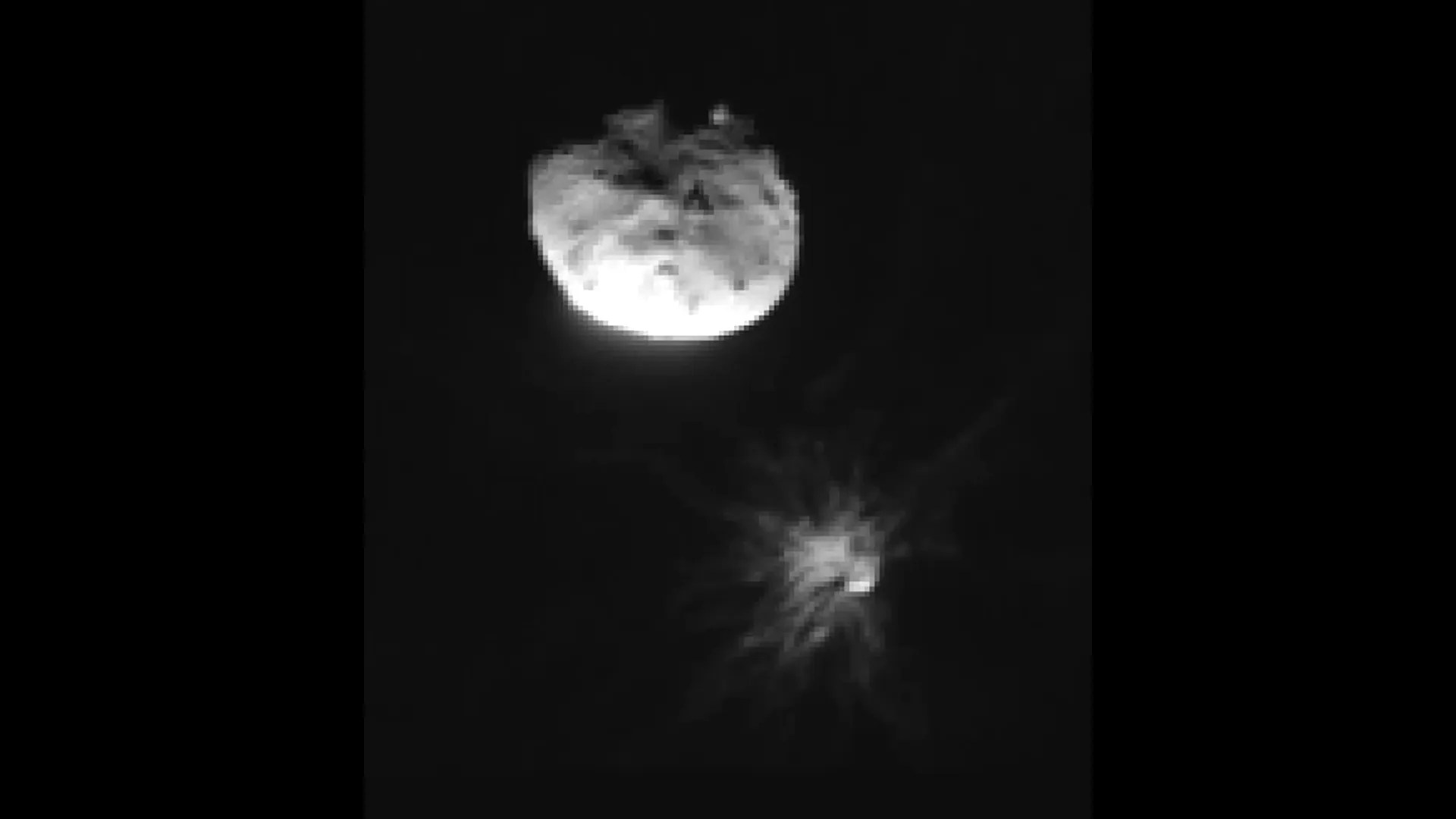
A large asteroid strike on the Moon could have negative consequences for the artificial satellites we now depend on. That being the case, a NASA-led team has looked into the options for preventing Asteroid 2024 YR4 from making such an impact in 2032. Contrary to the usual conclusions that asteroids should be diverted, not destroyed, they think this is a time for a Hollywood-approved demolition event.

Study Findings: The Variety and Origin of Materials Accreted by Bennu’s Parent Asteroid

Image (Credit): The asteroid Bennu produced by the OSIRIS-REx spacecraft. (NASA, Goddard and University of Arizona)

Nature Astronomy abstract of the study findings:

The first bodies to form in the Solar System acquired their materials from stars, the presolar molecular cloud and the protoplanetary disk. Asteroids that have not undergone planetary differentiation retain evidence of these primary accreted materials. However, geologic processes such as hydrothermal alteration can dramatically change their bulk mineralogy, isotopic compositions and chemistry. Here we analyse the elemental and isotopic compositions of samples from asteroid Bennu to uncover the sources and types of material accreted by its parent body. We show that some primary accreted materials escaped the extensive aqueous alteration that occurred on the parent asteroid, including presolar grains from ancient stars, organic matter from the outer Solar System or molecular cloud, refractory solids that formed close to the Sun, and dust enriched in neutron-rich Ti isotopes. We find Bennu to be richer in isotopically anomalous organic matter, anhydrous silicates, and light isotopes of K and Zn than its closest compositional counterparts, asteroid Ryugu and Ivuna-type (CI) carbonaceous chondrite meteorites. We propose that the parent bodies of Bennu, Ryugu and CI chondrites formed from a common but spatially and/or temporally heterogeneous reservoir of materials in the outer protoplanetary disk.

Citation: Barnes, J.J., Nguyen, A.N., Abernethy, F.A.J. et al. The variety and origin of materials accreted by Bennu’s parent asteroid. Nat Astron (2025).

https://doi.org/10.1038/s41550-025-02631-6

Study-related stories:

Rowan University – “Connolly: Bennu Samples Reveal Clues to Solar System Origins, Water-rock Chemistry, Space Weathering”

Science Alert – “Asteroid Bennu Samples Contain Stardust Older Than Our Solar System”

Astrobiology – “Asteroid Bennu Is A Time Capsule Of Materials Bearing Witness To Its Origin And Transformation Over Billions Of Years”

Martian Rock Sells for Millions

Image (Credit): Mars rock NWA 16788. (Sotheby’s)

NASA may face problems getting Martian rocks back to Earth, but the rocks that already made it this far are being sold to the highest bidder.

Earlier this week a rock from Mars sold for $5.3 million at a Sotheby’s New York auction. Officially named NWA 16788, the meteorite weighs 54 pounds. Located in the Sahara Desert in 2023, it is believed to have traveled to Earth after being blasted off the Martian surface by an incoming asteroid.

So who bought it? That information has not been shared, but if Elon Musk bought it I would consider that cheating. He needs to get to Mars on his own and fulfill his destiny (while giving the rest of us a break).