Audit Report: ISS Spacesuit Issues

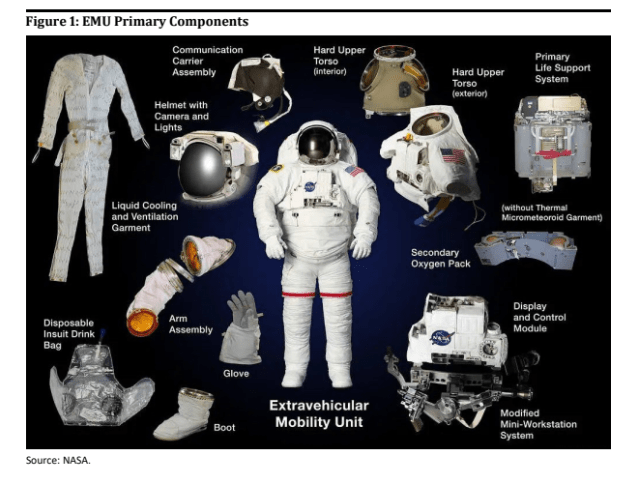
Image (Credit): Figure from the NASA OIG audit report, NASA’s Management of ISS Extravehicular Activity Spacesuits. (NASA OIG)

NASA has spent a significant amount of money on the Extravehicular Mobility Unit (EMU) spacesuits used during spacewalks on the International Space Station (ISS). Even so, these suits have ongoing problems that need to be resolved given that they will be critical to the ISS mission until the decommissioning of the station in 2030.

The NASA Office of Inspector General (OIG) has reported on issues with these spacesuits in the past and recently issued a new report on the status of the spacesuits. In its September 30th report, NASA’s Management of ISS Extravehicular Activity Spacesuit, the auditors noted that the contractor maintaining the spacesuits, Collins Aerospace, is having problems, including:

…considerable schedule delays, cost overruns, and quality issues that significantly increase the risk to maintaining NASA’s spacewalking capability.

The auditors stated that lack of competition for these spacesuit services as well as ineffective contract incentives are making the problems a permanent part of the program. While NASA has promoted competition for many years, these spacesuits designed 50 years ago have not benefited from this new approach, in part because the companies that feed into the supply line are slowly disappearing.

It seems dual-use rockets are much more in demand than antique spacesuits, potentially making spacesuits one of the weaker links in the space industry.

Note: Collins Aerospace ended a separate contract with NASA last year to develop a new ISS EMU. Collins continues with its contract to maintain the current EMU.

Space Stories: Dragonfly Issues, NASA Under a Government Shutdown, and Threats from Venus

Image (Credit): Artist’s rendering of the Dragonfly on Titan. (NASA/Johns Hopkins APL)

Here are some recent space-related stories of interest.

Physics World: NASA Criticized Over its Management of $3.3bn Dragonfly Mission to Titan

An internal audit has slammed NASA over its handling of the Dragonfly mission to Saturn’s largest moon, Titan. The drone-like rotorcraft, which is designed to land on and gather samples from Titan, has been hit by a two-year delay, with costs surging by $1bn to $3.3bn. NASA now envisions a launch date of July 2028 with Dragonfly arriving at Titan in 2034.

USAToday: Do Rockets Still Launch During a Government Shutdown? How NASA Could Feel the Effects

NASA is far from immune to the effects of a looming government shutdown if congressional leaders fail to reach an agreement before midnight Oct. 1 to prevent one. At stake for the U.S. space agency if the federal government grinds to a halt? The progress of many of its science missions and access to its public outreach arm. NASA’s contingency plan for a shutdown, outlined in a guide from 2018, emphasizes that only “activities which are necessary to prevent harm to life or property” would be exempt from ceasing operations during a shutdown.

Earth Sky: “‘Invisible’ Asteroids Near Venus: A New Danger to Earth?

Astronomers across the globe are dedicated to identifying the near-Earth asteroids that could one day impact our planet. But there might be a group of potentially dangerous nearby asteroids that have remained invisible to astronomers so far. On September 24, 2025, an international team of researchers at the São Paulo State University (UNESP) in Brazil said that a group of asteroids sharing Venus’ orbit could have remained undetected so far due to their location in the sky. And they could pose a threat to Earth within a few thousand years.

The USAID OIG Review of Starlink

While Elon Musk has done everything he can to make the U.S. Agency for International Development (USAID) disappear based upon fabricated tales, he has yet to eliminate USAID’s Office of the Inspector General (OIG). In fact, it is the OIG that may be real threat to Mr. Musk given that it initiated a review of Space’s Starlink program in Ukraine.

Back on May 14, 2024, the USAID OIG announced the following review – Inspection of USAID’s Oversight of Starlink Terminals Provided to the Government of Ukraine. The review is to determine how (1) the Government of Ukraine used the USAID-provided Starlink terminals, and (2) USAID monitored the Government of Ukraine’s use of USAID-provided Starlink terminals.

OIG’s perform a variety of reviews over high profile programs to ensure they are working as required. In this case, USAID and Starlink worked together to provide about 5,000 Starlink terminal to Ukraine during its war with Russia. A review does not mean there are problems with a program. Instead, it is simply a review to ensure all is well.

So far, while USAID has disappeared from the Internet, the USAID OIG site is still operating just fine. It should be noted that the IG at USAID has also avoided being unjustly fired by President Trump, something his peers in other agencies cannot say. So maybe things will work out.

Maybe, but when you have outlandish elimination of federal agencies based on fabricated stories, as well as the illegal firing of IGs across the government for no stated reason, I would not want to be the auditors on this team.

If this administration had any interest in improving the federal government, it would have seen the OIGs as an ally to identify fraud, waste, and abuse. That is why the OIGs were created back in the 1970s after the abuses of the Nixon Administration.

What we are seeing now is a whole different game that appears to have nothing to do with improving government. One can only wonder what fraud, waste, and abuse will occur under this administration now that the auditors have been eliminated or scared away.

Update: Well, that did not take long. On February 11, President Trump fired Paul Martin, the IG at USAID, after his office issued an audit critical of recent cuts at the agency. The audit report, Oversight of USAID-Funded Humanitarian Assistance Programming Impacted by Staffing Reductions and Pause on Foreign Assistance, concluded:

USAID OIG’s independent oversight of USAID’s humanitarian assistance programs over the years has identified significant challenges and offered recommendations to improve Agency programming to prevent fraud, waste, and abuse. Our longstanding concerns about existing USAID oversight mechanisms persist. However, recent widespread staffing reductions across the Agency, particularly within BHA, coupled with uncertainty about the scope of foreign assistance waivers and permissible communications with implementers, has degraded USAID’s ability to distribute and safeguard taxpayer-funded humanitarian assistance.

In other words, while Elon Musk’s Department of Government Efficiency (DOGE) did not really detect any fraud, waste, or abuse in USAID’s programs, USAID is now exposed to an increased risk of rampant fraud, waste, and abuse because DOGE illegally shuttered the agency. Are U.S. taxpayers paying attention?

Note: I saved the report below just in case it disappears in the same way all of USAID has disappeared from the Internet.

NASA’s Management Challenges

Image (Credit): The crew of NASA’s upcoming Artemis II mission. (NASA)

With NASA now facing a new administration in Washington, it is worth looking at where the agency is at the moment and what may need some attention. The 2024 Report on NASA’s Top Management and Performance Challenges, released by the NASA Office of the Inspector General (OIG), is a good place to start.

Here are a few of the challenges facing NASA at the moment:

  • Improving the Management of Major Programs and Projects
    • Changing requirements, significant technical issues, increased costs, and schedule delays continue to impact the sustainability of major programs and projects.
    • Cost increases and schedule delays often create cascading effects across NASA’s portfolio of projects.
    • Without complete, credible, timely, and transparent cost and schedule commitments for the Agency’s major projects, it is difficult for NASA, Congress, and stakeholders to make informed decisions about the prioritization of efforts and the Agency’s long-term funding needs.

  • Partnering with Commercial Industry
    • The transition to commercial space systems will require significant long-term financial investments by NASA and private companies as well as growing demand for non-NASA customers to ensure long-term economic viability.
    • Commercial partners are competitors in an emerging industry, developing modern space transportation capabilities and associated operations that have never been available.
    • The challenge to commercial partnerships comes in balancing the speed of development, flexibility, and adherence to timelines against the safety and reliability of new technology.

  • Enabling Mission Critical Capabilities and Support Services
    • NASA faces challenges with its mission critical capabilities including attracting and retaining a highly skilled and diverse workforce and managing outdated infrastructure and facilities needed for science, aeronautics, and exploration missions.
    • NASA’s decentralized information technology management structure and lack of strategic leadership negatively affect the Agency’s ability to protect and fully utilize computer systems and data vital to its mission.
    • NASA’s contract management practices have consistently led to increased costs and overly generous award fees.

This is quite a list, and the report goes into great detail on all of them. Of course, this is not SSA or the IRS with a pretty standard day-to-day mission, and where future expectations of the agency are easily foreseeable. As the auditors note, NASA is dealing with high-risk, complex issues requiring highly skilled workers who have to maintain many current programs around the solar system while also assisting a newly emerging private space industry here in the United States (which is pinching its staff). Moreover, looking back at the beginning of the universe as well as searching for sources of life in the universe today are big missions. We are asking a lot of NASA. This is rocket science and much, much more.

Kudos to NASA for what it has done over the years while maintaining a highly-motivated workforce.

In addition, since I expect Elon Musk will try to claim that he came up with these issues on his own, I thought it was worth highlighting this report now. NASA knows it has a lot to do and it is working to solve these matters each and every day.

Audit Report: Keeping the ISS Afloat is Getting Harder Every Day

NASA’s Office of Inspect General (OIG) issued an audit report this week, NASA’s Management of Risks to Sustaining ISS Operations through 2030 (IG-24-020), that highlighted the ongoing issues NASA faces to keep the International Space Station (ISS) in orbit as well as plan its decommissioning.

The OIG auditors specifically noted concerns regarding (1) repairing and maintaining the integrity of the station, (2) too little redundancy in the commercial partners carrying crews and supplies to the station, (3) continued risk of micro meteoroids and debris damaging the station, (4) lack of ready-to-use capsules to escape the station in an emergency, and (5) lack of Russian commitment to de-orbiting the station at the end of its life.

That’s a long list of concerns, none of which are surprising given the complexity of the space station and the ongoing environmental issue, be it commercial partners, exterior space, or Russian commitment. It is amazing that the station has had so few major issues to date.

These issues need to be resolved for the current station and be considered as part of any new stations (government-run or commercial), whether they are orbiting the Earth, the Moon, or even Mars.