Audit Report: Artemis III May Not Be Possible Until 2027

The legislative branch’s audit arm, the Government Accountability Office (GAO), has some bad news regarding the Artemis mission to the moon – the landing on the Moon may need to wait until 2027.

Here is what the auditors said in their November 30 report, NASA Artemis Programs: Crewed Moon Landing Faces Multiple Challenges, about NASA’s delays:

As of September 2023, the Human Landing System program had delayed eight of 13 key events by at least 6 months. Two of these events have been delayed to 2025—the year the lander is planned to launch. The delays were caused in part by the Orbital Flight Test, which was intended to demonstrate certain features of the launch vehicle and lander configuration in flight. The test was delayed by 7 months to April 2023. It was then terminated early when the vehicle deviated from its expected trajectory and began to tumble. Subsequent tests rely on successful completion of a second Orbital Flight Test.

The Human Landing System was awarded to SpaceX, which has been having a few issues getting everything to work on schedule. Of course, this is just one of many issues that contribute to potential delays (such as the space suit), but I expect SpaceX does not want to be labeled as the drag on the program when we are trying to beat the Chinese to the Moon.

The audit report is comprehensive and serves as a warning that things are slipping and may continue to slip without sufficient attention.

Artemis represent an international effort to bring together the best parties from the government and private sector for something amazing. The Apollo missions to the Moon were run by one country as a central government program. This is a chance for everyone to shine using a whole new approach. We just need to keep up the momentum.

Audit Results: More Concern About NASA’s Space Launch System

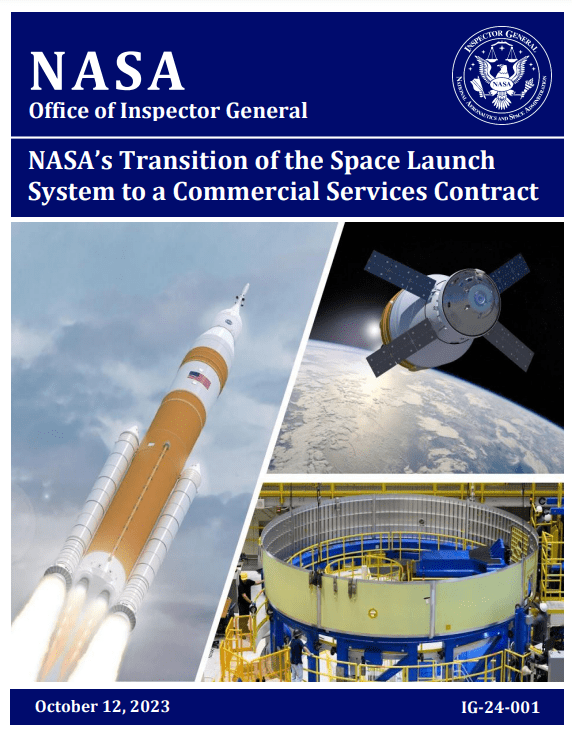
First, the US Government Accountability Office reported that NASA’s Space Launch System (SLS) is unaffordable, and now NASA’s Office of Inspector General (OIG) doubles down on that earlier finding, reporting that the SLS, a key component of the Artemis program, has costs that are spinning out of control.

In its report, NASA’s Transition of the Space Launch System to a Commercial Services Contract, NASA OIG concludes:

Our analysis shows a single SLS Block 1B will cost at least $2.5 billion to produce—not including Systems Engineering and Integration costs—and NASA’s aspirational goal to achieve a cost savings of 50 percent is highly unrealistic. Specifically, our review determined that cost saving initiatives in several SLS production contracts such as reducing workforce within Boeing’s Stages contract and gaining manufacturing efficiencies with Aerojet Rocketdyne’s RS-25 Restart and Production Contract were not significant and, as a result, a single SLS will cost more than $2 billion through the first 10 SLS rockets produced under [the Exploration Production and Operations Contract].

NASA OIG concludes that maybe other contractors needs to be considered, stating:

Although Congress directed NASA in 2010 to build a heavy-lift rocket and crew capsule using existing contracts from the canceled Constellation effort to meet its space exploration goals, the Agency may soon have more affordable commercial options to carry humans to the Moon and beyond. In our judgment, the Agency should continue to monitor the commercial development of heavy-lift space flight systems and begin discussions of whether it makes financial and strategic sense to consider these options as part of the Agency’s longer-term plans to support its ambitious space exploration goals.

Where are these “more affordable commercial options”? Could it be SpaceX? Blue Origin? If so, let’s start the transition ASAP so that the Moon and Mars remain a realistic goal in the near future. We have plenty of talent in this country and a race to the top is what we need, not a space agency stuck with an Edsel rocket system.

Asteroid Sample Coming to Earth This Weekend

Image (Credit): Asteroid Bennu as seen by the OSIRIS-REx as it begins its return to Earth back in May 2021. (NASA/Goddard/University of Arizona; Writer Daniel Stolte, University of Arizona)

This weekend will should see the safe landing of a asteroid sample from far away. On Sunday, NASA’s Origins, Spectral Interpretation, Resource Identification, Security, Regolith Explorer (OSIRIS-REx) spacecraft will return to Earth with sample material from asteroid Bennu, which it encountered two years ago.

Launched on Sept. 8, 2016, the spacecraft spent about two years getting to Bennu and then more than two years studying the asteroid and collecting a 250-gram sample that should be in the hands of NASA scientists shortly. The graphic below shows the return path of the sample as it heads for the Utah desert. You can also watch this NASA video for more information on the overall mission and keep abreast of mission highlights via this mission blog. NASA also has a recent podcast discussing the spacecraft’s adventures and trip back to Earth.

And what about OSIRIS-REx after it makes this deposit? It will become OSIRIS-APEX (APEX for “Apophis Explorer”) and go back into the inner solar system before encountering asteroid Apophis in 2029.

We talk about rocket reuse, but this is a terrific example of spacecraft reuse.

The timing could not be better as NASA awaits 2024 budget decisions from Congress and further discussions about another sample return, this one from Mars.

Credit: NASA

Audit Results: SLS Program is Unaffordable

Image (Credit): Artist’s rendering of the SLS. (NASA)

The Government Accountability Office (GAO) recently completed a review of NASA’s Space Launch System (SLS), which is the cornerstone of the Artemis program. GAO assessed the extent to which (1) NASA has established plans to measure the SLS program costs post-Artemis I, and (2) the program has made progress with its plans to reduce projected SLS costs.

The GAO report, Space Launch System: Cost Transparency Needed to Monitor Program Affordability, highlights a number of continuing issues related to project costs and budgeting.

So what is the bottom line? This quote is most concerning: “Senior NASA officials told GAO that at current cost levels, the SLS program is unaffordable.”

The SLS is the vehicle that is supposed to demonstrate our ability to return to the Moon as well as our readiness for a Mars mission. But all of this is contingent on continued funding from Congress, and the congressional auditors have raised a red flag.

I expect you could find similar audit issues with the earlier Apollo missions as well as other space missions, yet NASA does not need to give Congress a reason to put money elsewhere. Let’s hope NASA’s leaders take the audit seriously and show some progress to keep all of the parties happy and the funding alive.

NASA OIG: Artemis Partnerships with International Space Agencies

I was looking through audit reports from the Government Accountability Office and NASA’s Office of Inspector General (OIG) to see what was being said about NASA’s programs. The only report of interest so far pertained to the Artemis mission and the need for greater coordination among the various partners. Audit reports often make these same recommendations over and over again, yet it does make sense that NASA’s largest outreach program since the International Space Station (ISS) should have all the pieces in place, yet it does not.

Here is the first finding in the OIG report:

Interest in the Artemis campaign is high across the international space community, as evidenced by NASA’s 54 Artemis-related international instruments and the 23 signatories to the Artemis Accords. However, the Agency lacks an overarching strategy to coordinate Artemis contributions from international space agencies and entities. Except for the Gateway Program, the Artemis campaign does not have comprehensive forums—boards, panels, and working groups— for its international partners to routinely discuss topics such as flight and mission planning, safety, and research integration. In contrast, the ISS Program–seen as a model of long-term international space cooperation–employs these forums as well as on-site representation from partner agencies.

The OIG report makes a number of recommendations related to this issue and other identified by auditors. The report also includes some helpful graphics and tables that illustrate all of the pieces going into the three Artemis missions as well as the parties contributing those pieces. This looks significantly more complex than the ISS, so I would think good coordination would be even more critical.

Image (Credit): Contributions to the Artemis Program by NASA and partners. (NASA OIG)
Image (Credit): A table from the NASA OIG report IG-23-004. (NASA OIG)