NASA OIG: Artemis Partnerships with International Space Agencies

I was looking through audit reports from the Government Accountability Office and NASA’s Office of Inspector General (OIG) to see what was being said about NASA’s programs. The only report of interest so far pertained to the Artemis mission and the need for greater coordination among the various partners. Audit reports often make these same recommendations over and over again, yet it does make sense that NASA’s largest outreach program since the International Space Station (ISS) should have all the pieces in place, yet it does not.

Here is the first finding in the OIG report:

Interest in the Artemis campaign is high across the international space community, as evidenced by NASA’s 54 Artemis-related international instruments and the 23 signatories to the Artemis Accords. However, the Agency lacks an overarching strategy to coordinate Artemis contributions from international space agencies and entities. Except for the Gateway Program, the Artemis campaign does not have comprehensive forums—boards, panels, and working groups— for its international partners to routinely discuss topics such as flight and mission planning, safety, and research integration. In contrast, the ISS Program–seen as a model of long-term international space cooperation–employs these forums as well as on-site representation from partner agencies.

The OIG report makes a number of recommendations related to this issue and other identified by auditors. The report also includes some helpful graphics and tables that illustrate all of the pieces going into the three Artemis missions as well as the parties contributing those pieces. This looks significantly more complex than the ISS, so I would think good coordination would be even more critical.
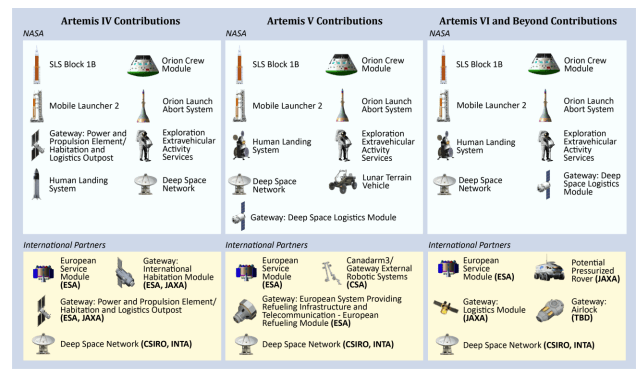
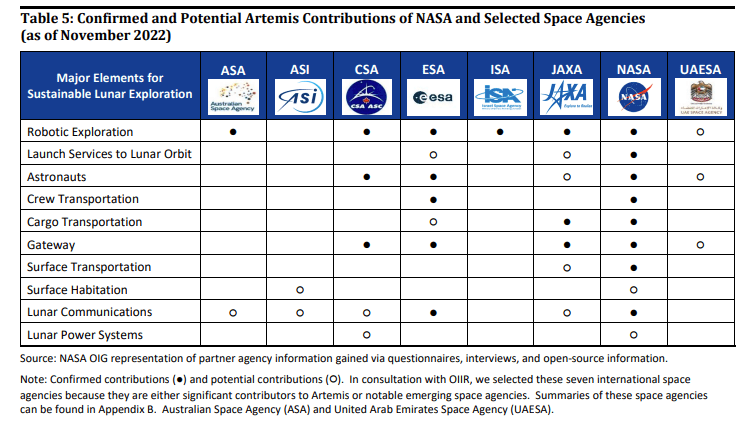
Image (Credit): Contributions to the Artemis Program by NASA and partners. (NASA OIG)
Image (Credit): A table from the NASA OIG report IG-23-004. (NASA OIG)

Is the U.S. Running Low on Astronauts?

Source: NASA OIG.

Does NASA need more astronauts than it has for upcoming missions? The Office of Inspector General’s (OIG) office believes NASA may have a problem. In a January 11, 2022 OIG report, NASA’s Management of its Astronaut Corps, the auditors found:

The processes NASA uses to size, train, and assign astronauts to specific missions are primarily calibrated toward meeting the current needs of the [International Space Station]. For example, NASA’s process for sizing the astronaut corps is designed to ensure that a sufficient number of astronauts are available to meet the Agency’s flight manifest needs, which includes maintaining a planned crew of between three and four astronauts on the Station over the next 5 years. However, the astronaut corps is projected to fall below its targeted size or minimum manifest requirement in fiscal year (FY) 2022 and FY 2023 due to attrition and additional space flight manifest needs. More concerning, the Astronaut Office calculated that the corps size would exactly equal the number of flight manifest seats NASA will need in FY 2022. As a result, the Agency may not have a sufficient number of additional astronauts available for unanticipated attrition and crew reassignments or ground roles such as engaging in program development, staffing Astronaut Office leadership and liaison positions, and serving as spokespeople for the Agency. In light of the expanding space flight opportunities anticipated for the Artemis missions, the corps might be at risk of being misaligned in the future, resulting in disruptive crew reorganizations or mission delays.

The real point it that bad human resource management may lead to mission delays, including the Artemis lunar landing mission. So what does the OIG recommend? The report states:

To ensure the training process for future Artemis missions is developed with sufficient time for implementation and revision, the Director of the Flight Operations Directorate and the Chief of the Astronaut Office should coordinate with Artemis program offices to complete the development and chartering of the framework of Artemis boards and panels to ensure alignment with future mission training needs for new vehicles and missions, including Orion, next-generation spacesuits, [human landing system], and Gateway.

NASA management agreed with all four recommendations in the OIG report aimed at resolving this shortage issue. I know these back office management issues can be dry, but without a solid pipeline of talent into the space program we will simply have a diminished program. Luckily, the auditors are doing their job and alerting management. Now is it NASA’s job to turn all of this around.