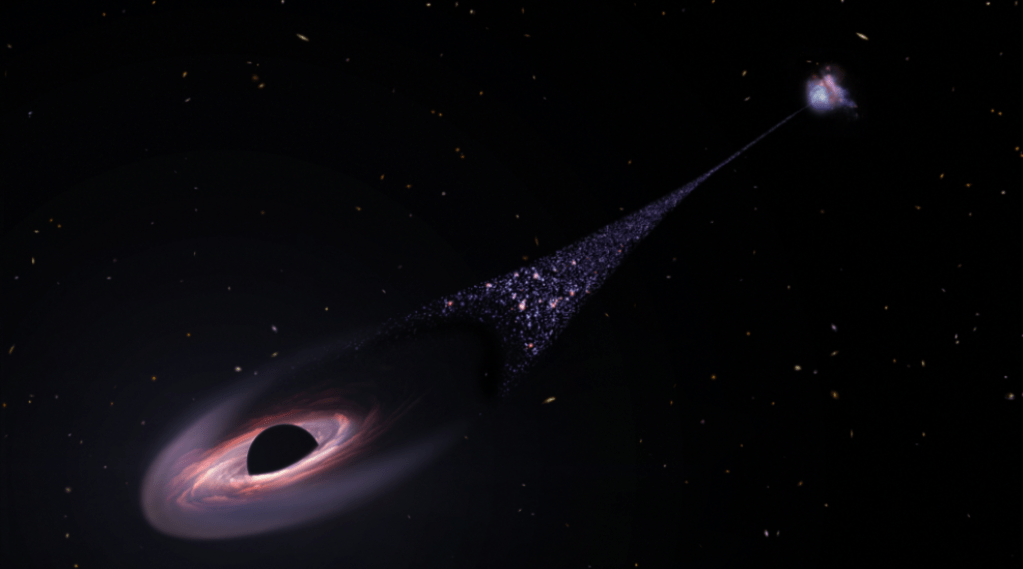
Image (Credit): Artist’s rendering of a black hole with a trail of stars behind it. (NASA, ESA, Leah Hustak, STScI)
This week’s image is an illustration showing what scientists believe the NASA/ESA Hubble Space Telescope has detected, though it initially showed as only a smudge. The dramatic illustration tells a fascinating story, as described by NASA’s Hubblesite
There’s an invisible monster on the loose, barreling through intergalactic space so fast that if it were in our solar system, it could travel from Earth to the Moon in 14 minutes. This supermassive black hole, weighing as much as 20 million Suns, has left behind a never-before-seen 200,000-light-year-long “contrail” of newborn stars, twice the diameter of our Milky Way galaxy. It’s likely the result of a rare, bizarre game of galactic billiards among three massive black holes.
Image (Credit): Barred spiral galaxy NGC 7496. (NASA, ESA, CSA, Janice Lee (NOIRLab), Joseph DePasquale (STScI))
This week’s image from the James Webb Space Telescope shows the barred spiral galaxy NGC 7496, which is over 24 million light-years away from Earth. The glowing center is a supermassive black hole.
The spiral arms of NGC 7496, one of a total of 19 galaxies targeted for study by the Physics at High Angular resolution in Nearby Galaxies (PHANGS) collaboration, are filled with cavernous bubbles and shells overlapping one another in this image from Webb’s Mid-Infrared Instrument (MIRI). These filaments and hollow cavities are evidence of young stars releasing energy and, in some cases, blowing out the gas and dust of the interstellar medium surrounding them.
Until Webb’s high resolution at infrared wavelengths came along, stars at the earliest point of the lifecycle in nearby galaxies like NGC 7496 remained obscured by gas and dust. Webb’s specific wavelength coverage allows for the detection of complex organic molecules called polycyclic aromatic hydrocarbons, which play a critical role in the formation of stars and planets. In Webb’s MIRI image, these are mostly found within the main dust lanes in the spiral arms.
In their analysis of the new data from Webb, scientists were able to identify nearly 60 new, embedded cluster candidates in NGC 7496. These newly identified clusters could be among the youngest stars in the entire galaxy.
At the center of NGC 7496, a barred spiral galaxy, is an active galactic nucleus (AGN). AGN is another way to refer to an active supermassive black hole that is emitting jets and winds. This glows quite brightly at the center of the Webb image. Additionally, Webb’s extreme sensitivity also picks up various background galaxies, which appear green or red in some instances.
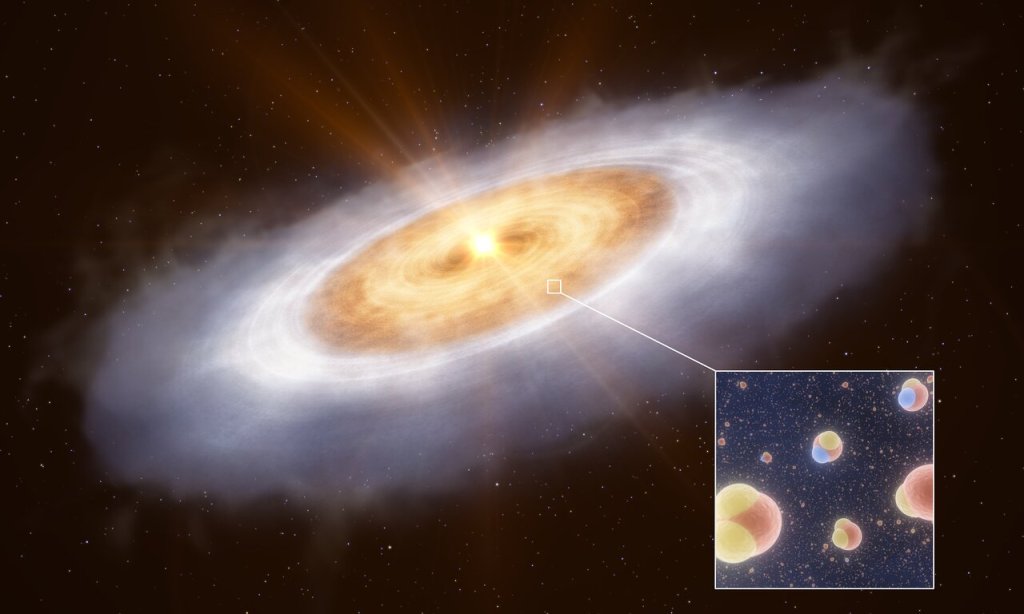
Using the Atacama Large Millimeter/submillimeter Array (ALMA), astronomers have detected gaseous water in the planet-forming disc around the star V883 Orionis. This water carries a chemical signature that explains the journey of water from star-forming gas clouds to planets, and supports the idea that water on Earth is even older than our Sun.
“We can now trace the origins of water in our Solar System to before the formation of the Sun,” says John J. Tobin, an astronomer at the National Radio Astronomy Observatory, USA and lead author of the study published today in Nature.
Astronomers have discovered the closest black hole to Earth, the first unambiguous detection of a dormant stellar-mass black hole in the Milky Way. Its close proximity to Earth, a mere 1,600 light-years away, offers an intriguing target of study to advance understanding of the evolution of binary systems.
What time is it on the moon? Since the dawn of the space age, the answer has been: It depends. For decades, lunar missions have operated on the time of the country that launched them. But with several lunar explorations heading for the launchpad, the European Space Agency has deemed the current system unsustainable. The solution, the agency said last week, is a lunar time zone.
Searching through existing data spanning 9 billion years, a team of researchers led by scientists at University of Hawaiʻi at Mānoa has uncovered the first evidence of “cosmological coupling” –a newly predicted phenomenon in Einstein’s theory of gravity, possible only when black holes are placed inside an evolving universe.
UH Mānoa astrophysicists Duncan Farrah, a faculty member at the Institute for Astronomy and the Department of Physics and Astronomy, and Kevin Croker, a professor of physics and astronomy led this ambitious study, combining Hawaiʻi’s expertise in galaxy evolution and gravity theory with the observation and analysis experience of researchers across nine countries to provide the first insight into what might exist inside real black holes.
Chemists have discovered a new form of ice, and their work may have major consequences for our understanding of the outer solar system. We usually encounter three forms of water on the surface of Earth: solid, liquid, and vapor. On our planet, solid ice mainly comes in one variety, where water molecules arrange themselves into an orderly and repeated crystalline structure. But scientists have discovered 19 other varieties of water-ice that may appear throughout the universe.
Using the Five-hundred-meter Aperture Spherical radio Telescope (FAST), Chinese astronomers have detected a new galaxy, which received designation FAST J0139+4328. The newfound galaxy is isolated, has a relatively low stellar mass, and is dominated by dark matter. The discovery was detailed in a paper published February 6 on the arXiv pre-print server.
While I recently used the new AI software ChatGPT (created by OpenAI, which was founded by Elon Musk and others) to draft up a poem, I did not use it to learn more about astronomy. Others have already attempted this and came back with mixed results.
Last month, the website Astronomy reported back on its results testing ChatGPT on a few questions. Some of these questsions included:
On average, how many stars are formed each year in the Milky Way?
What would happen if two supermassive black holes merged?
Why do the giant planets rotate so much faster than the terrestrial planets in our solar system?
The verdict? Astronomy was not impressed, reporting:
…once you start asking questions whose answers are not so obvious and dig into the subtleties of astrophysics — the types of informed, discerning questions that our readers regularly send us — ChatGPT becomes prone to giving answers that seem plausible, but are very wrong. To make things worse, ChatGPT is also very bad at knowing when it is making things up, and it can’t cite any sources.
Cloudy Nights users found ChatGPT to be a little more useful when listing out clear facts when answering questions such as “What are the best objects to observe in the night sky during January from the Northern Hemisphere?” It was also helpful answering this question – “What is the forum on the site Cloudy Nights about?”:
Cloudy Nights is a forum-based website that is focused on the hobby of astronomy. The site features a wide range of forums where members can discuss various topics related to astronomy, including telescopes, astrophotography, observing techniques, and more. In addition to the forums, the site also features reviews, articles, and other resources to help people learn more about astronomy and enjoy the hobby. Whether you are a beginner or an experienced astronomer, there is likely to be something of interest on the Cloudy Nights forum.
As with using Wikipedia as your main source, use ChatGPT at your own risk. I have more faith in Wikipedia because it represents the interaction of humans and therefore is based on more context for the answers. It also provides source material, unlike ChatGPT. If you use them as tools you should be okay. If you use them as oracles (in the original sense), then you are on your own.




 Our Awesome Universe