Space Stories: Black Holes, X-Rays, and Exploding Stars

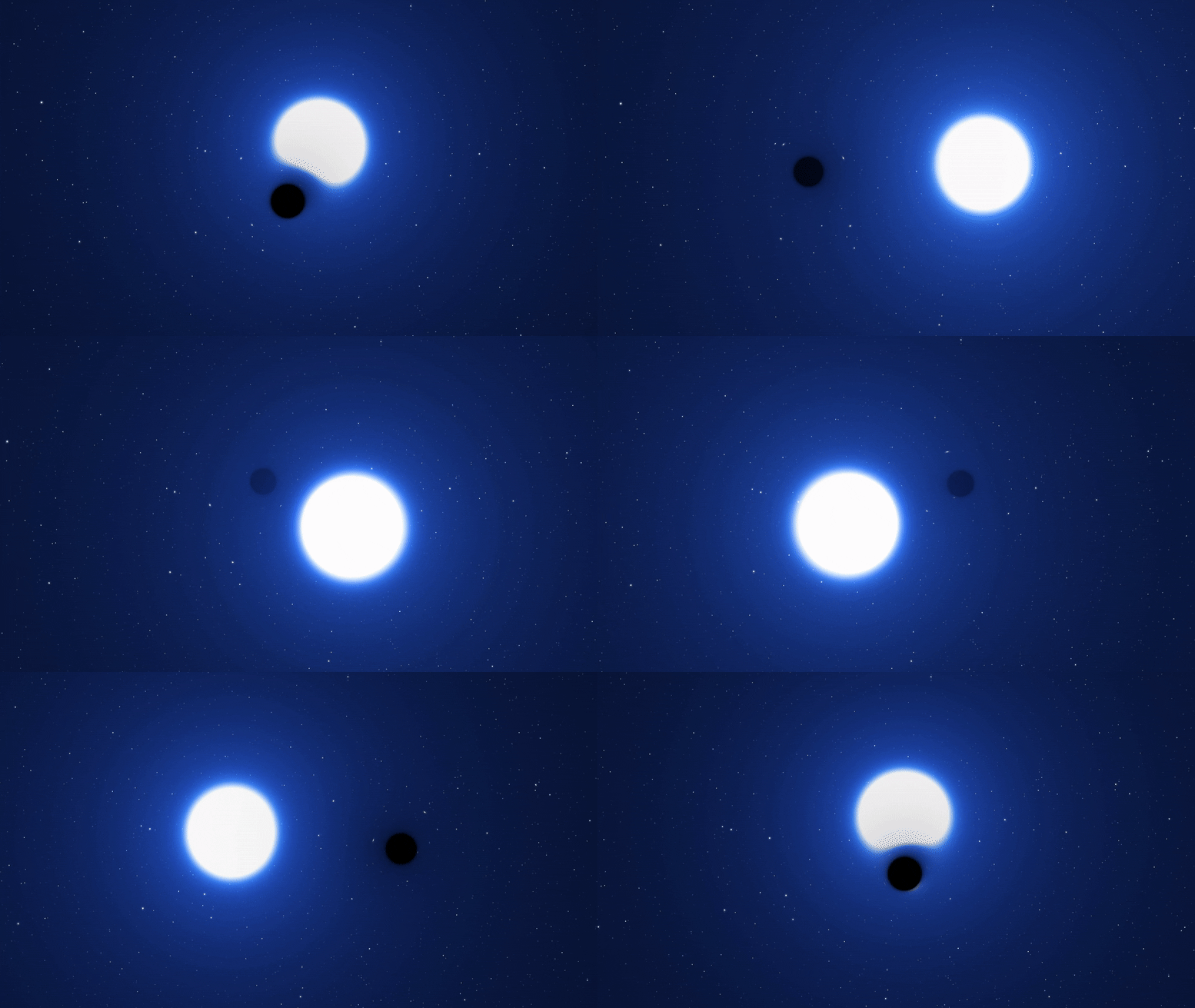
Image (Credit): Animation showing a binary system of a large, hot blue star and a black hole orbiting each other. (ESO/L.Calçada)

Here are some recent stories of interest.

SciTechDaily.com:Astronomers Have Discovered an Especially Sneaky Black Hole

VFTS 243 is a binary system, which means it is composed of two objects that orbit a common center of mass. The first object is a very hot, blue star with 25 times the mass of the Sun, and the second is a black hole nine times more massive than the Sun. VFTS 243 is located in the Tarantula Nebula within the Large Magellanic Cloud, a satellite galaxy of the Milky Way located about 163,000 light-years from Earth.

SpaceNews.com: ESA Scaling Back Design of X-ray Astronomy Mission

Faced within increasing costs, the European Space Agency is looking for ways to revise the design of a large X-ray space telescope, an effort that could have implications for NASA’s own astrophysics programs…That effort will involve potential changes to its instrument configuration as well as creation of a science “redefinition” team to reconsider science objectives. The goal will be to develop a revised concept, called a minimum disrupted mission, that will cost ESA no more than 1.3 billion euros but still perform science expected of a flagship-class mission.

NASA.gov:NASA Rocket Mission Using ‘Astronomical Forensics’ to Study Exploded Star

A NASA-funded sounding rocket mission will observe the remnants of an exploded star, uncovering new details about the eruption event while testing X-ray detector technologies for future missions. The High-Resolution Microcalorimeter X-ray Imaging, or Micro-X, experiment will launch Aug. 21 from the White Sands Missile Range in New Mexico. The mission’s target of study is some 11,000 light-years away from Earth, off the edge of the W-shaped constellation known as Cassiopeia. There, a massive bubble of radiant material known as Cassiopeia A, or Cas A for short, marks the site of a brilliant stellar death.
Pic of the Week: Dwarf Starburst Galaxy Henize 2-10

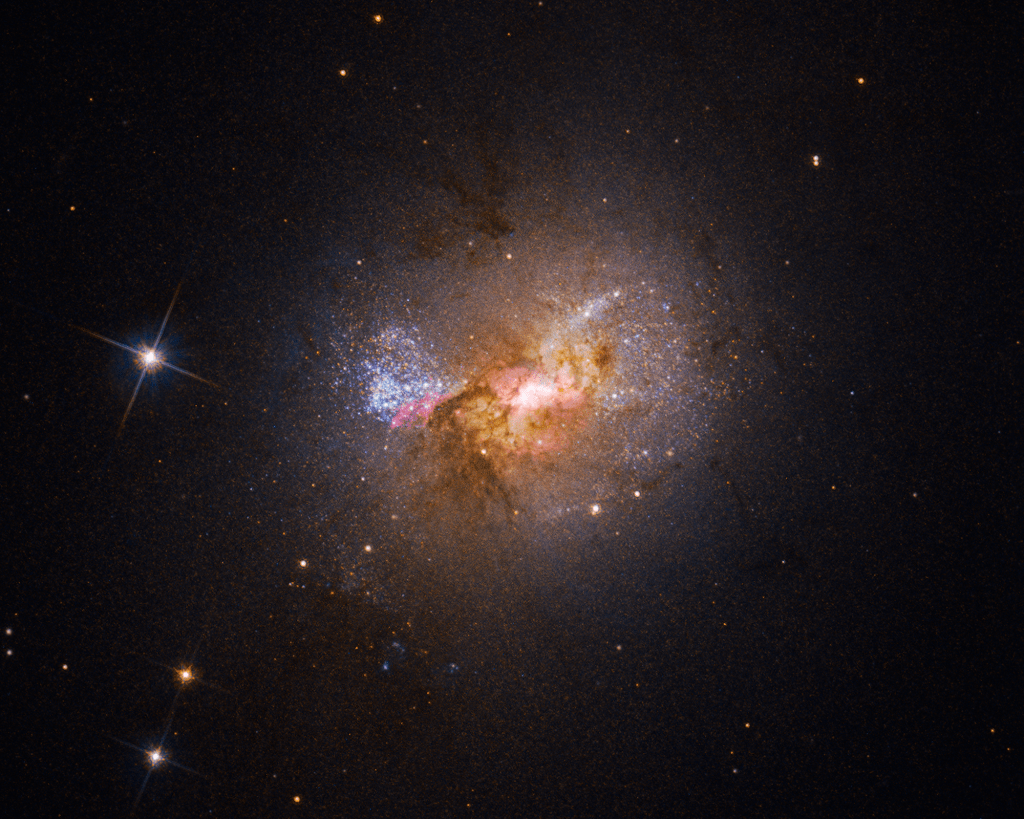
Image (Credit): Dwarf starburst galaxy Henize 2-10. (NASA, ESA, Zachary Schutte (XGI), Amy Reines (XGI), Alyssa Pagan (STScI))

This week’s photo is from the Hubble Space Telescope. It shows the Dwarf starburst galaxy Henize 2-10, which lies 34 million light years away. NASA notes that “The bright region at the center, surrounded by pink clouds and dark dust lanes, indicates the location of the galaxy’s massive black hole and active stellar nurseries.”

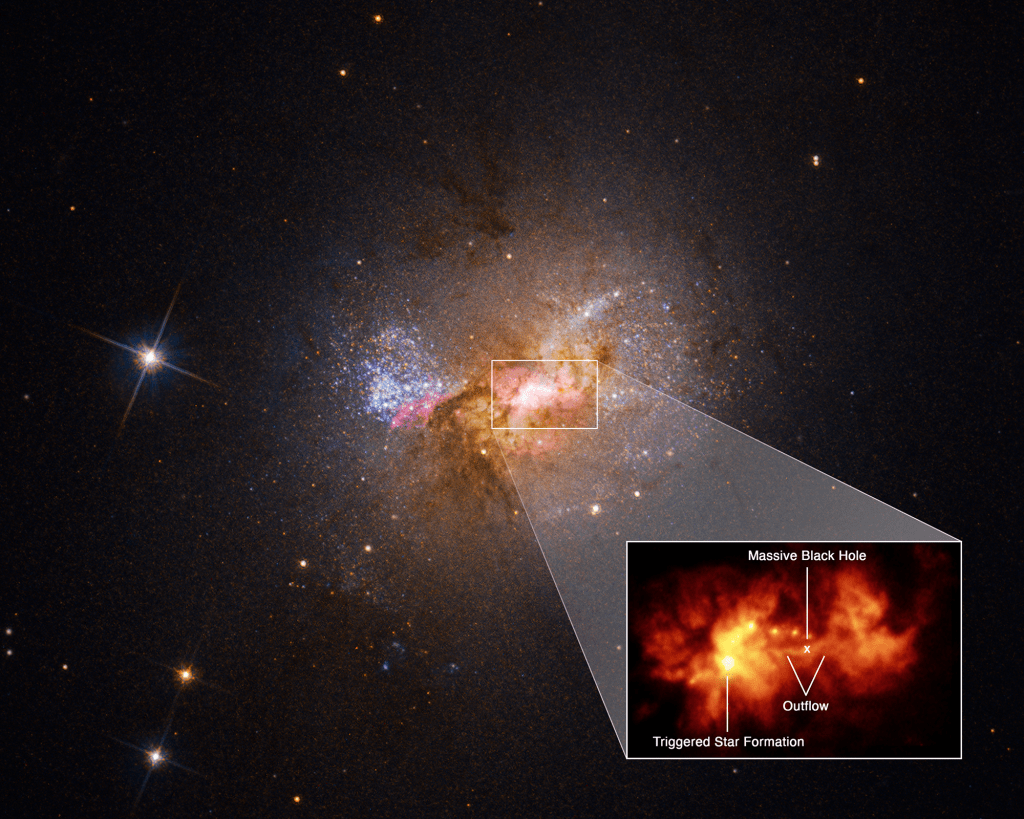
The image below better illustrates the link between the massive black hole and the related star formation. NASA explains:

A pullout of the central region of dwarf starburst galaxy Henize 2-10 traces an outflow, or bridge of hot gas 230 light-years long, connecting the galaxy’s massive black hole and a star-forming region. Hubble data on the velocity of the outflow from the black hole, as well as the age of the young stars, indicates a causal relationship between the two. A few million years ago, the outflow of hot gas slammed into the dense cloud of a stellar nursery and spread out, like water from a hose impacting a mound of dirt. Now clusters of young stars are aligned perpendicular to the outflow, revealing the path of its spread.

Image (Credit): Dwarf starburst galaxy Henize 2-10 with a pullout showing the black hole and related star formation. (NASA, ESA, Zachary Schutte (XGI), Amy Reines (XGI), Alyssa Pagan (STScI))

Black Holes in the Center of Galaxies are More Common Than We Thought

Image (Credit): An artist’s drawing a stellar black hole named Cygnus X-1. (NASA/CXC/M.Weiss)

We already knew a supermassive black hole sits at the center of our galaxy and others like it, but what about dwarf galaxies? SciTechDaily reports that astronomers in the University of North Carolina-Chapel Hill’s Department of Physics & Astronomy have found that large black holes are also more common than previously thought in dwarf galaxies.

The astronomers developed a new way to identify such black holes and found that about 80 percent of all black holes found in dwarf galaxies could be found in this way. These smaller black holes may help to create the supermassive black holes we see in larger galaxies as the dwarf galaxies collide and combine to make the larger galaxies.

Professor Sheila Kannappan, Polimera’s Ph.D. advisor in the Department of Physics & Astronomy and coauthor of the study, stated:

We’re still pinching ourselves…We’re excited to pursue a zillion follow-up ideas. The black holes we’ve found are the basic building blocks of supermassive black holes like the one in our own Milky Way. There’s so much we want to learn about them.

While even Albert Einstein had doubts that his theoretical black hole could exist in reality, astronomers continue to find they are a larger part of the universe than anyone expected. When you consider smaller stellar black holes, the figure is enormous. As NASA noted:

Judging from the number of stars large enough to produce such black holes, however, scientists estimate that there are as many as ten million to a billion such black holes in the Milky Way alone.

The Black Hole Sagittarius A*

Image (Credit): The first image of Sagittarius A*, the supermassive black hole at the center of our galaxy. (EHT Collaboration)

The Event Horizon Telescope (EHT), an array linking together eight existing radio observatories across the planet, has created the first image of the supermassive black hole at the center of the Milky Way galaxy. Named Sagittarius A* after a radio signal coming from a location in the direction of the constellation of Sagittarius (the A and * came later), the black hole is 27,000 light-years away and estimated to be four million times more massive than our Sun. The presence of the black hole was not in question, but capturing an image such as this took many years of work.

A press release from the European Southern Observatory (ESO) quoted EHT Project Scientist Geoffrey Bower from the Institute of Astronomy and Astrophysics, Academia Sinica, Taipei:

We were stunned by how well the size of the ring agreed with predictions from Einstein’s Theory of General RelativityThese unprecedented observations have greatly improved our understanding of what happens at the very centre of our galaxy, and offer new insights on how these giant black holes interact with their surroundings.

For more on the recent breakthrough, you may want to view the ESO Press Conference on the new Milky Way results from the EHT team (here on Youtube), which is followed by a public question and answer event.

Most Distant Galaxy on Record

Image (Credit): This timeline illustrates the earliest galaxy candidates as well as the history of the universe.(Harikane et al., NASA, EST and P. Oesch/Yale)

Just recently I posted about the discovery of the farthest star. Well, now astronomers have spotted the farthest galaxy. The Harvard Gazette reports that a galaxy named HD1 appears to be about 13.5 billion light-years away and may contain the universe’s first stars or even the earliest black hole discovered to date. The contents of this galaxy is still being studied (and theorized).

The story quotes Fabio Pacucci, an astronomer at the Center for Astrophysics who was involved in the discovery, who stated:

Answering questions about the nature of a source so far away can be challenging… It’s like guessing the nationality of a ship from the flag it flies, while being faraway ashore, with the vessel in the middle of a gale and dense fog. One can maybe see some colors and shapes of the flag, but not in their entirety. It’s ultimately a long game of analysis and exclusion of implausible scenarios.

More review of the data as well as updated data from the James Webb Space Telescope at some point in the future should help to answer questions related to this galaxy.

You can read more about this discover in the Astrophysical Journal. You may also be interested in the accompanying paper published in the Monthly Notices of the Royal Astronomical Society Letters,