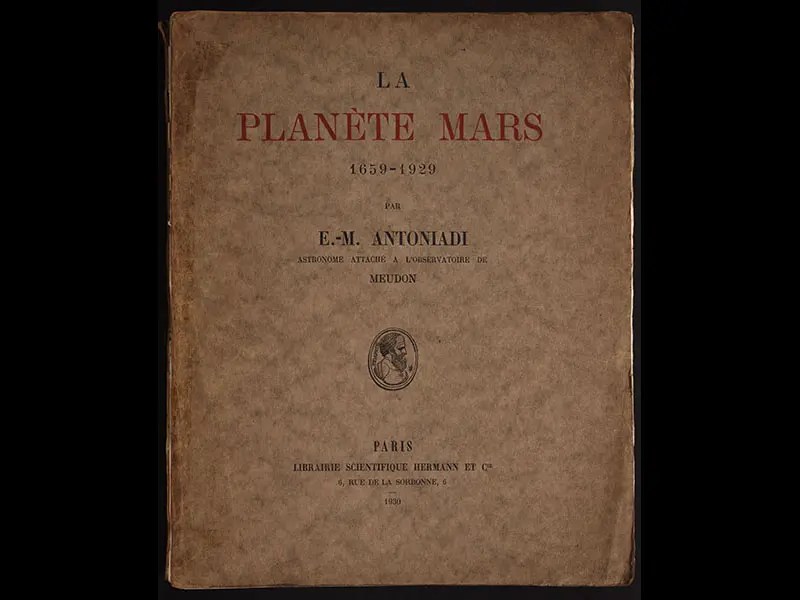
Image (Credit): E.M. Antoniadi’s 1930 book La Planete Mars. (Linda Hall Library)
On this day in 1944, Greek-French astronomer Eugène Michel Antoniadi passed away in Paris, France.
Mr. Antoniadi was one of the astronomers that battled the idea of a civilization creating canals on the surface of Mars, putting him at odds with American astronomer Percival Lowell. While he was initially open to the idea, he later believed the canals to be an optical illusion.
“The comparison I often like to make is with the East India Company: a private British enterprise that became so powerful it could shape the politics of nations and at times had an army twice the size of Britain’s. It began as trade; it ended in domination. Could a similar dynamic unfold locally in our solar system, where a handful of today’s tech giants and billionaires control access to orbit, communications, and eventually, extraterrestrial resources? A monopoly in space would be dangerous for humanity. The challenge is to encourage innovation and investment without ceding ownership of the cosmos to a few individuals or organisations.”
If you are interested in the idea of settling Mars, and the book A City on Mars has not scared you away, then you should plan on tuning into the upcoming 25-part video series by the Mars Society.
In a news release, the Mars Society defines the new series in this way:
Created for a broad public audience, each video offers a clear, accessible look at how Mars exploration drives scientific discovery, technological innovation, economic growth, and long-term planetary resilience.
I recommend you view the series, but also read the book cited above. The authors of that book seem to think we should have a Mars plan that will settle humans in the next few centuries rather than they next few decades. Or maybe we should be settling on a space station or asteroid, as suggested in the book The Giant Leap, though I expect that a society with “Mars” in its name might disagree.
This is really getting ridiculous. With the reopening of the federal government, the public has moved onto a new topic, and once again it is sex offender Jeffrey Epstein and his emails. However, this time it touches upon an popular cosmologist who wrote a book about Star Trek.
According to recent news stories, cosmologist Lawrence Krauss, author of The Physics of Star Trek, wrote to Mr. Epstein back in 2018 asking for ways to handle sexual harassment complaints against him. Mr. Epstein was a financial supporter of a program run by Dr. Krauss at Arizona State University (ASU). That same year, Dr. Krauss announced his retirement as professor at ASU while dealing with such charges. Dr. Krauss was also a contributor to Scientific American magazine and sat on Scientific American’s board of advisers, but was removed from the board in 2018 for reasons related to allegations of sexual misconduct.
As has been reported endlessly, Mr. Epstein engaged with a very large group of individuals, so Dr. Krauss is not alone. Still, it is not something you want on your resume.
You can still find Dr. Krauss sharing ideas on his podcast, The Origins Podcast with Lawrence Krauss, as well as his substack, Critical Mass. Whether this Epstein topic comes up on either the podcast or substack is anyone’s guess.
For, after all, in science one achieves the greatest impact (and often the greatest headlines) not by going along with the herd, but by bucking against it.
I don’t believe he was talking about these latest headlines.






 Our Awesome Universe